Gooding, David: 8 - Peeling Back the Curtain on Reality
ID mfh_1087261990Date unavailableBefore 3.18Restored 4.65
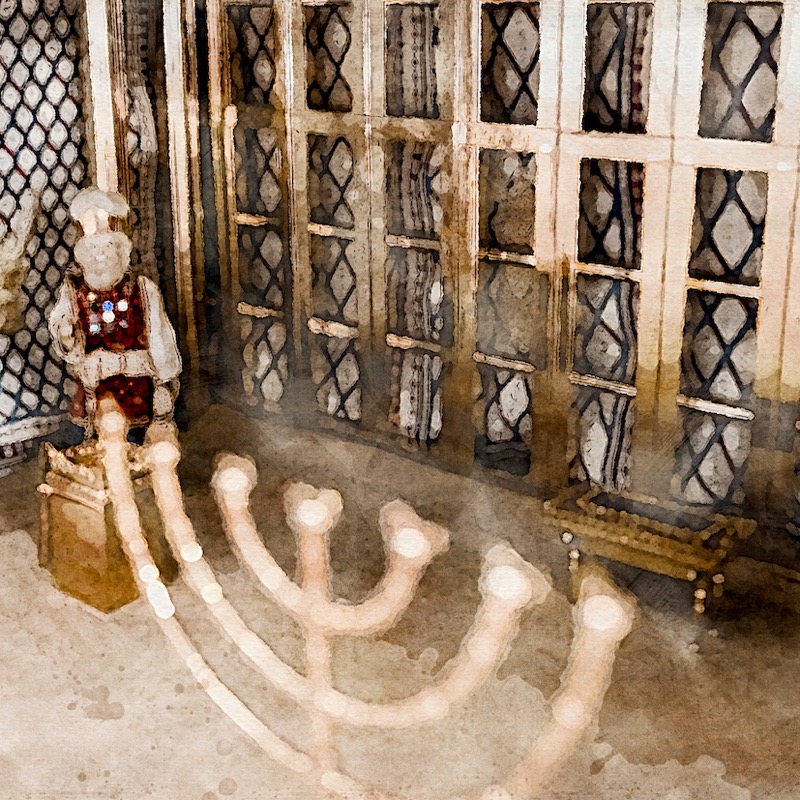
The book of Exodus, chapter twenty five and we begin to read at verse twenty three. And thou shalt make a table of acacia wood. Two cubits shall be the length thereof, and a cubit the breadth thereof, and a cubit and a half the height thereof. And thou shalt overlay it with pure gold, and make thereto a crown of gold round about. And thou shalt make unto it a border of an hen bred round about, and thou shalt make a golden crown to the border thereof round about. And thou shalt make for it four rings of gold, and put the rings in the four corners that are on the four feet thereof. Close by the border shall the rings be for places for the staves to bear the table. Thou shalt make the staves of acacia wood and overlay them with gold, that the table may be borne with them. And thou shalt make the dishes thereof, and the spoons thereof, and the flagons thereof, and the bowls thereof, to pour out withal. Of pure gold shalt thou make them, and thou shalt set upon the table showbread before me alway. And then the book of Leviticus, please, and chapter twenty four. Leviticus twenty four. And as we read, you doubtless will notice the recurrence of one particular preposition. And the Lord spake unto Moses, saying, Command the children of Israel that they bring unto the pure olive oil beaten for the light, to cause a lamp to burn continually. Without the veil of the testimony, in the tent of meeting, shall Aaron order it from evening to morning before the Lord continually. It shall be a statute forever throughout your generations. He shall order the lamps upon the pure lampstand before the Lord continually. And thou shalt take fine flour and bake twelve cakes thereof. Two tenth parts of an ephah shall be in one cake. And thou shalt set them in two rows, six upon a row, upon the pure table before the Lord. And thou shalt put pure frankincense upon each row, that it may be to the bread for a memorial, even an offering made by fire unto the Lord. Every Sabbath day he shall set it in order before the Lord continually. It is on the behalf of the children of Israel, an everlasting covenant. And it shall be for Aaron and his sons, and they shall eat it in a holy place, for it is most holy unto him of the offerings of the Lord made by fire, for by a perpetual statute. And finally, from the epistle to the Ephesians Ephesians and verse three: Blessed be the God and Father of our Lord Jesus Christ, who hath blessed us with every spiritual blessing in the heavenly places in Christ, even as he chose us in him before the foundation of the world, that we should be holy and without blemish before him. The Lord give us good understanding of his word. Cut away, please. In our last session this afternoon, we were thinking together of the lampstand that stood on your left as you entered into the holy place. Tonight, in our first study, we cross the tabernacle floor and come to the vessel that stood opposite the lampstand, namely the table of showbread, the table of the bread of presence, with its twelve loaves in two rows. As we remarked this afternoon, those two vessels were, in some sense, twins, because both of them were vessels of presentation. The holy place needed light. Well, then the function of the lampstand was to hold up those seven lamps that they might burn before the Lord continually. The showbread here, the twelve loaves of the bread of presence, were to be set before the Lord continually. And if they were thus to be set before the Lord continually, there was needed a table that the showbread might be presented in true dignity and upheld in the presence of God, for whose primary benefit they were. Now we discover, if we will read Jewish literature, that the ancient rabbis had, some of them, problems both about this lampstand and about the table. They said, you know, this is very odd because God himself is the giver of all life. He gives us bread. Why ever does he ask us Israelites to bake loaves and put them on this table and leave them before the Lord continually? Does God need us to feed him? Surely he doesn't need us to feed him. God doesn't eat bread anyway, does he? And so they scratched their rabbinic heads and wondered and pondered the point of the divine command that they bake twelve loaves and they put them on a table before the Lord continually. They had the same problem about the lampstand, you'll see. Why, said they to themselves, does the living God, who is the source of all light and created the sun and the moon, why does he ask us to beat olives and extract the oil and make lamps and put them their oil in the lamps and provide the lamps with a wick and set them alight that they might burn before the Lord continually? I mean, we humans need lights to see with when it's dark, but can't God see in the dark? And anyway, he's the supplier of light. Why does he ask us to light lamps and put them on a lampstand before the Lord continually? Well, you may smile at their problem, I don't know, but at least they had read their Leviticus chapter twenty four, hadn't they? Uh, almost as well and as carefully as you read it, uh, as we read it now together, where it is said of both those, uh, objects of furniture that they were vessels of presentation, and recurrent through those commands was this constant theme. You set the lamps on the pure lampstand that they might shine, you say for the benefit of the priest, not really, not in the first place, before the Lord continually. And you set the loaves on the table before the Lord continually. So however shall we explain the problem, and the second one in particular, does God eat bread? Do we have to feed him? But perhaps we shouldn't start with such difficult problems. Let's leave them to the end. Let's start where it's more easy, shall we? And here comes a very easy observation. When we were dis- we we were discussing this lampstand this afternoon, we found it was made to represent a tree, to look as if it was a tree, with this remarkable feature that it had all three stages of life present in it simultaneously. And it pointed us to our Lord, of whom it is said that all things were made through him. In him was life. He was the source of life, the source of every kind of a conceivable. He was its source. In him was life, and that life was the light of men. So in the lampstand, we are thinking in simple terms of our Lord as the source of life. When we cross the tabernacle floor and come to this table, we see upon it bread, and if we may for the moment say it is a picture of our Lord Jesus Christ, and surely that's correct, then we must notice that at the table, we're not thinking of him as the source of life, we are thinking of him as the means of life. You say, half a minute, what's the difference between the source of life and the means of life? Oh, well, let me ask you a question or two. Your physical life, how did you get it? What's the source of your physical life? I think perhaps you got it by eating bread and butter, did you? No, of course not, don't be foolish. Well, then how did you get it? I got my physical life from my parents, of course. Oh, I see. They were the source of your physical life, were they? Wouldn't you say in a sense they were, though of course they were only channels, really. The life eventually came from God. But, uh, within those limits, your parents were the source of your physical life. You got it from the source. You didn't have to eat bread and butter to get it. No, you say, certainly didn't. Oh. Oh, I see that. So now that you have physical life from its source, your parents, you don't eat bread and butter. Well, you say, of course I do. Oh, you mean to say you need two things? Well, yes, of course, any normal human does, doesn't he? You need as a source for your physical life, which was your parents, but once you've got the physical life, now you eat your bread and butter as a means of life. And if life is going to be viable, you will need both things, won't you? A source of life and a means of life. As in the physical world, so in the spiritual. If we would enjoy eternal life, we will need a source of life, and we will need the means of life. And God, who has thought of everything, has given us both in Christ, hasn't he? In him was life. A lesson that he had to teach to the learned Pharisee. He said to them, you search the scriptures because you think that in them you have eternal life, and that, of course, is a mistake. The scriptures are not a source of life. The rabbis treated Holy Scripture as though it were a source of life, and all you had to do was to study it so many hours a day, and simply by studying it, you got, uh, eternal life. That is not so, of course. As our Lord pointed out, scriptures are not, in that technical sense, a source of life. They are a signpost pointing to the source of life. You study the scripture because in them you think you have eternal life, but they are they that testify of me, and you will not come unto me that you might have life, said our Lord. How foolish men they were. Hm. Suppose one of these days you come down the road and you see a signpost that says, uh, sixty five miles to New York, and you see Gooding hugging the signpost. You say, Gooding, uh, what insanity now has come upon you in addition to the normal insanities? What are you doing? Well, I say, I've got New York here. What do you mean? Yes, New York, look, I want to go to New York, and here it is. New York, it says. You say, don't be so stupid, don't that's not New York. What is it then? You say it's a signpost. It's pointing to New York. It's no good you're hugging the signpost if you want to get to New York, man. You had to read the signpost and then do what it says and go in the direction and come to New York. Oh, I get the point, yeah. The Pharisees hadn't, had they? They were searching scripture as though scripture was a source of life. Well, all the while scripture's function is to point you to him who is the source of life. It's possible to read the scriptures and never come anywhere near Christ, isn't it? The scriptures, these are they that testify of me, but alas, you Pharisees, you will not come to me that you might have life. He is the source of life. And when we first come to the Savior, because he is a source of life, he can give us life instantaneously. Marvelous, isn't it? Like that man at the pool, you may remember, in that same John chapter five. He had been trying to use a means of healing, a God-given means of healing. When the water was troubled, he tried to get into the pool and thus be healed by its beneficial, uh, mineral spa waters. But he hadn't succeeded so far because he was too weak to use the means to get salvation. Then our Lord came along and said, my good man, would you like to be made whole? But the man had so got his eyes on this pool and thought it was the only way of getting life that he replied to our Lord, oh well, of course, but I have no man to put me into the pool when the water is troubled. And if I may paraphrase our Lord, he said, my good man, I don't need to use the pool. What are you thinking about? Ordinary men and women have to use the divinely appointed means, whether it is for the maintenance of their health or for its cure. The incarnate Son of God, he doesn't have to use a few pools if he doesn't want to. He is the source of life. He can just speak the word, and a whole galaxy springs into being. And he can meet a sinner dead in trespasses and in sins and under the judgment of God, and speak the word, and by that very thing impart eternal life, the very life of the ages, instantaneously. Marvelous, isn't it? And they are happy men and women that have thus met Jesus Christ as the source of life, able to impart eternal life to those who receive him. But if our blessed Lord is a source of life, for as the Father has life in himself, so has he given to the Son to have life in himself. Our blessed Lord is more than a source of life, isn't he? And in the Gospel of John, chapter five is followed by chapter six. how not? But in chapter six, there our Lord presents himself as the bread of life. And he says, he who eats me constantly, he shall live by me. Source of life, means of life, and we need both. We come to the Savior, and in him we find instantaneously the gift of eternal life. Then, as the years go by, we keep coming to the Savior, eating him constantly as the bread of God, and he maintains us and will maintain us all the journey through until he gets us home to our inheritance above. And I love those assurances given by the Lord in that same gospel of John chapter six, for he draws distinction between himself as the bread that came down from heaven and the manna that Moses gave them from heaven. I am the living bread, he said, which come down from heaven, not as your fathers did eat the manna and died. That was sad, wasn't it? The Israelites started out from Egypt. They were redeemed by the blood of the Lamb. They were baptized to Moses in the cloud and in the sea. They set their best foot forward. Perhaps it wasn't always their best. On their way to the inheritance. Manna came down from heaven to feed them and maintain them, and they ate the manna, and in spite of it, they never got into their inheritance, that first generation of Israelites, they perish in the wilderness. You say, half a minute, Mr. Preacher, go easy just there. Ha. I've been redeemed by the blood of my Passover lamb. I've been baptized, eh, unto the Lord Jesus. I've set forth to my great inheritance reserved for me, incorruptible and undefiled, reserved in heaven. You say, and I eat the manna that comes down from heaven, our blessed Lord. Eh, just a minute. The Israelites who ate the manna, they died. Could that happen to me, and I never get in at last? You know there are many believers around who think that is a distinct and real possibility, don't they? What a lovely thing it is to have the word of the Lord himself. Not as your fathers did eat the manna in the wilderness and died in spite of it. I am the bread which came down from heaven, which if a man eat of me, he shall live forever. Oh, how satisfying and how effective is our blessed Lord as the means of life. So John chapter five is our Lord as a source of life, and John chapter six is our Lord as the means of life, of course. And here, early blossoming in the tabernacle, is that same truth portrayed in the one vessel on the left, our blessed Lord as source of life, and in the other vessel on the right, as our Lord as means of life? If that be so, we come next to the question, on what conditions may we come and enjoy that bread of life? Because note a moment, if you will, in the tabernacle, after all, forget the rabbis if you must, but the bread was put there at the beginning of the week, and it had to be left before the Lord continually. Then at the end of the week, the priests were allowed to come to that table, take the old bread away, put fresh loaves before the Lord, and then taking those lo- the old loaves in the holy place, there they ate those loaves themselves. So in symbolic language, God and man fed at the same table. The loaves were the content of the fellowship, the table the basis of the fellowship. And it shouts at us, doesn't it, that very same message that John in his first epistle talks to us about. I write to you, he says, about the Word, you know, that eternal life that was with the Father, ever the Father's delight and eternal satisfaction. And he was manifest. We saw, and we heard, and we touched, and we handled that eternal life that was with the Father and was manifest to us. And these things we write that you may have fellowship with us in that great eternal life. And surely our fellowship is with the Father and with his Son, Jesus Christ. Oh, what a magnificent table is this to which God himself invites us. The content of the fellowship, nothing less than that eternal life that was with the Father, now manifest to us, and we are invited to partake of that same eternal life. That's a magnificent idea, isn't it? That God and man should sit at the same table and find satisfaction in the same bread of life. It makes us think a little bit seriously, doesn't it? For if you claim to have eternal life, pray remember what you are claiming to have. You are claiming to share the very life of God himself. Naturally, the question arises, on what conditions may we come to this great banquet and share that eternal life with God and have fellowship with God and with his son Jesus Christ? On what conditions may we come? We shall have to be careful about the answer there, because in fact there is a double answer to that question. In the epistle of John, chapter, first chapter, and verse, um, six and seven, it says as follows: But if we say we have fellowship with him and walk in darkness, we lie and do not the truth. But if we walk in the light as he is in the light, we have fellowship one with another, and the blood of Jesus Christ, his son, cleanses us from all sin. So the condition of having fellowship with God is that we walk in the light. That, as anybody can see, who attends to the grammar of it, is a question of where we walk. If we walk in darkness or if we walk in the light. It's a question of where we walk, and not first and foremost of how we walk, is it? It's whether we walk in the light or whether we walk in the darkness. Later on, of course, Go- John comes round to discussing the question of how we walk. Look at one John chapter two and verse six: He that saith he abides in him ought himself also to walk even as he walked. And now in that verse, it is a question of how we walk. We are to walk even as he walked. So notice the dist- the difference in phraseology. The first is where we walk, and the second is how we walk. And you say, what is the difference between those two? And what is this question of walking in the light? Is it saying this, that if a believer wishes to have, possess, and enjoy eternal life, he has got to behave properly, or as near properly as he can behave, and if he commits a sin, he is thereby banished from eternal life and for the time being loses that eternal life. You say, no, I don't believe that. Then what is this business of walking in the light? Let's help ourselves by using the tabernacle as a picture form to think with. Other way around. Here is a priest, and he's responded to his priestly privilege. He has been allowed to go along and take the bread off the table, privilege that many priests would have loved to have, of course, but he has been commissioned, believe me, he is the one that's allowed this week to go and take the bread off the table and eat the very bread that has been offered to God. What is the condition of his coming to the table and having fellowship with God at that table? Well, you say it's, it's very easy to answer physically, isn't it? For as he draws aside the curtain of the door, and he comes into the holy place, and comes up and walks across to come to the table to eat that bread. Let me ask you, where is he walking? You say he's walking in the light, isn't he? Yes, of course he is. That's the only way possible that he could ever come to the table, for that's how the candlestick was arranged, that as he came to the table, he would be flooded with the light from off the lampstand. If the man was so stupid as to claim that he was having fellowship with God when he walked outside in the darkness, well, then he would have been a liar, wouldn't he? It was an impossible thing to do. You have to come and walk in the light, and if you're not walking in the light, but you're walking in darkness, you are an old liar, and you are not sharing the life of God with him. But notice first how it is. He is to walk in the light. And as I said to some of you the other night, imagine a new priest who's never done it before, you see, and this is the day he's going to come to the table, you see. And he's all dressed up in his robes, and he's rehearsed what he's going to do, and he comes in and he's doing very well, but he gets a little nervous and all tensed up, and before you know where you are, he catches his big toe in the hem of his garment and goes sprawling on his face across the tabernacle floor. What now? Will you say he's fallen? He certainly has. Ha ha. But where has he fallen? We say he's just still in the light, isn't he? Ah. Oh, my brother. You know what we're talking about? We're not talking about those deep times of communion that we ca- that come. We're talking about that basic thing. If you don't share the life of God with God, you haven't got eternal life, have you? That's what having eternal life is. You have and possess and enjoy the same life as God has. On what condition do you continue to share with God his life and thus able to claim that you have eternal life. Is it on condition that you walk absolutely perfectly and you never stumble? Well, if that were the condition, none of us would ever have eternal life to start with, and we should certainly lose it the first five minutes after we had each. No, the condition is this, not so much how you walk, but where you walk. Do you walk in the light? You say, if I come and walk in that light, Mr. Preacher, it will expose me. It will indeed. And one of its direct results will be that you'll feel yourself to be worse than you ever realized before. I knew a lady once, and an elegant lady she was, and she had been converted in some mass gospel meetings in the city of Cambridge in England. And when I met her, she told me about her conversion. But then she said, you know, David, I, I, I, I guess I stood up and I did receive the Savior. I did, I really did, you know, she said, yeah, I did. But she said, you know, since I've been saved, I've been worse than I was before I was saved, and therefore I think I'm not saved. Now you work out the logic. And you can see what has happened, couldn't you? Before she trusted the Savior, she was highly religious, but she was in fact walking in the dark, and she thought she was very good. And then she came near the Savior in the light of his presence, and the light exposed her, of course. She trusted the Savior indeed, but the nearer she came to the Lord, the more she walked in the light, the more it discovered to her she wasn't anywhere near so good as she thought she was. It is a mark of those who would serve him best and live nearer to the Lord that they are more aware of their sinfulness than some other people that walk at a distance. Is that not so? Walking in the light will expose me to the very core of my being. How then shall I do? Ah, praise God for the end of that verse. If we walk in the light, we have fellowship one with another, and the blood of Jesus Christ, God's son, cleanses us from all sin and makes it possible for God to retain us in his light and therefore in his fellowship. And as we say that, you will, of course, pay attention to the verb, won't you? It doesn't say if we come to the light, we have fellowship with him. It says if we walk in the light. And that's a continued activity, isn't it? You wouldn't call one step walking, would you? It's not a question of coming to the light, it's a question of walking in the light. And you will see the difference indicated in that chapter eight of the Gospel of John, where our Lord announces himself as the light of this world. Halfway through the chapter, we are told that some of his disciples believed on him. Some of the Jews believed on him. So our Lord Jesus said to these Jews that, so to speak, had believed on him. He said, gentlemen, if you continue in my teaching, then you shall know the truth, and you really will be my disciples. For you shall know the truth, and the truth shall make you free. They picked up their ears. They said, excuse us, what did you say? Well, I said that if you continue in my word, then you will be really my disciples, and you'll know the truth, and the truth will make you free. Free from what, they said? Well, from sin, of course, said Christ. What do you think? Everybody that commits sin is a slave of sin. But if you continue in my word, you shall know the truth, and the truth shall set you free from the slavery of sin, said they. We'd pay you to keep quiet and go around the next corner. Do you know who you're talking to? Slaves? We've never been slaves to anybody. We'll have you know that Abraham is our father. You be careful what you're saying, young man. Who asked you to come here and tell us that we're slaves of sin? Get away. And it wasn't long before they were picking up stones to stone him. What had happened, you say? Ah, do you say they had come to the light, but when the light began to expose them, they weren't prepared to walk in the light. It's not enough, ladies and gentlemen, to come to the light. They don't have fellowship with God simply by coming to the light. The condition is, as you heard, if we walk in the light. Walking in the light will mean prepared to walk day by day with the Savior, and as his light exposes us, instead of running off back into the dark to pretend that we're better than we are, to remain in the light and let the light search us and let the light expose us, and humbly to agree with God that our sin is sinful and to confess it before the Lord and to seek his gracious cleansing and forgiveness. That is walking in the light. God does not ask us to be sinlessly perfect before we can receive the gift of eternal life or enjoy it, but he insists the condition is that we not only come to the light, we walk in it and allow him to teach us and expose us, and we get to know the truth, and little by little the truth makes us free. And all the wonder of it, that when we are exposed, as I have said, and we confess our sin, the blood of Jesus Christ, God's son, cleanses us from sin and makes it possible for God to retain us in the light of his presence. This is the condition. In case you think I am reducing God's standards, let us hear just the other side of the case. The condition of, of, uh, coming to God's table and eating the bread is that we walk in the light, where we walk. Does it matter how I walk? Well, of course it matters how we walk. He that saith he abideth in him and claims to have eternal life then is under a bounden duty to walk even as the Savior walked. And it puts the balance to the position, doesn't it? And walking as the Savior walked is a thing that will affect us at the level of our righteousness. It will mean that we have to learn to practice righteousness in our daily affairs. It will affect us at the level of our hearts. It will mean that we have to love like the Savior loved. And it will affect us at the level of our doctrine. Walking in the light will mean that we must surrender all false, false doctrine and go solidly according to God's holy word. So then we come to the table just for a brief moment, and notice it was made of two materials. Like others, it was made of wood and gold. I don't propose to examine all the other details with you. The hour is late and the congregation is tired, not to talk of the preacher, but let us just notice that it was made of two materials. It was made of wood overlaid with pure gold. Oh, how delightful a God God is, isn't he? I met a theologian once who was writing an exposition of the tabernacle, and he came to the table. He told me he didn't know what to say about it because the Bible didn't say what it was for. Well, without being a theologian, I think I know what tables are for, particularly if they've got bread on. Fancy that, God inviting us to sit at his table. Isn't it delightful? How could he say more clearly he wants our fellowship and friendship? And when we sit at his table, it's not just idle talk, you know, that's been a nice day today, I hope it's going to be a nice day tomorrow because it was yesterday as well. No, no. When we sit at his table, the food is food enough to keep the infinite intellect and heart of God eternally satisfied. He takes them satisfying, you know. And that same food God shares with us. What a delight it is. Try to make the conversation interesting to God when you sit at his table, won't you? Don't talk too much about the weather. Start talking about what really interests God, and that is his beloved son. But we come back now to another point. The bread upon that table, as you see, was composed of twelve loaves, no less. You say, wait a minute, Mr. Preacher, you've been having us to believe all this long, long, long, long while that the bread represents Christ, but how can that be if it's twelve loaves? Now, if it were one loaf, you could say that would represent Christ, but how can twelve loaves represent Christ? Well, one man says, well, perhaps you think I mean to say there was one loaf, uh, uh, for every tribe, and uh, Christ is enough to satisfy all his people. Well, that's a very good shot at an answer, isn't it? But we come back to the problem of the dear old rabbis. They started from the observation of the ritual that the bread, the twelve loaves, were put upon the table at the beginning of the week, and after that nobody came near them. They were put there before the Lord, continually, all twelve of them. What do you think about that basic problem that the rabbis had? Do we have to feed God? You say, to be sure we don't. How could we feed God? Oh, don't be so quick. What about that scripture in Re- Revelation three verse twenty where our blessed Lord says, I stand at the door and knock. If any man hear my voice and open the door, I will come in, and I'll do what? Sup with him. And he with me. Yes, that's it. I will sup with him. In the Old Testament, God commanded Israel in the book of Numbers, said he, my food of my offerings you shall offer me perpetually. Of course you have to feed God. Don't you? Not with little bread, of course. Why do you suppose God made you? Well, so that he might feast his heart upon you, that's why, my brother, my sister. You'll put those twelve loaves representative of the twelve tribes of Israel, you'll put them on the table before me, that God might enjoy his people. And not to, uh, compare great things with small, but forgive my crude analogies, but then I have a tiny mind. Uh, when I was a teenager, somewhere about fourteen, I had an older brother. Well, I was about, uh, I suppose I was about eleven and he was fifteen or so you're coming up the sixteen mark. We used to play football together and cricket in the summer, do you see, until the man got to about eighteen. I don't know what happened to him, at least I didn't know at the time. Instead of wanting to play football in the back garden, I'd go looking for him where the man had gone to and found him in one of the rooms, and he was sitting on one seat, and on the other seat was a beautiful young lady, you see. And they were talking. And at thirteen years old, I couldn't understand it. How would any man in his senses on a nice summer evening sit in a room and talk to a woman, you know, I mean to say? It was incomprehensible. He could have been out in the garden playing football. But there she was before him, you see, and something was going on. You should have seen the expression on the man's face. Oh dear, Josie. Of course, I begin to think you know. Yes, you know. You've sat many an hour, sir, haven't you? Thus engaged. Some people tell me it's the highest form of enjoyment in this life. I don't know. When God made us originally, he had the plan. We talked about it this afternoon, and we read about it again tonight from Ephesians five. Do you know why he created the world? So he could put you on it as a creature of his, so that then he could come to you and offer you salvation in Christ, so that you become a son, a child, a son of God, whatever for, so that he might have you before him to his eternal delight and satisfaction. Where else would you find a big enough objective for our salvation? However could it be achieved? For as creatures we were, but lowly creatures. To make it worse, we went and transgressed the purpose of our Creator, the very reason for which he created us, and instead of being before him to God's satisfaction, feeding the heart of God with delight, we went our own way, cared nothing for God, and instead of consuming us forthwith and destroying us, in his mercy he sent his son, and his son died that we might be forgiven. Not only forgiven, but reborn, regenerated, and what is more, we who were dead in trespasses and in sins has he quickened, and he has raised us together with Christ and set him with Christ in the heavenly places. Oh, look at that table. They didn't put the bread on the floor, did they, for the divine majesty's notice. They got a table, a vessel of presentation, and the vessel presented the loaves of bread before God. What a delightful picture of our blessed Lord. We are in him, and we are seated with him, and he presents our souls to God. So that we who ourselves are fed of him and have been satisfied and are continually nourished, might be able by his undergirding and presentation before God, to God's satisfaction, both now and eternally. God help us to grasp the magnificence of his grace and to begin to fulfill the purpose for which he made us and for which he has redeemed us. Shall we pray? O God, as we think of these things, there is the danger that they go beyond us and become mere words. Therefore, now we pray that by thy grace, thou Father of glory, that thou would give unto us a spirit of wisdom and revelation in the knowledge of him, that the eyes of our hearts may be enlightened, that we may know what is the hope of thy calling, what its ultimate purpose is, and what the exceeding riches of thy wealth in thine inheritance, what the greatness of thy power manifest towards us in raising thy son from the dead and quickening us and setting us at thine own right hand in him to thine eternal satisfaction. By thy spirit we beseech thee, make these things real, that we might perform yet more and more that high dignity of satisfying thy heart through Jesus Christ our Lord. Amen.