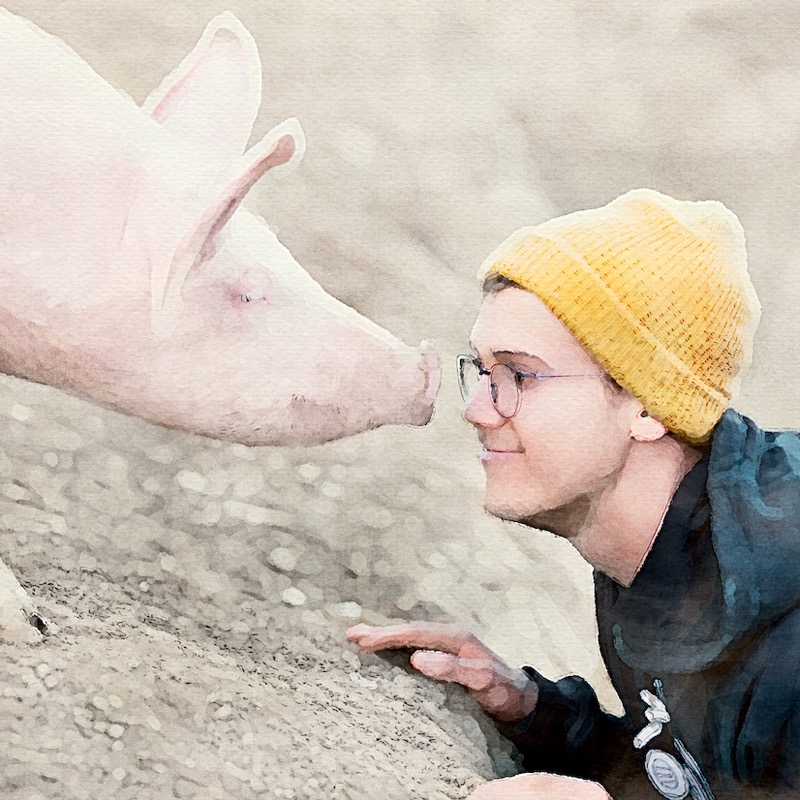
Gooding, David: 1 - Are You Worth More than a Pig?
ID mfh_1116220432Date unavailableBefore 3.76Restored 4.52
Hello, everybody. Thank you once more for coming to this talk this afternoon. I've been given the topic, what does it mean to be human? And of course, I thank the organizers of these sessions for setting me that particular topic. Though I can't help feeling that the, uh, proverbial man from Mars might be nonplussed a little bit if he were to come here and see us discussing such a subject this afternoon. He might well say, but goodness me, aren't you all human? Surely you know what it means to be human. You don't want to ask anybody to come and tell you what it means to be human. You know it yourself. I think, therefore, in defense, we should have to say to our proverbial Marsh- Martian man that, yes, we are all human, but nowadays human beings hold very different views about what it means to be human. And particularly about the fundamental question, what is the intrinsic essential value of a human life? Nowadays you can hear views at all kinds of extremes. There is the traditional view, such as is held by Jews and Christians, and to some extent by Muslims. And for all I know, some of you may have been brought up under that traditional view. And that is, that human beings are the creator of God Almighty, and that they are made in his image, made possible to have spiritual and moral fellowship with their creator, and in some sense to be his viceroy for the administration of earth, and therefore to take the innocent life of one of God's creatures made in him- his image is an offense against Almighty God. That's one extreme. At the other extreme, a professor of bioethics has recently informed us that a human babe for at least five years is no more worth, not so much worth perhaps, as a pig, to extremes of evaluation. So I want to come at the discussion this afternoon to suggest to you that there are certain questions that we should ask when we consider what it means to be human. Now I warn you, in all fairness to you, that I myself am a Christian, and so you must be looking out for all my prejudices and biases and things, do you see? But I suggest that when we ask what it means for us to be human, we should ask the question first, where do we come from? For the simple reason that none of us invented ourselves. We didn't make ourselves. We didn't create ourselves. To what ultimately then do we owe our existence? Who or what brought us here? And then we can ask a second question. What are we anyway? Are we a rather sophisticated form of matter, but nothing more than matter? Sophisticated machines, if you like, but only matter. Or do we have a non-material part to us? What does it mean to be human? What are we exactly? Then we should ask, surely, why are we here anyway? Whatever or whoever brought us here, what for? Is there any purpose, any ultimate purpose in particular? Or are we just the products of blind chance? That then they invented us and produced us, blind cha- chance working on mindless forces, brought us here for no particular purpose at all. And finally, we could ask, surely, what is the meaning of human life? Not just, of course, our individual lives. We are part of the human race. What is the meaning, the significance of the human race on our earth, and indeed within the uni- in the universe at large? But of course, it applies to our own individual lives, surely. Is there any ultimate meaning? I know our studies can be meaningful, our careers can be meaningful, a go- a round of golf could be meaningful, or even tiddlywinks, but is there any ultimate meaning to the whole phenomenon of my existence here on this planet. For after all, life is a journey. That's an old adage, but it is true, isn't it? We grow up from babyhood to womanhood and manhood, with all its interesting e- e- uh experiences. Then we get old. And asking the ultimate question, what was the meaning of it all? Is there an ultimate meaning? Or does our individual life fizzle out in dust and ashes with no particular significance at all? Is it ultimately futile? I suggest that our answers to those questions will depend a great deal on our world view. And ultimately, there are really just two worldviews, many permutations between them, of course, but ultimately two worldviews that we will discuss this afternoon. There is the atheistic worldview, or if you like, atheistic materialism. That there is no God, and man is just so much matter, and nothing more. He is but a temporary phenomenon in this temporary world. Over against that, there is the theistic view that says, yes, but there is a God and a God creator. That God is spirit and has given to man, his creature, a non-material element to his being. Call it soul or spirit as you will. Two views then, on what man is. And as we shall now see, those different views have wide-ranging implications for the meaning of life and what it means to be human. So let's take the atheistic view first, shall we? And we'll have, uh, our number one. Here are the opinions of Professor William B. Provine. He was the historian of science in Cornell University in the States. His view is as follows: the implications of modern science, however, are clearly inconsistent with most religious traditions. Now let's mark the next sentence. No purposive principles exist in nature. Nature. Which implies, of course, that there's no purpose behind our lives in this world. Organic evolution has occurred, he says, by various combinations of random genetic drift, natural selection, Mendelian heredity, and many other, now notice here comes the same adjective, and many other purposeless mechanisms. There is no purpose behind us. Humans are complex organic machines. They're not personal. That die completely, with no survival of soul or psyche. Then he adds, no inherent moral or ethical laws exist. Nor are there absolute guiding principles for human society. The universe cares nothing for us, and we have no ultimate meaning in life. I hasten to add that not all atheists hold to those, uh, implications of atheism. But I have to say, they sound to me exceedingly pessimistic. We are the product of mindless forces, working on non-rational matter, that have produced us and don't know they have produced us. They never had any purpose in mind anyway. And we are but machines, and death ends everything. One representative of the atheistic point of view. Let's come to a second. Peter Singer is a professor of bioethics. And in the first edition of his book, Practical Ethics, he told us that the life of a newborn baby is of less value than the life of a pig, a dog, or a chimpanzee. And from that he drew the conclusion that a period of twenty eight days after birth should be allowed before an infant is accepted as having the same right to live as others. So that, for example, infants born with debilitating defects could be killed, that could rightly be killed. That again would be regarded by many atheists as an extreme view. And Peter Singer himself seems to have revised his view a little bit in the second edition of his volume Practical Ethics. There he says, for on any fair comparison of morally relevant characteristics like rationality, self-consciousness, awareness, autonomy, pleasure, and pain, and so on. The calf, the pig, and the much derided chicken come out well ahead of the fetus at any stage of pregnancy. Presumably that means even at in the few hours before the baby is actually born. Now, of course, Peter Singer is an evolutionist, and therefore he holds that human beings and animals are simply different buds on the same twig of the evolutionary tree. And therefore, you should measure the value, the inherent value of a human being, not by the fact that it is a human being made in the image of God, which of course Professor Singer doesn't believe anyway, but that you should assess its value and right to life by these considerations that he calls moral considerations. And as far as his moral considerations go, a human baby about to be born is, uh, of less significance, less value than the calf, the pig, and the much derided chicken. So let us now take a view from the past. I quote you now Bertrand Russell. His voice might come, seem to come from a distant age to you. When I was a student, of course, he was very much alive. His view is that man is the product of causes which had no prevision of the end they were achieving. Because those minds are, those forces, of course, are mindless. They're not aware of anything. They had no prevision of what they were producing. They had no purpose, of course, in what they producing. And when they produced it, they didn't even know they had. He goes on to say, his origin, man's origin, his growth, his hopes and fears, his loves and his beliefs are but the outcome of accidental collocations of atoms, gatherings of atoms, if you like. Man's existence, but not only his existence, his hopes, his fears, his loves, his beliefs, are but the outcome of accidental collocations of atoms. And one is tempted to pause, and if he were alive, to ask him, but sir, if you are true, the sentiments you are now expressing are the result of accidental conquer con, uh, collocations of atoms, aren't they? Why should we take any notice of them if they are such. Mm-hmm. He goes on to say that no fire, no heroism, no intensity of thought and feeling can preserve an individual life beyond the grave. That all the labours of the ages, all the devotion, all the inspiration, all the noonday brightness of human genius are destined to extinction in the vast death of the solar system, and that the whole temple of man's achievement must inevitably be buried beneath the debris of a universe in ruins. Well, it is true that, uh, the Bible itself has been saying for a long time that our world and the heavens around it will one day be destroyed. But of course, more recently, it has been the voice of the cosmologists that have told us that it must inevitably be so. And if we are merely part of the universe, as Bertrand Russell is here, uh, saying, then not only we individually, but all the, uh, achievements of the human race will one day disappear in the debris of a, a universe in ruins. And the only comment will be, so what was all that? Apparently nothing in particular. He urges then at the end of his passage, only within the scaffolding of these truths, as he calls them, only on this firm foundation of unyielding despair can the soul's habitation henceforth be safe. I think it is fair to say, is it not, even given my prejudice as a Christian, that this is a woefully pessimistic view, both of humanity as a whole and of the individual. And what will she say to Professor Dawkins, much loved of the BBC, of course? His view is that we humans are the product of selfish genes, and nothing more than selfish genes. They are selfish, he tells us, because these genes that have made us are not interested in anything else but propagating themselves. Of course, in his phrase, selfish genes, we notice that the word selfish is a metaphor, because he holds that genes are just plain matter and nothing else. How can matter be selfish? I don't know whether you distinguish in your garden between selfish matter and unselfish matter. The concept is a little difficult. Selfish genes, then. And all they're interested is not in producing you, madam, or you, sir. They are merely interested in propagating themselves as genes, and you happen to be a good factory for producing genes. It's like saying that, uh, acorns, our selfish acorns, uh, the oak tree is merely a means that acorns employ for propagating acorns. Anybody who likes oak trees and admires them will find difficulty in that concept as well. But then Professor Dawkins has a sense of morality, doesn't he? And so he tells us that while our genes are selfish, we should and can rebel against our selfish genes. But that too is a very difficult concept. If we are nothing but genes, what is there in us that could rebel against the aforesaid genes? Steve- Professor Stephen Rose of the Open University, himself an atheist and evolutionist, yet gently criticized Dawkins on that very count. If we're nothing but genes, what is there left to rebel against the genes? And if the genes make us do very bad things, what ground have we for protest, if we are nothing but genes? The implications, therefore, of the atheistic view can be pessimistic Pessimistic in in the extreme. Proclaiming life to be an unpurposed accident of mindless matter and non-rational forces. So let's turn from that. And now ask ourselves, what can we know ourselves about ourselves? You'll see, scientists can theorize about us, put us under their microscopes, analyze our chemistry, put us in the, uh, machines that go dot, dot, dot and examine our hearts, brains, and all else. And tell us things that we didn't know about ourselves that are very valuable to know. On the other hand, we do have a certain advantage over the theoretical scientist because we are human. They talk about human life, we live it. As the philosophers would say, we are the subject of our lives. And because we are the subjects that do the living, we know certain things intuitively about ourselves, and it's worth living- listening to intuition, what we know about ourselves. I'm going to suggest one or two things that we know. We know, for instance, that we are personal. We are persons and personal. As distinct from matter that is not personal. I suggest, if my experience matches yours at all, that you feel yourself superior to impersonal matter. Because you are personal. It is not altogether swelled-headedness on my part that I think that I am more significant than the sun up in the sky, you see. My little brain is very small, the sun is very large, but I have to, and very important to our survival, giving us warmth and heat. But when all is said and done, the sun is impersonal matter. It is so much gas. It doesn't know I'm here. I know it's there. It doesn't know how I work. I have an idea how I work, with the help of the scientists. We know ourselves. And that holds implications, does it not? For a great deal of our universe around us is mere matter. That insight that we are superior, being persons, to mere matter is a thing, it seems to me, we should hold on to. Attempts have been made to tell us that our brains are mere machines, made up of electrochemical reactions. Next. Let's look what Jo- Professor John Polkinghorne says about what he calls reductionism. Of course our brains are made of matter, but the reductionist will say that they are nothing more than matter. Do You you see. see? Take a wedding ring. If I were to try to convince you that the wedding ring is gold or platinum, and therefore just a bit of matter, you would say, but you ignorant man. Of course it is in one sense just matter, but it has added significance because, and you would perhaps go rapturous about its significance. Reductionism says that our brains are matter, nothing more than matter. And in this passage, Poggenhorn disputes it. In this reductionist view of man, thought is replaced by electrochemical neural events. Two such events cannot confront each other in rational discourse. They are neither right nor wrong, they simply happen. If our mental life is nothing but the humming activity of an immensely complexly connected computer-like brain, who is to say whether the program running on the intricate machine is correct or not? And later he says, the very assertion of the reductionist himself are nothing but blips in the neural network of his brain. So why should we believe them anyway? The world of rational discourse dissolves into the absurd chatter of firing synapses. Fra- quite frankly, that cannot be right, and none of us believes it is. So let's go further. What can we know about ourselves? We are personal, not just matter. Then we have what is called transcendence. That is, we can sit on our seat and think not only about ourselves, but we can think about other people. We can think about the world at large. We can think about the question, what was there? What happened before our world? We can transcend its past in our thought. We can transcend the future, of course. What's going to happen after we are dead? What will happen after the universe ceases to exi- uh, the universe ceases to exist? And because of that, uh, uh, ability, um, we necessarily ask where we come from and where we are going to. Let's hear what Professor Medebue says. Mm-hmm. Only human beings guide their behavior by knowledge of what happened before they were born and a preconception of what may happen after they are dead. Thus, only human beings find their way by a light that illumines more than the patch of ground that they stand on. It's not a weakness of our nervous system, that as life advances, we come to think about life's end and what lies beyond. And that gets wrapped up with the whole question of the meaning of life, not the meaning of id- individual parts of life, but life as a whole, our own individual lives, and the life of the planet on which we live, the life of mankind as a whole. Is it in the end, as Bertrand Russell thought, nothing but the ashes in the midst of the debris of a universe. The next thing we can ask about ourselves is about our rationality. We are aware that we have a certain amount of it. Anyway, we are rational. And what is significant is that being rational, not just personal, we can turn round on the universe in which we are living and penetrate its laws and understand how it works. And the vast advances made by our scientists in recent, uh, decades is a magnificent thing, isn't it? A marvelous display and use of human rationality. What is its significance, if anything? I read you some words of Professor Paul Davies. Paul Davies is a mathematical physicist. He is not a Christian, of course. He, I say of course, but simply because of what he's, uh, he says constantly about himself. He is an atheist, he doesn't believe in God. He says in some places he doesn't like the idea of God. But he holds that the universe is rational all the way down to the point of metaphysics, which in everyday language means that Professor Davies thinking about the universe and how it began, is not prepared to accept the idea that there was a mindless big bang somehow. He says that won't do. Even before the universe began, there was a rationality there that invented its laws. The universe, rational, all the way down. Let me read you what he says, therefore, in his book, The Mind of God. He doesn't believe in God. It was meant to be a provocative ti- uh, title to get the book selling, you see. The central theme that I have explored in this book is that, through science, we human beings are able to grasp at least some of nature's secrets. We have cracked part of the cosmic code. Why this should be, just why Homo sapiens should carry the spark of rationality that provides the key to the universe, is a deep enigma. We who are children of the universe, animated stardust, can nevertheless reflect on the nature of that same universe, even to the extent of glimpsing the rules on which it runs. What does it mean? What is man that we might be a party to such privilege? I cannot believe that our existence in this universe is a mere quirk of fate, an accident of history, an incidental blip in the great cosmic drama. Our involvement is too intimate. Through conscious beings, the universe has generated self-awareness. This can be no trivial detail, no minor byproduct of mindless, purposeless forces. We are truly meant to be here. That's Paul Davies, the atheist. When asked what he thinks it is brought our universe about, he doesn't like the idea of God. He says he thinks it must be some very clever mathematical formulae. I wish he were true some days, because then I could write down on a piece of paper a mathematical formulae, namely that two thousand pounds times one hundred leads to the, uh, uh, sum of two hundred thousand pounds, you see. And then I could go down to the bank and say, look here, there's this mathematical formula I have here, and there should be two hundred thousand pounds in my account in your bank, you'll see. And he says, uh, well, who, did you put it there? No. Well, what put it there then? These mathematical formulae put it there. I don't think I should manage to convince my bank manager, you'll see. But there you are. We are truly meant to be here, says Paul Davies. There's another thing we may know from our personal experience. We're not only rational, we are moral. We have a moral sense. Even the growing infant has it. The infant will protest to something, oh, it's not fair. Why the infant should expect the universe to be fair, who knows? The Bible says, of course, that God has put moral laws into our very hearts, that there are some things that we know, cannot not know, moral principles, such as it is wrong to torture and kill innocent human life, for instance, and a good many other things. What happens, we finally ask, if in the end mindless forces obliterate us, leaving all the moral questions hanging. We wouldn't want, would we, the sad state of our world morally to continue forever? What sane person would? But where does this sense of morality come from? As a Christian, I would say, as I have just said, it is not the product of mindless material forces. It is a product of our Creator. We are personal. It would be illogical to think that what produced us is less personal than we are. We oughtn't to think that the Godhead is like stone or wood, impersonal, when we, the product, are personal. We are rational. It is unlikely, surely, that reasoning has been produced by mindless forces accidentally. We are moral. That That suggests suggests that our creator too is moral. What then hope is there for this world? Would you want it to be that morality is a thing that concerns us but is not of any permanent value. I can give you the Christian answer now as I cease. There's going to be a final judgment, say- says the Christian gospel. When Earth's wrongs shall be judged and put right, because our moral sense and our rationality and our personhood come from our Creator, who is personal, uh, and, uh, rational and just. How can we be sure of it, that life doesn't end in simple debris, morally meaningless? The answer the Christian gospel will give is the one that Paul, the great Christian apostle, gave to the Stoic philosophers and the Epicureans in Athens these centuries ago. He said, gentlemen, God is not impersonal, he is personal. And our creator is concerned with morality. There's coming a day when he will judge the world in righteousness by the man he has ordained, Jesus Christ, and has given assurance to all men of this fact by raising Jesus Christ from the dead. Therein lies, of course, the heart of the Christian's gospel and of the value of human life and of the significance of the world we live in. It will not end in a whimper. The resurrection of Christ doesn't merely say that after death we go off into some insubstantial world beyond. Though that is true, we go into a spiritual world beyond. The resurrection of Christ says that Christ, being human, with a human body like ours, as well as God incarnate, was raised from the dead, thus beginning the restoration of all things. It casts its light, therefore, back into life. We listen to Paul talking to his converts in Corinth. Your labor, your work is not in vain. Why not? Because Christ has been raised from the dead, and this life is given eternal significance thereby. You say, perhaps, what evidence is there for it? Do you have to accept that if you're going to be a Christian by sheer faith, leaping in the dark? No, indeed not. The New Testament talks at great length about the historical moral ev- and moral evidence for the resurrection. Time forbids me to detail it to you, but if we would know the meaning of human life, then the resurrection of Jesus Christ is one big, very relevant fact to be put into the pool of our thinking. And now, as I stand here, remembering my past in this university, and now at my age, with life's end coming nearer, I would urge it on all seriously to consider the resu- the evidence for the resurrection of Jesus Christ. It is the clue, according to the Christian gospel, for the understanding of what it means to be human.