Gooding, David: 5 - Peeling Back the Curtain on Reality
ID mfh_1087262023Date unavailableBefore 3.06Restored 4.64
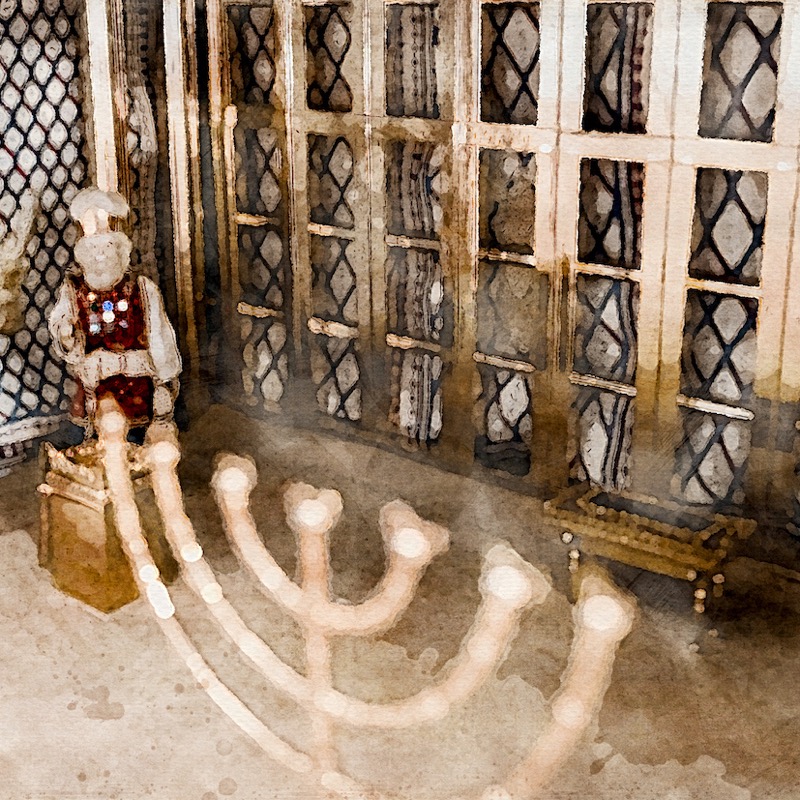
Hebrews chapter six and verse uh seventeen. Wherein God, being minded to show more abundantly unto the heirs of the promise the immutability of his counsel, interposed with an oath, that by two immutable things in which it is impossible for God to lie, we may have a strong encouragement who have fled for refuge to lay hold of the hope set before us, which hope we have as an anchor of the soul, both sure and steadfast, and entering into that which is within the veil. Whither as a forerunner, Jesus entered for us, having become a high priest forever after the order of Melchizedek. Now, having spent a while by the golden altar of incense, we must move on in yet further towards the presence of God. And as you notice from the cutaway diagram, we have come in through the door here without any time to stop and consider its detail or significance. And we've come on straight to the altar of incense, and we have noticed that it stands before the second veil, which is by far the more important veil, and therefore is frequently referred to simply as the veil. It was the second of two, of course. This is the first veil, this is the second veil, but this being the more important is normally referred to as the veil. It was the counterpart of this veil that, as you know, was rent in twain when at Calvary our Lord cried, it is finished. We come, therefore, to consider for a few moments the veil. And, uh, if we can have it there directly in front of us, let us now notice that the veil is used in a number of different significances. And unless we take the time patiently to distinguish these various significances, we shall find ourselves ultimately involved in certain difficulties and contradictions. The veil in the tabernacle, while as the tabernacle was still standing, was in some sense a symbolic representation of that veil which hides the unseen world of heaven from our mortal eyes here on earth. That comes about because, as Hebrews chapter eight reminds us, the tabernacle that Moses made was for him and his contemporary Israelites. It was a sh- a copy of heavenly things. And if you notice it, it is still true today. Wherever heaven is, we cannot see into it, even we of this day and generation, Christians though we are, we cannot see into heaven with our mortal physical eyes. There is a veil, isn't there, that hides heaven and the presence of God from our view. One day we read in scripture that that veil shall be rolled aside. The heavens shall be drawn asunder, says the book of the Revelation, and men shall be allowed to see right into the very presence of God, and impenitent men shall cry in their alarm to the rocks and the caves to fall on us and hide us from the face of him that sitteth on the throne. In God's mercy, there is a veil, who can tell of what it is made, a veil that hides the presence of God even now from our mortal eye. So in the tabernacle, which was a copy of things in the heavens, there was a veil that hid the presence of God even from their most exalted high priests. It is that meaning of the veil that the writer to the Hebrews follows, does he not, in chapter six of his epistle, and draws a lesson from it for us Christians today. He says that God, in his infinite mercy, has intended to give us strong encouragement, we who have fled for refuge. And to give us absolute certainty and assurance of our salvation and acceptance, God has given us his word, and for any respectable Christian, God's word by itself ought to be enough, for God cannot lie, says Hebrews. If he just told you something without an oath, you ought to believe it the next split second and go on believing it for eternity. But God, willing to show to the heirs of promise the abundance of certainty and encouragement, interposed with an oath, and that presented the Almighty with a momentary difficulty, didn't it? Because when men want to assure you of the truth of what they say, they take an oath by someone greater. But God, when he proposed to take an oath that there was nobody greater he could swear by anyway, so he had to swear by himself, saying, the Lord has sworn, by myself have I sworn, that blessing I will bless thee, and multiplying I will multiply thee. That by two unchangeable, immutable things, God's word and that word supported by his divine oath, we might have strong encouragement who have fled for refuge to take hold of the hope set before us. So, says the writer, our hope is no uncertain thing. You know, in modern English, I don't know how it is in American, and I didn't attend Sam Robinson's, uh, lectures, after all, I couldn't find the time, but, um, uh, in English, English, at any rate, hope is, can be a very uncertain thing. We say in Ireland, we hope, uh, that it will be good weather on our holidays. We mean that it very likely won't be, but in spite of that, uh, we entertain a little hope. I don't know why we haven't given it up long ago. Uh, we hope the weather will be fine on holidays, we'll see. But when it comes to biblical hope, there's no uncertainty in it, if it did be founded in Jesus Christ our Lord. It is utterly certain. It is, says the writer, like an anchor for the soul, both sure and steadfast. Now, everybody knows without a degree in nautical affairs that the strength of an anchor and its efficiency depends upon the ground into which the flukes, as we call them in English, I don't know what you call them, the pro- you know, the prongs of the anchor. It all depends on the ground into which the anchor enters. For if the ground be not stable, when the storm comes and blows the ship, the anchor will drift. So therefore, when we hear of our hope being like an anchor, and it is entered into, then we're all a god to know exactly what is it entered into. It has entered into that which is inside the veil, says the writer to the Hebrews. We thank God for it. The hope of our an- the anchor of our hope is not within our own breasts, praise God. That would be no certain or even sensible ground to put the anchor in. It is anchored in nothing in this temporary little planet of ours called Earth. The anchor of our hope has entered through the veil into the immediate presence of the eternal God and founded deep and sure in the Savior's love, as the hymn Hesed, more appropriately in the word and oath of God. And so, though we cannot see into heaven, nor can we see the ground with our visible mortal eyes into which our, uh, anchor has rested, we know by faith it is there. And the writer adds, whither the forerunner is for us entered, even Jesus Christ. So now begin to perceive why we must dis- notice and distinguish this significance of the veil from other significances. In Hebrews chapter ten, for instance, the writer likens the veil to the flesh of our Lord, the veil that is his flesh, his humanity. But here in Hebrews chapter six, he is using the veil not as a symbol of our Lord's humanity, is he? Listen to what he says. Our, our anchor has entered through the veil. What veil? Well, whither the forerunner is for us entered. That is, the forerunner has entered into heaven itself, and of course taken the anchor of our hope with him and lodged it in the very presence of God. And we may pause at that moment to see the significance of the description that is here given to our Lord. He has entered through the veil. The blessed apostles saw him go, rising up from the Mount of Olives until a cloud received him from their sight. What happened next, they didn't see, and they don't, uh, purport to tell us how you cross over from our world, our four-dimensional world, uh, into that other world that is heaven. Scripture doesn't attempt to tell us how could we understand it. We shall know one day because we shall cross over ourselves. The moment we can't understand it, but the apostles saw him go, and he went into heaven. He's gone as our forerunner, as our precursor, and oh, what tremendous ground of confidence there is in that, is there not? In the ancient world, if a king or a queen was about to visit a foreign country, they would take a simple precaution. They would send a forerunner to the foreign powers to test the ground, so to speak. And if the foreign power received the forerunner and honored him, then it was likely that the foreign power would honor the king who came behind the forerunner. If, on the other hand, the foreign power rejected the forerunner, well, then the king or the queen didn't go. They said, if they reject my forerunner, they will reject me. So it was when the blessed Lord Jesus came, John Baptist came as his forerunner. And our blessed Lord watched with intense interest, didn't he, what happened to the forerunner. The world took the forerunner and executed him. Thereafter, there was no doubt what the world would do to Jesus Christ himself. And now we read that our blessed Lord has entered heaven not merely for his own sake and in his own name, he's entered as our forerunner. And just like John the Baptist made it clear, said he, I'm not the Christ, there's coming one after me. So our blessed Lord, in entering heaven, has made it clear to all that inhabit those delightful realms that he is the forerunner of a mighty host of men and women that is coming on behind. You can't see into heaven this moment, can you? How secure is your hope? How deeply and certainly is it anchored? You have a test you can apply. How has our blessed Lord got on in heaven? Do you imagine? Oh, you say they welcomed him. I have been given reason to think that he is at this moment seated on the very throne of God. Well, that's interesting. Has he ever been asked to move or retire? You say, of course not, what a blasphemy it would be. Well, then see the point, my brother, my sister. He's not there merely for himself, is he? He's entered as our forerunner, and you may argue that just as God has treated the forerunner, so he will treat you. It's enough to make you shout glory, isn't it? For he's been in heaven these two thousand years, seated at the pinnacle of all power, might, dominion, and authority, and he hasn't been asked to recede not one centimeter in two thousand years. That's your forerunner, and he has entered in for you. So that's using the veil as a picture of that veil, whatever it's made of, that hides the unseen world, even to this present day, from our world. A veil that has not been split in two. But then as we look at that veil, we notice it had another function for Israel. We must never allow ourselves to think that the Old Testament is a kind of a flat earth affair. Even in the Old Testament, there are different levels of meaning. It's a sophisticated book, let alone being inspired, you know. And, uh, here was the veil. It performed another function because actually God was pleased to dwell in that tabernacle. He sat enthroned upon the cherubim. And therefore the veil acted as a means of keeping Israel out from the divine presence. And they were straightly charged, tell even Aaron and his sons that they do not come at all time into the most holy place, certainly not. They must keep out. And the addition of cherubim to the colors of that veil would surely remind anybody of the long story of man's fall and his being driven from the Garden of Eden. You will remember that when Adam and Eve were cast out, God put the cherubim and a flaming sword at the entrance to the garden to guard the way to the tree of life. So that veil said for generations, as eloquently as it could speak, keep out. And yet, you know, though it was a veil that told people to keep out, there was a sense, was there not, in which it was a very merciful provision. Let's look again at the cutout of the tabernacle, and notice now as follows. Even the priests of Israel had to keep in the holy place, they may never come into the most holy, except the high priest once a year. The veil it was that kept them out. See what would happen if you took this veil away. Then the moment a priest of Israel had entered into the first division, he would stand exposed to the throne of God. If it had not been for that veil there, no priest would even have been allowed to come into the first division. Because stepping inside this one, without a veil here, he would have been in the immediate presence of God. There was a sense, wasn't there then, that that veil was a merciful provision. Though men couldn't come into the immediate presence of God, that veil allowed man to come far nearer to God than he could have done if the veil hadn't have been there. Yes? And what marvelous lessons they learned, surely, all down those centuries. Do you think the priest lingered after he'd offered the incense and looked at that veil and started wondering and perhaps worshiping? That wasn't a blank sheet of material, was it? Though it hid the glories of God, it revealed the glories of God, did it not? What, after all, were those beautiful colors? Weren't they telling him anything about God and the beauty and the glory of God? And those cherubim, for all they were the stern ministers of God's justice, did they not tell the man something about the holiness and the wonder and the mystery of God? The veil, therefore, was a merciful provision, and it taught Israel something about the glory of God. Had they eyes to see it, of course, it would have taught them something about the one who one day should come to be in reality what this veil was in symbol. For now, I ask you to notice that when the priest came and stood at that altar, he was facing God on the ark, he was addressing God, but as common sense would have it, there had to be a mediator between him and God. The veil stood on four pillars. They were made of wood. They were overlaid with gold. They were on sockets of silver. And the silver, we are expressly told, was made from the ransom money that every Israelite had to pay for the redemption of his soul. Yes. When we come to the epistle to the Hebrews chapter ten therefore, the inspired writer s- talks about the veil once more, but no longer does he use it as a picture of that veil that hides heaven from earth. He uses it as a picture of the flesh that is the humanity of our Lord, doesn't he? In case you disbelieve me and say this man is talking confusing things, let's have a look at Hebrews chapter ten once more. Chap- Hebrews ten verse nineteen: having therefore, brethren, boldness to enter into the holy place by the blood of Jesus, by the way which he dedicated for us, a new and a living way through the veil, that is to say his flesh, that is his humanity. So you can rightly take with the, with the scriptural authority the veil as a picture of our Lord's humanity, his flesh. And when you think of that once more, it is delightful. There came a day when God became incarnate in the person of the Lord Jesus. Weren't they marvelous scenes that were enacted in Palestine in those days, when our Lord was functioning as a veil, in this sense, that men and women could come to the Lord Jesus. Oh, how near they could get to God, didn't they? Little children could sit upon his knee and pull his beard like infants will. On the other side dwelt all the fullness of the Godhead, bodily. And fallen women could come and kneel at his feet and wash his feet with their tears and touch him, much to the grief of the Pharisee, and touch the feet of him whose body was the earthly dwelling place of God, the Almighty. Marvelous days they were. And all as men and women looked at the veil, that is to say his flesh, what delightful colors they saw. For no man has seen God at any time, the only begotten Son who is in the bosom of the Father, he has told him out. What a delightful telling out of God happened when our blessed Lord acted as the veil in his humanity in the days of his flesh. You say, you know, hmm, I've often thought, like the hymn said, I wish I had been with him then. Did you ever think that? I mean, oh, if the Lord was sitting here this morning like he once sat in Palestine, oh, how near to God I could get, much nearer than I am now, you say. I could come right to the Lord Jesus, I could touch him, I could speak to him, knowing that God dwelt, so to speak, on the other side. I could get near to him. Well, so you could have done, my brother. You can get nearer still now, can't you? Ah, because listen now to what Hebrews chapter ten is saying once more. Yes, in the days of his flesh he acted as a veil, but will you not remember how at Calvary, when he cried, it is finished, the veil of the temple was rent? Fitting gesture to indicate that now our blessed Lord Jesus, in that sense, was not going to act as a veil anymore. For the blessed Lord being rent and his gracious human body being rent at Calvary, dead and buried, he is risen and gone into heaven and made us a way into heaven itself. So says Hebrews chapter ten and verse twenty, doesn't it? And we are to draw near, not just into the holy place, but into the holiest of all. And we come by that new and living way which Christ has inaugurated for us through the veil, the offering of his body, his human sinless body to God, and having been accepted, he's gone into the presence of God, and he sits down on the right hand of the throne of the Majesty on high. You say that's all too complicated. That now made me confused. I shall never know what I'm thinking about now when I sing those hymns at the Lord's Supper. Uh, is it a rent veil, or isn't it a rent veil, or which veil is it? Uh, sorry I've come to America, I must say. But then you see, God is far richer than sometimes we allow him to be. God's revelation, like himself, yes, it is simple, it is exceedingly sophisticated and has meanings at many different levels. Ours worshipfully to bend our intellects to try and understand the variegated levels of significance in God's revelation. Sum it up then. Yes, our Lord still, in one sense, acts as a veil, doesn't he? Shall I point it out again? The pillars of the veil were made of wood, and they were overlaid with gold. They point us to our blessed Lord in his humanity and in his deity. But they were on sockets of silver taken from the ransom money. And you say the veil, we're told in Hebrews ten, represents his humanity. Mediator between man and God. And says Paul in, uh, one Timothy chapter two, doesn't he? Do you know, we ought to pray for all men. For God, uh, is willing, wishes that all men be saved and come to the knowledge of the truth. And our blessed Lord, in pursuance of that objective, he gave himself for all men. A testimony to be received in its time. For there is one mediator between God and men, himself a man. The veil, that is to say his flesh. There is one mediator between God and men, the man Christ Jesus, who gave himself a ransom. Look at that silver redemption money, who gave himself a ransom for our sin. So yes, in that meaning of the veil, our Lord still acts as a mediator between men and God. In another sense, the veil has been rent, and we now have access into the divine presence. That being so, we shall want to take advantage of our liberty, shall we not, and enter the holiest of all. And we shall be more than interested to see now what exactly is inside, what is within the veil. We have a vested interest because we earlier heard how that the anchor of our hope enters into that which is within the veil. Well, what is within the veil anyway? And in the veil, of course, were two pieces of furniture. There was the ark, and there was the mercy seat. Two, not one, pieces of furniture. In the model, here it is. There is the ark. It was a box overlaid outside and inside with gold. It had feet at the corners, and by the feet were the staves to carry it. Then on top of that ark went another piece of furniture. It was made not of wood and gold, but of solid gold. It was a slab of pure gold, out of the ends of which were beaten cherubim. Two pieces of furniture then. And we come to think about them, first of all. Uh, can we have now a picture of the ark? There it is, with the mercy seat or the slab upon the ark. Let's see another picture to emphasize that there were two pieces of furniture. Here is the ark with the mercy seat, so-called, raised so that you can see that there were, in fact, two pieces of furniture. Now, normally, as you know, nobody was allowed to enter the Most Holy Place except the high priest once a year. Leviticus sixteen it is that gives us the regulations on that great day of atonement, how the high priest was to proceed when he entered on that solitary occasion into the most holy place. As Hebrews points out, he entered not without blood, which he offered for himself and for the sins of the people. Let's see the high priest doing exactly that, with a picture of the ark and the high priest standing before it on the great day of atonement. He entered not without blood, which he offered both for himself and for the errors of the people. Why must he go to that elaborate ceremony? For the simple reason, as we know well, that that ark was not merely a sacred box, but in that ark were the tables of the law. The tables of the law must have condemned both that high priest and the people he represented. As Paul the Apostle reminds us in the Epistle to the Romans in chapter three: by the deeds of the law shall no flesh be justified in his sight, for by the law comes the knowledge of sin. Now, in our gospel preaching, it is important to make that clear, isn't it? By the deeds of the law shall no flesh be justified in God's sight. That is not because there's something wrong with the law. The law of God is holy and just and good, and God never intends to scrap its divine demands. But then ultimately the law was never given so that man should keep it and thus earn salvation. The function of the law is to bring man to a realization of his sin. The function of the law is not to save man. Permit me a crude analogy. The law is like a thermometer, isn't it? Ah, there's mother here, and she's not feeling too good, uh, of a Monday morning, you'll see, and she's just shivering and a shaking, and husband, delightful soul, says you ought to go back to bed, but first pack my breakfast. And, uh, she still perseveres, and when he comes home at night, she's nearly dead, but she tells him she can't go to bed because, well, there's all the children, and tomorrow she's got a committee meeting somewhere, and this, that, and the other, you'll see. And, uh, so eventually her husband calls the doctor and says, my dear, you're ill, and along comes the doctor, and he looks very learned and costs a lot, and he gets out his thermometer and puts it into her mouth or elsewhere, and takes it out and consults it learnedly and said, oh, one hundred and ten point five, You are ill, my woman. You must go to bed this very minute. So you go to bed. The thermometer has discovered to you how ill you are. You're more ill than you thought you were. Thermometer can't cure you, can it? Suppose I got a cold one day, you hear I got the influenza, and you come to visit me in my house, and there I'm sitting in bed with my nightcap on, and I got a thermometer on my mouth, and I'm sucking it very vigorously. You say, hello, gooding old chap. I hear you're ill. Yes, I say, I'm very ill. Oh. Tell me, you say, what are you doing sucking that thermometer? I say, can't you see? I took this thermometer and put it in, and I found I was one hundred and ten point five. You know, that's dangerous. I'm very ill. You say, yes, you are. Uh, but um, I say now I'm trying to get the thermometer down, you see. And if I could manage to get the old Quicksilver down and get it back to normal or somewhere near normal, I should feel a lot better. So that's what I'm doing. I'm working on this thermometer so that I can get to the proper standard. And what would you say? You would say, gooding, you're ill. You are very ill. You're more ill than you think you are. Hey, you don't suck thermometers to get better. Thermometers are just showing you how ill you are. God's law was like that. It was given. Why was it given? Well, Romans chapter three tells us why it was given. We know that what things soever the law says, it says to them that are under the law, that every mouth may be stopped in silence, and the whole world be brought in guilty before God, utterly without excuse, mouth shut, liable to the judgments of a holy God. That is the verdict of the law, and will always be the verdict on those who attempt to approach God on the ground of his law. Therefore, when the, uh, when the high priest came in the name of his people and representing them into the presence of God, he did not come on the ground that Israel had done their very best to keep God's holy law. When he came into the presence of God, he found not merely an ark containing the law, he found on top of that ark the great slab of gold, pure gold, and out of the sides of it, cherubim of gold. We're not told that the priest said anything, actually. All he did is he came in and burned his incense to obscure his own presence. He took the blood of the sacrifice and sprinkled it before the ark, before the mercy seat, and on the mercy seat. And it was clear, wasn't it, what the man was saying by that simple but important gesture. He was saying that he and his people had broken the law of God. He was saying in true repentance that the people were verily guilty and deserving of the wrath and sentence of a holy God. He made no excuse for their sin, but he was saying that by the divine mercy, God had allowed that people to take an innocent victim, and the victim die in the place of the guilty priest, in the place of the guilty people. And as he sprinkled that blood before and on the mercy seat, he was saying that the law of God and the holy sanction and penalty it demanded had been carried out. There was the evidence that a death had taken place for the transgression. So does our blessed Lord Jesus, and on that ground invite us to come into the holy place. Not on the ground that we have kept the law or nearly kept it, on the ground that we have broken it, and that he gave himself and shed his blood to meet the demands of that holy law, paid the penalty, died for our sins, the just for the unjust, that he might bring us to God. At this point, however, I shall have to trouble you with a little lesson in Greek and Hebrew. Eh, I can only say in self-defense that I shall not charge you anything for it, do see. But this is one of those rare places where it is proper, perhaps, to remind a general congregation of some Hebrew and some Greek, and I am sure you will be painless and moderately intelligible. Let's have the mercy seat, if we can, separately now, so that we can see it. Mercy seat is a translation that the older translations used, following Luther's German translation. When he came to translate the Hebrew word for this object, he called it Gnade Stuhl, grace seat. And the early English translators followed him, and they translated it mercy seed. In Hebrew, the word is kaporeth, kaporeth, and it has a double meaning. It means, in the first place, something that covers, for that slab of gold went onto the ark and covered all that was inside. But the Hebrew verb kapah, and therefore this noun kapores, takes on an additional connotation, for it means to cover in the sense of making atonement before God and hiding from the view of God the sins that so offend him. Therefore, they used the name Caporeth for this slab of gold, meaning two things: the slab that covered the ark and therefore covered the law and the other contents, but also the place where covering in the sense of propitiation was made. Caporeth, the blood was sprinkled on the mercy seat and before it, bef- on the Caporet and before it. Round about two hundred and seventy BC, there were large numbers of Jews in the city of Alexandria in Egypt. Many of them could no longer read their Hebrew Bibles, nor even understand the Hebrew when they heard it read in the synagogue. So learned men amongst that Jewish community in Alexandria translated the Hebrew into Greek, the first Greek translation that we know of, of the Old Testament, as a, a, the whole of the Pentateuch, at least. When they came to this word here, Capores, they tried to make the best of both worlds. They translated capores by two Greek words. The one word is epithema, E-P-I-T-H-E-M-A, epithema, which simply means something that is put on top of something else. Good word for a lid, if you like, a covering. Epithema. That is the first meaning of kapha, kapore. But then they added epithema hilasterion, a covering that has to do with propitiation, the place where propitiation is made. Let's have the priest doing it again. The ark is covered with its lid, with its capores, with its epithéma. But the epithéma is an epithéma hilasterion, it's the covering where propitiation is made. The interesting thing is now, and here's the point of this little digression, the interesting thing is that in Romans chapter three, Paul uses that very word, hilasterion. Let's notice the verse in which he does it. It's Romans chapter three. And we'll read the context. Let's start at verse twenty. Because by the works of the law shall no flesh be justified in his sight, for through the law comes the knowledge of sin. And when we think of that, we think of the ark, and we think of the law of God in the ark. And Paul is telling us that that law makes known our sin, but there's no way of salvation through the law. How can we be saved then? Well, now, says he in verse twenty one, apart from the law, a righteousness of God has been manifested, being witnessed by the law and the prophets, even the righteousness of God through faith in Jesus Christ unto all them that believe, for there is no distinction, for all have sinned and all do fall short of the glory of God, being justified freely by his grace through the redemption that is in Christ Jesus, whom God hath set forth to be. Now here comes your word. I don't know what you will have in your translations. Here it is in the Greek tongue, whom God has set forth to be a hilasterion. Oh, thank the Lord. That's the place of covering, the covering where the atonement is made. Isn't scripture exact, you know? Huh? How carefully the typology was arranged. Do you see the flow of the argument in Romans chapter three? First the law in the ark that condemns us, now the way of salvation, the mercy seat, the propitiatory, the capores, the hilasterion, with its blood, where we may meet God and find acceptance through the sacrifice of Jesus Christ, our Lord, whom God has set forth a propitiatory. And the words come ringing in our ears from the command that God gave when he gave the instructions to make this ark and then its mercy seat. There, said he, I will meet with you. Oh, what a lovely thing, my brothers and sisters, to be able to stand before unconverted people and tell them, to their disappointment, there is no salvation in their attempt to keep God's law. They must come and repent radically, and own they are helpless under the sentence of God's eternal judgment. There is nothing they can do to save themselves. You've got to start with repentance, haven't you? You've got to start with the old thermometer. They're more ill than... When you brought them to see their helplessness under God's law, oh, what a delightful thing, even to use the tabernacle to do it, to hold it in front of their noses and say, God said, here I will meet with you over that mercy seat by the cherubim where the blood is shed. And to this very present day, there is a place in the vast universe where God will meet with sinful men and women. Oh, praise God for it. There is a place. It is Jesus Christ, our Lord. There, says God, I will meet with you. It has often been pointed out that those cherubim, executives, of course, of God's judgment, had their faces pointing down towards the blood. On the veil, presumably, their faces looked outward towards the people and forbade the people to enter. But when the high priest eventually came through on the day of atonement and sprinkled the blood, notice where the cherubim were looking. They weren't looking at the high priest. They were looking at the blood upon the mercy seat. They did not therefore fly, so to speak, to execute this sinner, but allowed him to come and know himself accepted. Why? Because they weren't just looking at the law, which, if it had been by itself, would have demanded that they rise up to execute this priest and the people. They were looking at the mercy seat and the blood that atoned for sin, and the man was accepted. Oh, isn't it marvelous? Do you know, I was one afternoon, many, many years ago in my youth, and you'll see that was a long while ago, but I was out for a walk with a senior Christian gentleman who felt that he ought to examine my soul a little bit. Said he, David, now come now, be serious. What are you depending on for your acceptance with God? And I was about to say, I'm depending upon the mercy of God. Ah, mercifully, I noticed just in the nick of time what he was a getting at, you see. Isn't it nice to be able to defeat your examiners now and again? And I said, oh my good sir, I'm depending on the justice of God. Ten marks out of ten, he said. What are you depending on? The mercy of God? That's marvelous. Yes, but you should be depending on the justice of God. You say, how do you mean? Oh well, says Paul, you see, when we have trusted Christ and we're justified by faith and God accepts us through the blood and sacrifice of the Lord Jesus, he can do it with absolute justice to declare his righteousness at this time, that he himself might be just and the justifier of him that believeth on Jesus. We do not lower the standards of God's law, says Paul. We establish the law. Oh, marvelously. God is going to have you in heaven if you trust his son. He'll not hide you when you come in in case the cherubim noticed you. No, no, he doesn't mind what cherubim looks at you, because he does it righteously. The sacrifice of Christ has upheld the law, paid its penalty, and God can be just and the justifier of him that believes in Jesus. And what else can we see for our great encouragement? On the great Day of Atonement, the Yom Kippur in Israel, when once in the year the high priest came into the divine presence, there were many elaborate ceremonies, as you know. The high priest on that occasion entered, of course, more than once in the course of that day, though looked at from the context of the whole year, it was, so to speak, one entry on that day, though it took several individual entries to complete his task. There were, of course, many elaborate sacrifices. Central to the whole ritual, however, were a couple of very simple sacrifices. The high priest, while the people waited outside the tabernacle, the high priest would come out from the tabernacle. He would appear before the people in the court, his first appearance. They would take a goat, such as you see there at the front. The elders of the nation, in the name of the nation, would lay their hands on the head of the goat and confess their sins. The goat would be slain, its blood taken. The high priest with the blood in the basin would then turn round, and he would go back and disappear within the door, and presently enter through the veil into the most holy presence of God. So having appeared before the people to offer the sacrifice, he would then appear in the presence of God for them. Having done that, he would, uh, t- turn round and come out again. And to cut out the detail, he would come out eventually and appear the second time before the people. When he appeared that second time, they took another goat, this time a live goat. They didn't kill that one. They laid their hands upon its head, they confessed their sins once more. Then the goat was led out by the hand of a fit man, out into the wilderness, over the cliffs and the mountains, and banished to the land of forgetfulness, a symbolic action to say that Israel's sins had been banished. So there were three appearances. He appeared to put away sin. He then appeared in the presence of God for them, and he appeared the second time. And every schoolboy knows all the way through America, surely, at least in Sunday school, boys, because you've told them that many times, haven't you, on the basis of the tabernacle. What the writer to the Hebrews says at the end of his chapter nine, where he compares our Lord and his appearances to those three appearances of Israel's high priest. Just let's look at them. They come at the end of chapter nine, And it says, you'll see, verse twenty six, but now once at the end of the ages, the consummation of the ages, has he appeared to put away sin by the sacrifice of himself. It wasn't done in a corner, my brethren. Put away our sin, the blessed Lord came through that veil that hides the unseen presence of God from our human eyes. He came out into our world. He appeared at Calvary in full view of the whole world and of heaven, earth, and hell. And there he offered the sacrifice to put away sin by the sacrifice of himself. And having done that, he has gone back to heaven, hasn't he? What for? Like Israel's high priest, now to appear in the presence of God for us. Oh, what a delight. Let's savor it again. We thought of it already, but I like to think of these things. They encourage my feeble heart. Ha. There is a legend, you know, you mustn't think it true, but a legend that you'll find in Jewish traditional writings like Talmud and Midrash. They say that when the high priest had offered the sacrifice for sin and went that once in a year through the veil to appear in the presence of God for the Israelites, they tied a big long rope around his waist, and left the end of it trailing out here. You say, what do they do that for? Well, the idea was this. Israel had realized the significance of the fact that when the high priest went in there, he was appearing not just for himself, but for them. And anxious moments followed. What would God say to the high priest? Would he, after all, accept the blood of the sacrifice? Would he accept the high priest? Well, if he did, of course, then he had accepted the people themselves, for the high priest was appearing on behalf of the people, and God knew it. So if God accepted the high priest, he accepted the people on behalf of whom the priest was appearing. But what if God got tired one year and said, well, I accepted you last year, but this, ha, since then you've had, you've acted so impossibly badly. Sorry, high priest, your little sacrifices of sheep and kids and goats and things and the bloods of heifers, sorry, they are no good, they never really were, and I got sick and tired of you, my patience is given out, and I reject you. The man would have died on the spot. Ah, but see the implication for the people standing outside. That's why they got the rope, so if the high priest was executed by the judgment of God, if God didn't accept the high priest, they could haul out the dead body. It emphasizes a fact, doesn't it? For us Christians about our Lord, he now appears in the presence of God for us. One or two practical questions I want to ask about that. Of course, when the Lord entered heaven, entering for himself, as far as he himself was concerned, heaven made him welcome. God bade him come and sit at the very right hand of the throne of God. Well, that's understandable if God was accepting him for his own sake. What I want to ask is, when God accepted the Lord Jesus into heaven, did he know that the Lord Jesus was representing me? Huh. Was he aware that, uh, he was appearing for me? Or is it that God accepted the Lord Jesus for his own sake? And one of these days, if I were to try and turn up in heaven, God would say, who are you and what are you doing here? Well, my name is David Gooding. Yeah, but you're no right here. And I say, yes, yes, I trusted the Savior, and he was, has been appearing for me. And God say, well, I'm sorry, I never knew he was appearing for you, for that would have been a very different story. Ha, if I'd have understood he was appearing for David Gooding, well, he wouldn't have been welcome here. You say, of course it won't happen. The very idea borders on blasphemy. Well, then rejoice, my brother. You mean to tell me that when the Blessed Lord entered the presence of God, God knew he was appearing for you? And God welcomed him, sat him at his own right hand, knowing he was representing you, then are you eternally secure? Oh, praise God. He appears in the presence of God for us. He's been sitting at the right hand of God these two thousand years and has never been asked to retreat, not one centimeter. It's lovely to be able to tell that to the, uh, Christian folks, isn't it? You'd love to tell them that, you have told them. And doesn't it help to have a tabernacle? All the riches of God's grace. How will you motivate your fellow believer to serve him better than to tell them of their acceptance by God through Jesus Christ, our Lord? Oh, it's nice when the sun shines brightly. Oh, how much better it is when the sky is all dark and difficult and emotions are tried, and I don't know where I am, to know the fact that the Lord Jesus appears in the presence of God for me, and as long as God has accepted him, God accepts me. Ah, and says the writer to the Hebrews, that isn't all. But just as the high priest, having appeared on behalf of the people, came out and appeared the second time, so will our Lord. He shall appear the second time. And now comes a very big contrast. When Jude, the Jewish high priest, appeared the second time, he had to offer another sacrifice, and they took the goat, and they confessed their sins, and it was led away. When our Lord appears the second time, it shall be apart from sin, that is, apart from a sin offering. When he appears the second time, no more sacrifices. All the work of sacrificing has long since been done. He shall appear the second time, apart from any sacrificing for sin, unto salvation. You say, salvation in what sense? So I'm saved already. Well, so you are. You're saved in the sense you are forgiven. But when the Lord appears the second time, he shall complete your salvation. It will be the very redemption of the body, and he'll take you back with him into the Father's house on high, never to go out again. Oh, magnificent, isn't it? And with a gospel like that to preach to men and women, we say with the Apostle Paul, I'm not ashamed of a gospel like that. It is the power of God unto salvation. Shall we pray? Our Father, words fail us to describe the immeasurable d- d- immeasurable dimensions of thy grace. Yet do we ask that thou wilt strengthen us by thy spirit in the inner man, that Christ may dwell in our hearts by faith, to the end that with all saints we may become strong to apprehend what is the height and the depths and the length and the breadth of this marvelous mystery, and to know the love of God which passes knowledge. We thank thee for him who at this moment appears in thy presence for us. We thank thee for the vivid expectation that soon he shall appear the second time and take us home to be with thee eternally. So imbue our hearts with the sense of the wealth, of the riches of thy grace, that like the lepers of old, we may say to ourselves, we do not well to hold our peace, and that the sense of our overwhelming wealth may go to tell those who sit in grinding spiritual poverty of the glory of thy salvation through Jesus Christ our Lord. Amen.