Gooding, David: 9 - The Frames for the Tabernacle
ID mfh_1087364680Date unavailableBefore 4.09Restored 4.55
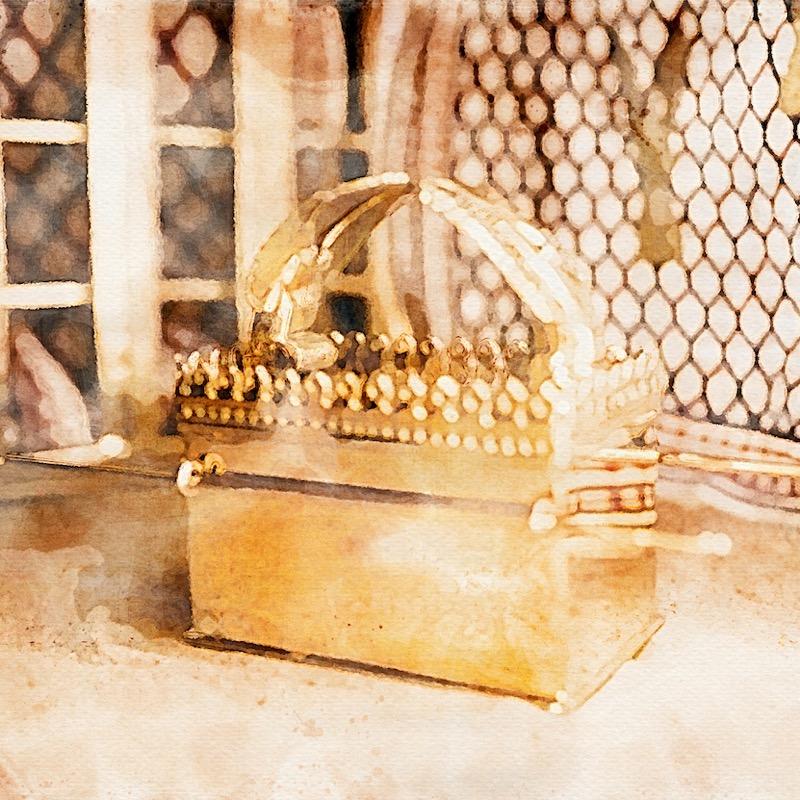
So welcome to this, the ninth talk in this series of lectures, and the penultimate talk. Last, uh, lecture, we discovered a very interesting thing about the use in the Old Testament of the term tabernacle. It is, of course, used, generally speaking, of the whole setup, the building and the court and its curtains and so forth. In fact, it is more generally used in that sense. But la- uh, on our last lecture, we discovered that it has a stricter meaning. It is the term given to the lovely series of curtains that form the inner curtains of the building. They are called the tabernacle in the strict term. There was another series of curtains that was put above these ten curtains. They are called the tent over the tabernacle. Moreover, the frames that held them up are called frames for the tabernacle, meaning they were the frames that gave practical expression to what the tabernacle curtains symbolized and held them up on three sides and at the back. Now, in our last lecture, we were studying this series of inner curtains, and we notice that they are referred to as the tabernacle, in Hebrew, the Mishkan. And immediately we saw the point of what John the Evangelist is saying in the first chapter of his gospel and verse fourteen. He says at that point, the Word was made flesh and dwelled among us. Some of the older translations have it, the Word was made flesh and tabernacled among us. And that, in fact, though old fashioned, gives us a clue to what John is doing when he makes that statement. The term of tabernacle in Hebrew is Mishkan. It is the noun formed from the verb to dwell. The verb to dwell is simply shakan, S-K-N, with suitable vowels in between. Now, when John wrote that verse fourteen in his chapter one and said the Word was made flesh and dwelled among us. John, who wouldn't have known his Hebrew, has deliberately chosen a word that in Greek makes almost the same sound. It is derived from a noun which is in Greek skene, S-K-N with suitable vowels, just like the Hebrew word S-K-N. It is no accident that John uses it. Of course, he uses a Greek wor- verb that contains it, eskenosen, and he puts across in terms of the ultimate reality, what that tabernacle for centuries symbolized. He said the Word was made flesh and dwelt in a tent, dwelt in a tabernacle, if you please, among us. That gives us the authority to look back to this original tabernacle and to see in it not only the lessons that it taught the Israelites in those far off centuries, but the prophecies that its symbolism made. For the New Testament informs us that the tabernacle was a shadow of the good things to come. Which good things, of course, were the coming of Christ, his incarnation, his life, his miracles, his death at Calvary, his burial, his resurrection, and his ascension to the right hand of God. And therefore, tonight we shall once more take the curtains and consider how they pointed to Christ and what practical lessons we shall learn from them. In our last lecture, we also noted that these, uh, ten curtains that were called the tabernacle, the Mishkan, were a plurality in unity. That is, they were formed of ten curtains. They were four cubits broad, uh, but uh, they were lengthways on, and the five of those curtains were placed side by side and then sewn together. Then other such five curtains were taken, laid side by side, and sewn together. And then the two sets of curtains were joined by an elaborate system. There were fifty loops on the selvedge of the one set. There were fifty loops on the selvedge of the other set. And then through the loops on both sides, there were placed fifty clasps of gold. And the text actually explicitly says that that was done that the tabernacle, meaning the, uh, inner curtains, that the tabernacle might be one. It was one tabernacle, but composed of ten curtains, and the ten curtains joined together by these fifty loops and fifty clasps, that the tabernacle might be one. It is worth stressing, for in our next and final lecture, we shall be considering the second group of curtains that were placed over these to protect them on all sides. They were made not of linen, but of goat's hair woven, not goat skins, goat's hair woven. There were eleven of those curtains, and they were joined together, two sets, one five and the other six, and they were joined together by that similar method of fifty loops down the selvedge of each set, and then fifty clasps, this time of bronze. On top of them were skins. They were simply to protect the building and the curtains and the furniture from sand and the occasional rainstorm that they get in those parts. And the description of them was given in simply one verse. They were simply practical affairs. There was a, a, a set. We don't know how many, of ram skins that were dyed red. And then there was a set above them of what the older translations called, uh, uh, badger skins. That is a most unlikely translation, for I'm told there are no badgers in that area of the world. They're more likely to have been dugong, the sea cow, which is plentiful in the Red Sea. They might even have been seal skins. But we need not trouble them with them further. The two big sets of curtains are what interest us, and when the, uh, description is given of the second set, the goat's hair curtains, it is then emphasized that they were joined together so that the tent might be one. That is the stress of the text. Both of them were unities, but pluralities in unity. And so we asked ourselves whether this detail too might be a shadow of the good things to come. That the tabernacle itself, the ten inner curtains, were such a shadow, John tells us in the verse we have already studied, John chapter one and verse fourteen. The Word was made flesh and tabernacled among us. But when we consider what happened and what our blessed Lord did on the day of Pentecost, we then find a clue to what the foreshadowing is telling us. For on the day of Pentecost, our Lord poured forth his spirit on the early believers, and the epistles subsequently explain the significance of it and what it achieved. With our Lord's own instructions, the apostles had to wait in Jerusalem for ten days after his ascension, so that on the day of Pentecost, the Lord sent forth his Holy Spirit, and according to Paul's epistle, we were all baptized in one spirit, into one body. For just as the human body is one, yet has many members, and for all they are many, it is simply one body. So also is the Christ. And throughout the e- epistles of Paul, we discover that our blessed Lord Jesus, now throned in glory, while forever himself and always distinguishable, yet is the head of a body, and that not a simple metaphor that might tell us who belong to Christian churches we ought to behave like a body does. In talking of the body of Christ, Scripture is talking of a fundamental reality that now has existed in the universe since the day of Pentecost. A body formed of redeemed men and women, formed Formed by by that same Holy Spirit coursing through them and in them, illuminating and guiding them, a vital living link with the head, our Lord Jesus Christ in heaven. As Mrs. Alexander's hymn says, it is a thing most wonderful, almost too wonderful to take in. Our believers here on earth today are joined with all other believers by the fact that the Holy Spirit is in all believers and are joined to our blessed Lord in heaven, who sent forth his spirit. He therefore is the head of the body, the church. And we saw in our last lecture that this idea of a body of Christ formed by all believers of the past and the present and the future, is not something concerned merely with life on earth. It is to be an eternal feature. For we are told that our blessed Lord, the head of the body, has been raised. He is seated in heaven, far above all principalities, powers, mights, and dominions. As Son of God, he made them in the beginning, those great spirit powers, executive powers. But not only did he make them, he became a man, human, like we are. And God has raised him from the dead and seated him at his own right hand, far above all principalities, mights, powers, and dominions, which is a thing to contemplate. For not only is he human, though never ceased to be God, but we are said to be joined with him, one body in the Lord. And it is said of all believers that God has raised up us too with Christ. We are seated in heavenly places in Christ Jesus, far above principalities, mights, powers, and dominions. And I don't know whether Michael the Archangel has got over the shock yet. But redeemed human beings, joined with Christ. I said above him, far above him. And therefore, our behavior as members of the body of Christ, now here on earth, is exceedingly significant. It is on that that we wish to concentrate this evening. When we think of the tabernacle, the ten inner curtains, we notice they are basic linen with colors blue, purple, and scarlet on them, and then cherubim placed on them. We don't know whether by embroidery work or whether by damask work. But there they were, cherubim, talked of in the Old Testament as God's executives, the living creatures. They are on that, uh, tabernacle because Christ, to whom they pointed, is above them and controls them. And we too are seated with Christ spiritually above them, and one day shall control them. But alongside of that, when people hear about this great unity that is the body of Christ, they cannot help seeing the facts that Christians throughout this world are sadly divided. What comes of the unity then, that the body of Christ is meant to show? With that in mind, we come to our special topic this evening. We are to consider these frames. And when the directions are given for them, it is said, Moses is told, you shall make frames for the tabernacle. Meaning Meaning, frames frames for for those ten curtains. Frames that held them up. Frames that were the practical means of giving expression to those ten beautiful curtains, let me repeat, the Mishkan was where God Almighty condescended to presence himself. And for those, uh, curtains to be spread out as a dwelling, as a Mishkan for God Almighty. Those frames were provided to be the practical means of holding up and presenting and, uh, uh, keeping those beautiful ten curtains. We shall read now the beginnings of the technical details that are given us in the text. This is Exodus chapter twenty six. Exodus chapter twenty six. For time's sake, we shall not read it all, but select important features. Here is Exodus twenty six, and we shall begin to read verse 15. And thou shalt make, says my old-fashioned translation, thou shalt make the boards. But they weren't boards, whatever else they were, they weren't boards. We get the impression from the details that they were ladder-like constructions. Now, architects and experts disagree among themselves what exact form these frames took, but this we can be sure of, they were ladder-like constructions and served one obvious purpose. If they had been solid boards or planks, then of course you could not have seen the curtains through the interstices in the frames. If they had been solid planks, then the only place you would have seen the curtains was if you had looked up to the roof. Whereas the being frames, ladder-like constructions, when you went in by the door, you will s- have seen the delightful blues and purples and scarlets of the fine twined linen and the cherubim all around you. You would have seen them on the roof, you would have seen them on the walls, you would have seen them in the veil in front, for it too was ad- uh, adorned with cherubim. And as we s- saw in a very early lecture, when you came in, you not only saw cherubim, but on the left you would have seen this lampstand that was formed like a tree, like a living tree. It had buds, it had blossoms, calyxes and blossoms, and then eventually almonds. Oil lamps in the shape of almonds. A tree made to look as if alive, with all i- i- i- its, um, fruits simultaneously. And its base like the roots of a tree, going down into the ground. Any priest that knew his Genesis, as he came into that door, will have seen cherubim all around him. And a tree. The tree of life, indeed. And could have remembered the sorry happening to Adam and Eve in the garden, when they disobeyed God and fell and were cast out of the garden, lest they should put forth their hand and take and eat of the tree of life. So they were put out of the garden, and at the gate of the garden were placed cherubim to stop them coming in. Now see the wonders of God's grace already here in this tabernacle, people redeemed out of Egypt by the blood of the Passover lamb and the power of God at the Red Sea, were privileged to come in, at least to that first division, and see the cherubim and the tree of life, and could come in and touch the very tree of life, as they were required to do to light the lamps upon it. The beginnings of the end of man's exile, only the beginnings. It would be centuries before believers in general would be admitted, so to speak, to the equivalent of the most holy place. In Israel's day, only the high priest was allowed into the most holy place, and he only once a year. But all the wonder when Christ came and offered his perfect sacrifice for sin, died, was buried, and has risen, and he's gone into heaven. And because of his great sacrifice, we too are enjoined in the Epistle to the Hebrews, chapter uh ten to have boldness. We have boldness to enter into the holiest of all by the blood of Jesus, through the way he has inaugurated for us, through the veil, that is to say, his flesh. So we come in then to the holy place, in those far off days, to learn what else we may from these frames. I repeat, they gave practical expression to what the curtains were symbolizing. If we read down the further technical details in chapter twenty six, we should find at least four things that are important because of their significance. Along the base, or at the base of each frame, and therefore running along underneath all the frames, were sockets, and they were sockets of silver. At the corner, at the back, and that corner and this corner, there were corner frames. It is difficult to understand exactly what the Hebrew means, just exactly how they were arranged, but their purpose is obvious. Given you had two walls each side of these frames, and then a wall at the back, they would need to be joined so that they would be steady. They would need corner frames that could s- uh, give and determine the angle at which the series of frames in front, uh, were s- were spaced out. It wouldn't do to have the frames stretched out like that or too narrow. They had to be exactly it, and it was the corner boards that would have determined the angle at the back and therefore the angle of the walls. Then, because they were individual frames standing side by side, they had to have means by which they could stand together, not higgledy piggledy. Frames will be frames, you know, and uh, one frame would stand upright, another frame would lean this way. Another frame would lean inwards. And the frame that leant outwards would think that the frame that leant inwards was far too narrow, do you see? And the frame that leant inwards would think that the frame that leant outwards was far too wide, you see? And all sorts of disputes could have arisen had they been allowed to do what they pleased. So there was a device done. Each frame had a series of rings on it. And then, when all had the rings, poles were put through the rings. And as each frame got hold, a- each uh board frame got hold through its ring of the board, uh, uh, uh, of the, of the pole, the frames all stood in alignment. Do you get the technique? It was a simple technique, wasn't it? Let me repeat it. Each frame had rings. Long poles were put through the rings. Each frame by its rings had to get hold of the same pole, and when that was done, lo and behold, they all stood, all in order, straight shoulder to shoulder. Simple device, wasn't it? And finally, they were overlaid with gold, not only the frames themselves, but the poles and the rings. Now, some people, when they have read this account of this apparently extravagant use of gold, have thought that this is fairy story, simple imagination. How could people in that far distant age have afforded such lavish decoration of such a building? Uh, Professor A. R. Millard has shown that gold in those days was far more plentiful than perhaps it is even now. And many a temple in those far off days had its pillars covered in gold. If you go and examine those pillars, you will find a circle of little holes around, at various stages around the pillar, where the gold was nailed on. And we shall all have, uh, seen pictures of Tutankhamun's tomb and the lavish lu- use of gold in it. This is no fairy story. These frames all overlaid with pure gold. Now, when we come to the New Testament, we find authority again for making a comparison between that, uh, house of God and the house that Christ is now building. Hebrews three verses five and six read like this. Now Moses was faithful in all God's house as a servant to testify to the things that were to be spoken later. We notice that phrase. Moses, faithful in God's house, in the tabernacle, as a servant to testify to the things that were to be spoken. But Christ is faithful over God's house as a son. And we are his house. If indeed we hold fast our confidence and are boasting in our hope. So Christ is the head of his house that corresponds to Moses and his house, or God's house that Moses built. And then we are told that Christ, as son over his own house, has made believers part of that house. We are his house, if indeed we hold fast our confidence and our boasting in our hope. So now we come to the practical side of our topic. Let's look at Ephesians chapter four. And consider the problem that Paul is dealing with in that chapter. Ephesians four verse one reads as follows: I therefore, the prisoner in the Lord, beseech you to walk worthily of the calling wherewith you were called, with all lowliness and meekness, with long suffering, for bearing one another in love, giving diligence to keep the unity of the spirit in the bond of peace. There is one body and one spirit, even as also you were called in one hope of your calling. One Lord, one faith, one baptism, one God and Father of all, who is over all and through all, and in all. In the distressing fact that there are many divisions amongst God's people, I find this a comforting observation. We are not here told to make the unity. We are faced with the statement that there is a unity, meaning not a union, but a oneness instead of a two-ness. Did you notice the phrase? There is one body? It is a fact. All believers, whatever they may call themselves, granted they are true believers, are the body of Christ. It exists. It is. What we are here exhorted not to do is to act as if the body of Christ were divided. There is one body, you'll say. There's only one spirit. Even as you also were called in one hope of your calling, one Lord, one faith, one baptism, one God and Father of all, who is over all and through all and in all. It's the glorious fact of the oneness of all believers in Christ. That is a unity that we don't have to make. It is the unity for which Christ prayed in his famous prayer recorded in John chapter seventeen as he stood on the threshold of Gethsemane and prayed to his father, that those whom the father had given him may all be one. And in answer to that prayer, God has sent his spirit, and Christ has formed the body of Christ. There's only one body, and all believers belong to it. We are to rejoice. But now, we could learn a lesson or two, couldn't we? From our illustration, our God-given illustration. Part of the success of these frames to perform their function of holding up the Mishkan, the dwelling place of God, was that they were stood in sockets of silver, every one of them. Indeed, each frame had two struts that went down like a ladder does, and there were two sockets, one under one strut, one under another. And it wasn't just any old silver. The silver, so we are told, Exodus thirty, and then again in the later chapter thirty eight, it was made, these sockets were made from the ransom money. Because, you see, when the census was held in Israel, then everyone had to bring an atonement, a ransom for his life, for his soul. The fact that God allowed him still to live as an individual. Now to be registered as a member of Israel, he had to give a ransom for his life, for his silver, for his soul. That ransom money being silver, was then taken and molded to become, among other things, the basis, the sockets in which the frames were put that gave them solidity. It, it lowered, of course, the center of gravity, didn't it? Because it now had a heavy weight at the bottom and made them less likely to topple over. Based on the ransom money. It is a foundational provision and requirement for the true church of God, that every believer should stand on the ransom that Christ has provided for our souls. For we are redeemed, not with corruptible things, as silver and gold, but with the precious blood of Christ as our ransom. For Christ gave himself a ransom for all. Only those that are ra- that are, are, only those are ransomed, that in true repentance and faith receive Christ and take their stand upon his redeeming blood. It is a source of serious weakness if the church pro- forgets to proclaim that membership of the house of God depends on an individual's acceptance of the ransom and taking his and her stand on the redeeming blood of Christ. It is a sorry state of affairs when an evangelical can write in a newspaper that is the theory of propitiation is right, that God laid on Christ the iniquity of us all, and he suffered the indignation of God against our sin. If that is true, then God ought to be had up for child abuse. That written and published by a professed evangelical. I cite it simply to show the importance of getting our foundation right. Every frame stood on the redeeming money, so ought every believer in the house and family of God. And then not only so, but as I say, at the corners at the end here were corner frames. I repeat, we don't know exactly what the specifications mean, how in practice they were, uh, achieved. Architects have different views of it, but we know their purpose, to set the angle between the back wall and the two sides. When we come to the New Testament, it uses a similar metaphor, but now it uses not a tabernacle, a portable shrine. It takes its metaphor from a solid building. So Peter says in his first epistle and chapter two as follows. Unto whom coming, that is to Christ, uh, coming to Christ, unto whom coming a living stone, rejected indeed of men, but with God elect precious, you also as living stones are built up a spiritual house to be a holy priesthood, to offer up spiritual sacrifices acceptable to God through Jesus. Because it is contained in scripture, behold, I lay in Zion a chief cornerstone, elect, precious, and he that believeth on him shall not be put to shame. You see, the metaphor now is drawn from a solid stone building. And in those ancient times, they had at the corner a very big, huge cornerstone. If you want to see an example, go to the Wailing Wall in modern day Jerusalem and look at the cornerstones in the wall. They are huge. They not only took the weight of the building, they set the angle. And using the metaphor, God says, behold, I lay in Zion a chief cornerstone. To me, elect, precious. That is our blessed Lord Jesus. And Peter says, unto whom coming, coming to Christ, you also are built up as living stones. Dear old Peter, he is forever dropping hints about his own experience, isn't he? When he came to Christ, Christ said to him, oh, you are Simon. You shall be called Peter, which is the, eh, eh, eh, Cephas, which is the Aramaic for stone. Peter coming to Christ was made a living stone. And we coming to Christ are made a living stone. For what? To be built around the cornerstone. And what's the point of that? Well, because God is building a temple, and he wants us as a spiritual priesthood to offer up sacrifices acceptable to him. That's the first requirement of worship, isn't it? Not whether we enjoy it, but whether God enjoys it. I mustn't go outside my experience to give advice to married men about buying presents for their wives. But suppose this man is just hurrying out of the door after breakfast, and his wife says, do you, have you forgotten what day this is? No, it's Monday, isn't it? Yes, I don't mean that. Oh, it's your birthday. Oh, well, I hadn't really forgotten. Hmm. What would you like? Would you like a lovely box of chocolates? No, I, I don't, uh, no, not chocolates, you see. I would like a lovely bunch of roses. Righto, you shall have them, my dear. So he comes home that night, you see. He's got something behind his back. I, I, I have remembered your birthday, my dear. Mm-hmm. I got you a beautiful present, and here it is. She looks at it. What is that, she says. It's a box of chocolates, the very best I could get hold of. I thought I said I didn't want chocolates. Were there no roses? Yeah, well, yes, there were roses, uh, you see, but then why did you bring me chocolates? Well, I like chocolates, my dear. Ooh. I don't know what wives do to husbands like that. I- I have no experience, you see, but he'd be a fortunate man if he didn't get the chocolates thrown at him. And God was going to build a tabernacle, a temple, where he might dwell and receive the worship of his people's hearts. And he laid a cornerstone. That is our blessed Lord Jesus. And many of his contemporaries came and looked at the cornerstone and heard what he said and taught. They didn't like it. They took that cornerstone, threw him out, nailed him to a tree. God gave them forty years to repent. And when as a nation they didn't, God said, I don't like your temple. And he let the Romans destroy it. For worship. All this is a basic principle, isn't it? It's not what I like, primarily. It is what God likes, and it is centered on and around his dear Son. And then there were this series of rings on the, uh, on these wooden frames and poles that went through, so that each frame was required to submit to the pole that went round its rings. That was God's provision in those far off days. Now, if we look back to Ephesians chapter four, where Paul is talking about maintaining the unity of the faith. We observe that when Christ, this is verse eight, or verse seven— but unto each one of us was grace given according to the measure of the gift of Christ. Wherefore he says, when he ascended on high, he left, led captivity captive and gave gifts unto men. What kind of gifts? Well, verse eleven tells us, he gave some apostles, some prophets, some evangelists, and some pastors and teachers for the perfecting of the saints unto the work of ministering, unto the building up of the body of Christ, till we all attain unto the unity of the faith and of the knowledge of the Son of God, unto a full-grown man, unto the measure of the stature of the fullness of Christ. Wonderful words of triumph. For Christ, you see, when he ascended on high, so we are told, led captivity captive and thus gave gifts to men. The metaphor is drawn from ancient warfare, where a general, general would go out with his army and fight the enemy and defeat the enemy, and then he would get the enemy soldiers, generals that survived, and many of the people, and bring them back home and distribute them to his friends as their slaves. So Christ has ascended up on high and taken captive, uh, those that would have otherwise captured the Lord's people. And he turned some of them into gifts. He gave these ex-captives to the church. And if you say, what kind of people were they? Well, the man who wrote this epistle is one of them. He was Saul of Tarsus, and did his utmost to destroy the early Christians. He thought they were blasphemous and must be eliminated. He was on the road to Damascus to persecute and perhaps have executed believers in that city when Christ met him, conquered him, and gave this were erstwhile persecutor, gave him to the church as a gift. Thanks be to God for such a gift. But to each one of us is given a gift. We are all, in that sense, conquered by Christ. We don't all have the same gifts, but we're now in the body. In the body, there are men, uh, uh, members that are apostles, some prophets, some evangelists, some pastors and teachers, for the perfecting of the saints. Till we all come to the unity. That's what these gifts were given us for, says this passage. Till we all come to the unity of the faith, and no longer be children tossed to and fro by every wind of doctrine that the enemy puts in front of us to delude us and, uh, uh, waylay us and so forth. He's given us gifts, the apostles and evangelists and prophets and teachers and pastors, till we all come to the unity of the faith. We mustn't allow us to be, uh, allow ourselves to be cynical. As far as the evangelist concerned, we need them, don't we? We've not surely arrived at a position where we need no longer have evangelists. Men and women need to be born again. They need to be saved. They need to hear the gospel and receive Christ. It is to those that receive him he gives the authority to become children of God. We expect the individual, if ever he's going to be a frame in the dwelling place of God, we need him to say, yes, I accept the message the evangelist brings and grab hold of the gospel. We need all that the apostles have written and be willing ourselves personally to grab hold of it. And you know, if you grab hold of it, the gospel, the teaching of the apostles, and I, for my part, grab hold of it, well, then the likelihood is that we should be standing pretty well alongside of each other, don't we? We could all have s- small differences of interpretations. We've not arrived at the unity of the faith yet, but we press on. We're not cynical. We haven't given up hope. We press on. And then the point of having these gifts, says Paul, is for the perfecting of the saints to their work of ministry. Let me cite John Stott, our dearly beloved teacher of the people of God. Commenting on this passage, he says, you know, the ministers are not just one man. All the members of the church are ministers, says he. He says we should change our church noticeboards. Instead of it reading such and such a church minister is X, Y, Z, it should read ministers every member of the church. The point of the gifts is to foster all the believers in their particular work that God has given them to do. So we all arrive. And what is the standard? Not only the unity of the faith, but we're part of the body of Christ, are we not? And the ultimate objective is for the body to grow up in proportion to the head. We have a long way to go, haven't we? It would be a tragic thing if the head had only tiny little undeveloped members, wouldn't it? In God we have the promise that when we see him, we shall be like him. We shall see him as he is. And finally, from our object lesson, we could take the fact, could we, that those frames, those poles, those rings were overlaid with gold. And when I observe it, I cannot forget the words of the Lord Jesus. As he stood on the threshold of eternity, of uh, and the threshold of Gethsemane, about to be crucified and to return to his eternal home. Judas, who never was a believer, was already betraying him. But Peter would deny him, true believer though he was. The others would all, in a few hours, leave him and flee. And he stood to pray for them, that God would keep them. And having made his many requests of the Father, for those whom the Father had given him, he then adds, and the glory, and the glory. Oh, what a wonderful addition it is. After all we've thought about this evening, or experienced in life. Then let me quote you. Ah, and the glory. For says Christ to his Father, and the glory that thou gavest me, I have given them that they all might be one. Oh, how could Christ lavish such glory on a bankrupt failure like myself? And the glory. My dear Christian friend, as we leave God's word tonight and go to our beds, may this at least resound in our ears, the words of the Lord Jesus, and the glory, the glory that thou has given me, I have given to them that they might be one, and the world might see that you love them as I love them. So may our, uh, may God bless our study here this evening and make us to be frames that stand up straight by the strength of God and stand to please God, to be reliable members that hold up, so to speak, or are covered by the tabernacle of his presence. Thus to please him with our sacrifices and to bless the world with our testimony to God and to the love of Christ. Shall we pray? And so, Father, we thank thee for thy word. We thank thee for its wonder, for its exactness, and for its detail. We thank thee, thou has given us not only doctrine, but illustrations, so that we might understand with our imagination what we understand by our reason. But now, blessed Lord Jesus Christ, as we go from this place, help us to remember the prayer of thy heart, that we may be one and not be a cause of division amongst thy people. And Lord, what shall we say of thy request and the glory? What can we do but to prostrate our hearts in utter devotion before thee? And pray thou who hast spent so much of us, on us, by shedding your precious blood to redeem us, may work- make us worthy representatives of thee and worthy executives until thou shalt come and receive us to thy glory. So part us with thy blessing, we pray, for thy name's sake. Amen.