Gooding, David: 8 - The Ten Linen Curtains—The Tabernacle
ID mfh_1087364698Date unavailableBefore 4.08Restored 4.46
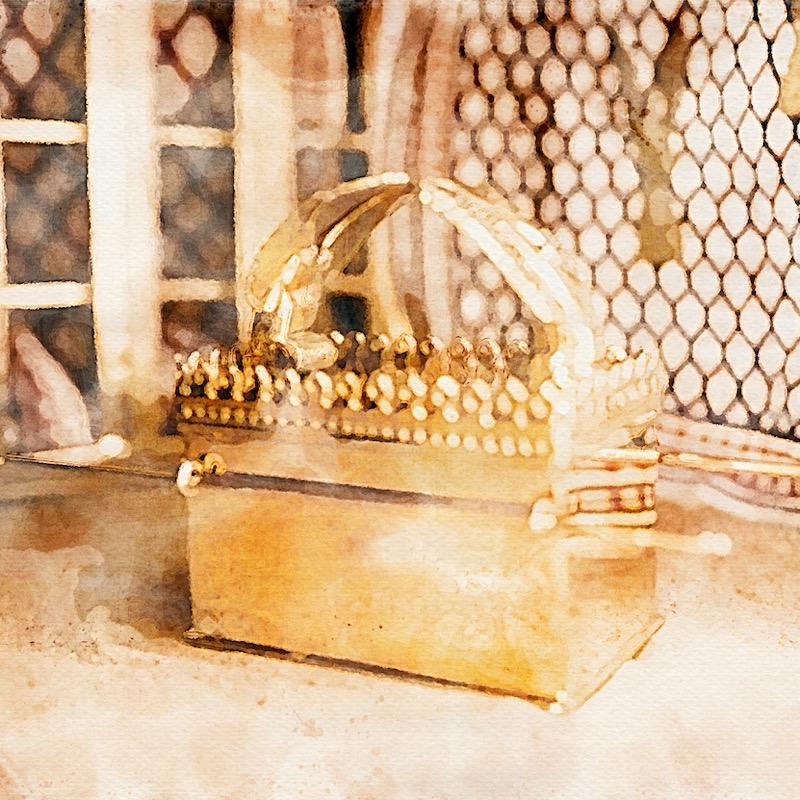
Welcome once more to this eighth in this short series of studies that we have been engaged in on the topic of the tabernacle. Now, so far in our studies, we have used the term tabernacle to refer to the whole of this building and to its content. We have even observed that the first part of the building is sometimes called the First Tabernacle. It was, of course, the holy place. The second part of the building is called in some parts the Second Tabernacle. It was the most holy place. But the term tabernacle is used generally of the building, its coverings, and the, uh, sacred pieces of furniture. While that is so, tonight we have to accustom ourselves to the fact that the term tabernacle is sometimes used in the Old Testament in a much more restricted sense. Not now to apply to the building as a whole, nor indeed to all the coverings that covered the building, but to the innermost set of curtains that form the dwelling place of God. Hence, we have stretched out the model's equivalent of those inner set of curtains. They are made of pure linen, pine twined linen. They are colored with blue, purple, and scarlet, and they have on them representation of cherubim. There are ten of these curtains. They are formed as you see them in front of you. They are running like this and over the edge of this frame, and, uh, they are joined one to another in fives. So there are five curtains here, joined together. Then there is another set of five such curtains, and they are joined together. And then they have an elaborate system to join the two sets together. There are loops of blue on the selvedge of that set. There are fifty loops of blue on the selvedge of this other set. And passing through the two loops from either side are fifty clasps of gold. So were the tabernacles joined together that they might be one tabernacle. So tonight, when we're talking about the tabernacle, we shall be talking about these curtains. We shall presently read of another set of curtains, if you like, that were used to cover the tabernacle curtains. They were made of goat's hair woven. There were eleven of them. Uh, they were similarly joined in two sets, and then the two sets joined together. But I mentioned them to show you the distinct term now used of this first set. This first set comprises the tabernacle. The goat's hair curtains that went over them are called a tent over the tabernacle. And that makes sense, of course, if you observe that the term tabernacle is now being used in that restricted sense, referring not to the whole building, but to this inner set of ten curtains. So let us read some of the technical details about these curtains, and that will prepare us to see their spiritual, uh, meaning. This is the book of Exodus and chapter twenty six. Beginning there, Exodus twenty six and verse one. Moreover, thou shalt make the tabernacle ten curtains. The particular English version I have in front of me says, moreover, thou shalt make the tabernacle with ten curtains, as though the ten curtains were something other than the tabernacle, but that is to misunderstand their se- the sense. Moreover, thou shalt make the tabernacle ten curtains. The ten curtains were the tabernacle. With a cherubim the w- of blue of fine twined linen and blue and purple and scarlet, with cherubim the work of the cunning workman shalt thou make them. The length of each curtain shall be eight and twenty cubits, and the breadth of each curtain four cubits. All the curtains shall have one measure. Five curtains shall be coupled together, one to another, and the other five curtains shall be coupled one to another. And thou shalt make loops of blue upon the edge of the one curtain from the selvedge in the coupling. And likewise, thou shalt make in the edge of the curtain that is outmost in the second coupling. Fifty loops shalt thou make in the one curtain, and fifty loops shalt thou make in the edge of the curtain that is in the second coupling. The loops shall be opposite one to another, and thou shalt make fifty clasps of gold, and couple the curtains one to another with the clasps. And, now let's pay close attention to this phrase that follows, and the tabernacle shall be one. That is, the ten curtains, when thus coupled together, form one tabernacle. And you will find that technical term, the tabernacle, used consistently if you follow down the next instructions. Do you see? And that is for the goat's hair cur- curtains. Verse seven: thou shalt make curtains of goat's hair for a tent over the tabernacle. And if you are interested after this session, come up here and look at the goat's hair curtains that are laid out for you here on the board of the model. Thou shalt make these curtains of goat's hair for a tent over the tabernacle. Eleven curtains shalt thou make them. And then if we look down and to to verse fifteen, and thou shalt make the frames, not boards, the frames for the tabernacle of acacia wood standing up. It is referring to the frames such as you see them in the model, and their purpose was to uphold the ten tabernacle curtains. So now we are used to this, and we shall be using the term in this restricted sense this evening. The tabernacle, uh, the ten innermost curtains of blue, purple, and scarlet, adorned with cherubim. So now the tabernacle, in this sense, was the dwelling place of God. In Hebrew, it is called the Mishkan. That is the word for the tabernacle. And these curtains are called the Mishkan. And so in Exodus forty verse thirty four, when the tabernacle itself was erected, then we're told, Exodus forty verse thirty four: then the cloud covered the tent of meeting. Notice first the term the tent. Secondly, and the glory of the Lord filled the tabernacle. That is the ten innermost curtains. Moses was not able to enter into the tent of meeting because the cloud abode thereon, and the glory of the Lord filled the tabernacle. So far then, the tabernacle, the Mishkan, as a copy of the things in the heavens, as Hebrews chapter eight says. But tonight, of course, we are more interested in the idea given us in scripture that the tabernacle was not only a copy of the things in the heavens, it was a sh- copy and shadow of the good things to come. And in our studies so far, we have seen what those good things are. The good things to come was, of course, in the first place, our blessed Lord himself, from his conception and birth, his incarnation, his life and ministry, his death for our sins according to the scripture on Calvary, his burial, his resurrection, his being with the apostles for forty days, and on the fiftieth day, the day of Pentecost, fifty days after he rose from the dead, his ascension into heaven. So if this principle of interpretation runs true throughout, then in studying tonight the Mishkan, the tabernacle, we shall be studying a foreshadowing of Christ himself. Pray remember, I repeat it, the Mishkan is the dwelling place of God. Let me prove my point, if I must, by reading to you from the gospel by John and chapter one. John's gospel, chapter one and verse fourteen. And the Word became flesh and dwelt among us. Stupendous statement. For John has already told us, in the beginning was the Word. Not in the beginning the Word began. Not in the beginning the Word became anything. He had no beginning. For as the verse goes on to say, the Word was with God, and the Word was God. Pray don't read that phrase as if it was, and the Word was God, as though he ceased to be God later on. Pray read it with the proper emphasis, and the Word was God. All things were made by him, and without him was not anything made that was made. In him was life, and that created life was the light of men. But now John tells us something stupendous, beyond even the fact of creation by the Word of God. He tells us in this verse fourteen that the Word became flesh. God became human, without ceasing to be God, of course. You know, God is so very marvelous and wonderful and big. He's always doing new things. You'll never get bored with God if you live with him for eternity, for he'll always be doing new things. There was a time when he hadn't created the universe, then he did it. There was a time when the second person of the Trinity, as we call him, was not human. But then he became human without ceasing to be God. And the wonderful implication is this: God knows what it is to be human and to feel like humans do. Now I have to draw your attention again to a few technical matters. I almost apologize for it, but there it is, and then afterwards we shall get on to their implications. John is concerned to show us that what the tabernacle was in its day, it was also a foreshadowing of the Lord Jesus. So I must give you a little lesson in Hebrew and then in Greek. It will be quite painless, or if it gives you a headache, a few aspros will cure it. The verb for dwelling in Hebrew, one of the words, is shakan. It has three consonants. Initial shin, pronounced sh, a middle k, and an n at the end. Shakan, yes? And if you take the word to dwell, and you make a noun of it as a dwelling place, you put an M in the front, and you call it Mishkan. Yes? That is the name of the tabernacle that we're studying tonight, which formed God's dwelling place. Now, says John, and the word became flesh and dwelt among us. Here I must teach you a little lesson in Greek. The word John uses is a word derived from the Greek word for a tent. The Greek word for a tent is skene. You'll notice the consonants, won't you? S and a K in the middle and an N at the end. You say, how, how like that Hebrew word? Yeah, indeed, isn't it? Glad you saw that, uh, do you see? The Hebrew word was sharken, S-K-N, do you see? Now John is pleased to use a word that comes from the Greek word for a tent, skene, S-K-N, with suitable vowels in between. And then he says the word, and he uses a verb that means pitched his tent among us. You couldn't miss it if you tried, could you? But don't try, and you'll see. Mm-hmm. John is telling you that what those curtains were in picture in the early days, the dwelling place of God, the Mishkan of the Almighty here on earth. What that was merely as a foreshadowing. One day, the reality to which it pointed came into our world. The word was made fresh and eskeno is the word he used, skenoo, eskenosen, among us. That is why some of the older English translations translate the verse thus. The Word was made flesh and tabernacled among us. Very good translation. It gets the whole point of what John is saying. You know, we read the verse together, that when the Old Testament Mishkan was erected, then the cloud descended, and the glory of the Lord filled the Mishkan. Now listen to John. And the Word became flesh and pitched his tent, or if you like, tabernacled among us, and we beheld his glory. Far exceeding what Moses saw. The person of our Lord become flesh, become human, without ceasing to be God. And all the fullness of the Godhead dwelled bodily in him. We saw it, says John. Can't you, can't you sense his excitement? We beheld his glory, glory of the only begotten with the Father, full of grace and truth. Wonderful dwelling place of God. So that we, uh, have authority for taking these inner set, this inner set of curtains as a foreshadowing of Christ, and using their pattern to provoke our imaginations to understand our Lord even more. So to come back to these ten curtains that form the Mishkan, the tabernacle, pray will you notice that the tabernacle was a plurality in unity. That simply means it wasn't just one curtain. It was a plurality of curtains. There were ten of them. As I said before, they're running this way on, you'll see, and then joined, sewed together, running this way on, and five of them are sewn together in one group. Then another five are similarly sewn together in another group. There's a plurality of curtains. But then the instructions that we read tell us how that plurality was made into a unity. You shall have fifty loops of blue on one selvedge and fifty loops of blue on another selvedge, and you shall make fifty clasps of, uh, gold, put them through the loops, that the tabernacle may be one. So it was a unity. And you rightly ask the question, of course, what's that got to do with our Lord? When he was here on earth, he was just one, wasn't he? Ah, yes. But now I must take you beyond his life on earth to what happened on the day of Pentecost. The day of Pentecost, as you may remember, was, uh, happened each year in the Jewish calendar on the fiftieth day after the first fruits. And when our Lord rose from the dead, he visited his apostles from time to time for forty days. And he said to them, just before he left, now I want you to stay in Jerusalem until you are baptized in the Holy Spirit, as John the Baptist announced. You will remember that when John the Baptist announced our Lord, John the Baptist pointed to the distinctive things about our Lord. This is the one, he says, who will baptize in the Holy Spirit and in power. I am merely his forerunner. I'm not worthy to handle his sandals. I baptize you in water. He shall baptize you in the Holy Spirit. And we could pause there, couldn't we? To notice the similarity and the contrast. If you came to John the Baptist to be baptized upon the confession of your sins, John the Baptist took you, and he put you in the water. And then you had to come up out of the water. John baptized people in water. The Messiah, the Son of God, he shall baptize, said John, not in water, he shall baptize you in the Holy Spirit. And we perceive at once that, um, it's not the Holy Spirit that does the baptizing. It is the Lord Jesus that does that baptizing. And he takes those who trust him and receive him as savior, and he baptizes them, that is, he puts them into the Holy Spirit. So our Lord Jesus told his apostles during those forty days he was with them after his resurrection. He told them to wait in Jerusalem until they would be baptized in the Holy Spirit. So after forty days, he ascended into heaven. They waited another ten days, and when the day of Pentecost, the whole fifty days after first fruits, had arrived, Christ poured out his Holy Spirit on his people. They were baptized by the risen Lord in the Holy Spirit. You say, when did that happen? Well, it happened fifty days after the Feast of Firstfruits. You say, oh, how odd. When you were talking about those curtains, how did you say they were joined together? Well, I couldn't help it because I had to read the text. There were fifty loops of blue on the one selvedge, and there were fifty loops of blue on the other selvedge, and there were fifty clasps of gold to join them together, you see, that they might be one. But don't take too much of that because people will tell you you're fanciful if you do that. I have to be true to the fact, you see. Not only did our Lord baptize his people on the day of Pentecost, he's proceeded to do it ever since his, uh, people have come to him in faith and repentance, and he imparts to them the Holy Spirit and puts them into the Holy Spirit. But now we're to read another passage that brings out the implications of this for the person of Christ himself. And this is one Corinthians in chapter twelve. One Corinthians chapter twelve, and we shall take up the reading at verse twelve. And here Paul first uses an analogy of a human body. For he says, as the body that is an ordinary human body is one and has many members, and all the members of the body, being many, are one body. A physical body, a human body, has m- has one body, it has many members. In spite of the fact it has many members, it is still only one body. We know that to be a fact, don't we? We happen to inhabit a human body. Now notice the next phrase. So also is the Christ. For when our Lord baptized his people in the Holy Spirit, he gave them his very life, and they become one body in the Lord. Don't ask me to explain it any further. This is a vast mystery, but is a glorious reality. One body with Christ. So we read on. How do we come one body? How does Christ become this body? For in one spirit we were all baptized into one body, whether Jews or Greeks, whether bond or free, and were all made to drink of one spirit. Here Paul describes the process by which we become body of Christ. It's a double process, as you see. If we were, for in one spirit, we were all baptized into one body, and were all made to drink of one spirit. Let's take a simple illustration. If I have a glass of water in front of me, and I dip my finger in water, my finger goes into the water, yes? Ah. And when Christ baptizes his people in the Holy Spirit, he puts them into the Holy Spirit. Just like John, when he baptized people, took hold of them and put them in the water. That's the first bit of the process. He puts his people in the Holy Spirit. But then the second pro- part of the process is, as verse, uh, uh, thirteen says, and we were all made to drink of one spirit. So that if I took that glass of water, and instead of putting my hand in the water, I raised it to my lips and drank the water, now the water would go into me, yes? My finger went into the water, it was baptized in the water, but now I drink it, and the water goes into me. Simple, but very important, isn't it? There is one, uh, uh, uh, uh, uh, sphere where it is absolutely vital. Look, if you can, ju- just for a brief second, and then I'll release you. Look at this human body standing in front of you. I know it's a trial, but still, uh, look at this. And it's got many members. And what keeps these members all in one body? You say, well, anybody knows that, it's all the bones and the ligaments and muscles and things. No, it isn't. Because if you strangled me and laid me out on the floor and came back in fifty years, you would find, in spite of all the muscles, lots of my bones had come apart. What keeps me all together? Well, the fact is, I am in the air, and the air is in me, and I need both, of course. You can't have one without the other. There's no good if you do. I have to be in the air, and the air in me, do you see? Suppose you come to me and throttle me for some reason or other. Then I'm still in the air, but the air isn't any longer in me. Alas. I die, of course. Not enough for me to be in the air. I must also have the air in me. Yes? If, of course, you take me to Ca- Cape Canaveral and you say, Gooding, we're going to give you a free ride, my man. You're interested in astronomy? Yes, I am. Well, we're going to give you a free ride. We're going to tie you on the outside of this rocket, you see, and we're going to send you up into space, and you'll get a marvelous view of the galaxies. So they say, take a deep breath. So I take a deep breath, and they shoot me up in. So I've taken a deep breath, and the air is in me for the time being. The trouble is, I'm not in the air. That's no good either. To have the air in me and, and I not being in the air has no use whatever. For human life, of a human body. The body needs both to be in the air and the air to be in the body. The same thing is true of the body of Christ. Christ, to form us as members of his body, puts us into the Holy Spirit. Not content with that, he puts the Holy Spirit into us. It's no use having one without the other. For that is what life is, in the body of Christ. It goes beyond our comprehension very quickly, doesn't it? But it is a reality. And we have to think now of the significance of the body of Christ as is given us in various parts of scripture. Here in one Corinthians twelve and then again in fourteen, we are, uh, have pointed out to us that we are all as believers in the body of Christ, but we don't have all the same gifts. The gifts vary, and they vary because they reflect the three persons of the Holy Trinity. Do you see, um, verse five says, says of chapter twelve, there are diversities of ministries. Oh, sorry, verse four, there are diversities of gifts, but the same Spirit. There are diversities of ministries and the same Lord. And there are diversities of workings, but the same God who worketh all things in all. And our variety of gifts reflects the three persons, as you see in this verse, of the Holy Trinity. A variety of gifts, but one body. It's a comforting thought to the likes of me, Josie, because it works twofold. If, says Paul, a foot you s- would get it into its head, because I'm not a hand or an eye, it wasn't of the body. Well, then the foot would be talking nonsense, wouldn't it? It wouldn't be a foot if it weren't in the bodies to start with. Huh? When God was making the body of Christ, he didn't say, now where shall I find a few feet? Go to a shop for secondhand feet or something. No, nonsense. He put us in the body. And being in the body, we eventually find what gift we have. It might be a foot, or it might be an eye or brain or something. Do you see? If a foot shall say, because I'm not the hand or the eye, I'm not of the body, it's talking sheer nonsense. It couldn't say anything if it weren't in the body to start with. Hm. You say, well, then what decided what gift I have? Well, the Bible says, and God hath placed each member in the body even as it pleased him. And that's been a great comfort to me over years. You'll see, I've often regretted that I wasn't an evangelist, a big evangelist like Billy Graham or somebody. Would have been marvelous, wouldn't it? But no, I'm not that, you'll see. Felt disappointed until I read this. God have placed the members in the body even as it pleased him. Do you know what? Dear old Billy Graham, all he can do, tremendous evangelist as he is, is to please God. Yes? God has put him in the body even as it pleased him. Hurrah for me! I can please God! For God has put me in the body, even as it has pleased him. And to please God, what is more, all you who have big gifts, don't you despise me, who have a small gift. Because you see, the big gifts cannot say to the lesser gifts, I've no need of you. We could get on without you. You couldn't. For all the members of the body are necessary, and all are given their gifts that they might please God. But sometimes we might be inclined to regard the metaphor of the body of Christ as being simply good advice for the way we Christians should get on with each other in the church. A- a- and that is very good advice indeed. But it's more than that, isn't it? Do you see those cherubim? Mighty powers created by God. Colossians one tells me that my blessed Lord, who died for me and rose again, has gone into heaven and has put me in his body. He made them. He made not only our universe, but the principalities, powers, mights, and dominions. Those colossal powers. He made them. What is more, Ephesians and Colossians tell us that upon his resurrection, he was, uh, raised into heaven and sat down above all principalities, powers, mights, and dominions. He's above them. Now let's listen to Ephesians once more. You too has he made alive and raised us with Christ and seated with him in heavenly places, far above all principalities, mights, powers, and dominions. Being part of the body of Christ is not merely a temporary arrangement for running of the church here on earth. It is an eternal thing. We shall eternally be part of the body of Christ. You see, Hebrews chapter two tells us that not unto angels has God subjected the world to come, of which Hebrews speaks. Why does it say that? Because in a very real sense, this present age, the world as now is, is under administrative powers by some of these created beings. But not the age to come. Not only to the angels has he projected the age to come of which we speak, but one in a certain place testified, saying, what is man? You made him a little lower than the angels for the suffering of death, and now he's crowned with glory and honor, raised above principalities and powers. And you are his body, the fullness of him who fill us all in all. To be the body of Christ will mean then what it means now. We are Christ's executives. The ones he uses to do the tasks he has assigned for us. And oh, what a wonder it is. The eternity that lies before us. You say, according to the Bible, this universe is going to come to an end. Yes, so it is. You say, well, what should we be doing then? Well, I can assure you once more that God isn't hard up for ideas. And the last vision of the holy city given us in the book of the Revelation at the end of the New Testament is of the eternal city, the New Jerusalem. Now mark its motion, says John, I saw it coming down out of heaven towards earth. Now, if I'd have written it, I'd have said, I saw the Jerusalem, New Jerusalem, and it was getting, you know, fast, moving away from earth and saying good riddance to bad rubbish, um, and walk going into heaven. No, it's the other way around. For the Holy Spirit coming, uh, the Holy City coming down. God will always have some material expression of his character and his ways and his purposes. All the wonder of it, when part of his redeemed creatures, part of his very body. We are assigned to our present, our eventual tasks in that glorious eternity. Even now, says Ephesians, chapter one, verse twenty and twenty onwards. That Christ, God has raised Christ, you see. He's at the right hand in the heavenly places, far above all rule and authority and power and dominion, and every name that is named, not only in this world, but also in that which is to come. And he put all things in subjection under his feet, and gave him to be head over all things to the church, which is his body, the fullness of him that filleth all in all. And in chapter three verse ten, we're told in uh that verse, three verse ten, to the intent that now unto the principalities and powers in the heavenly places might be made known through the church, the manifold wisdom of God, according to the eternal purpose which he purposed in Christ Jesus, our Lord. Amazing fact. Even now. As members of the body of Christ, as the church of Christ, God is teaching the principalities and powers a very deliberate message. Do you see? That they might be, that they, uh, through the church, they might be made known to them the manifold wisdom of God. The angels are looking on, you know, and mightier powers than we can imagine, are scratching their heads. How did God get them? By what power has he transformed them? And made them part of the body, one of his dear son. And placed them above us. How has God done it? With what wisdom has he ordered their ways, saved them, made them loyal to Christ, and eager and anxious to serve Christ and serve God? Even now, God is teaching them a lesson. And to that, chapter two verse seven adds, well, let us read the verse six as well. Raised us up with him and made us to sit with him in the heavenly places in Christ Jesus, that in the ages to come he might show the exceeding riches of his grace in kindness towards us in Christ Jesus. In the ages to come. An everlasting lesson. You, my dear sister, and you, my brother. And at last, we are conformed completely to the image of Christ. And serve him as his executives. We shall be an eternal lesson to the principalities and powers. So as the body, the human body has many members, but is one body, so is the body of Christ. And I remind you of the directions to Moses about these fifty loops, fifty loops and fifty casts of gold, that the ten curtains might be one, that the tabernacle might be one. The oneness of the body of Christ. For this our Lord prayed. According to John's gospel in chapter seventeen, he lifted up his eyes to heaven and prayed to his father to keep his people while I was with them, I kept them in thy name, and I have lost none of them, except the son of perdition. Now, Father, please, you keep them. Do you suppose that God will be less skillful and able to keep us than Christ was? Well, of course not. I pray for them that they all may be one. That prayer has not gone unanswered. On the day of Pentecost, the blessed Lord Jesus poured out his spirit and has baptized his people into one body. And all believers, of whatever stripe or color, all true believers are in fact members of that body. They shall reign with Christ. You say, but Mr. Preacher, you're being a little unrealistic now. Your enthusiasm has run away with you, talking of the oneness of the body of all believers. Have you forgotten that the church is sore distressed by heresies, distressed and divisions and quarrelings? Enough to break the heart of Christ, I should have thought. Yes, I'm all too painfully aware of it. Are all these plans that we've been thinking about moonshine? Or has God made provision Provision. to To maintain maintain the unity that he is in fact created for all who have trusted Christ, have been baptized in his spirit and made to drink of one spirit, and therefore are of one body. But then what provision has God made, or Christ made, for the maintenance of that body, for the keeping of the one faith, and for growing up into Christ, who is the head. That is a big question, and realism demands that we face it. God willing, if he brings us to tomorrow's lecture, we consider what God provided, that not only this tabernacle be one, but his provision of those, uh, uh, uh, so-called boards, but they are supports, ladder-like cons- constructs, to hold up the tabernacle. Thou shalt make these frames for the tabernacle. For when the tabernacle was put over those frames, the edges of the, of the tabernacle didn't reach the ground, you know. They couldn't stand by themselves, no. Didn't just float in the air. God told Moses to make these frames for the tabernacle, to give practical expression to the unity that the tabernacle curtains symbolized. And And then then... there would be all sorts of hostile elements as they passed through the desert, raining down on them. They were given a further set of curtains, this time made of goat's hair, to be a tent on the tabernacle and to protect it from what otherwise would have been destruction by the forces of nature. That, to that practical question, God willing, we shall come in our next lecture. But let it not detract from what God has been telling us again tonight. Every true believer in the Lord Jesus, placed in the Holy Spirit by Christ, baptized into the Spirit by Christ, and made to drink of the Spirit, and thereby made a member of the body of Christ and an inheritor of the kingdom of heaven. Shall we pray? Our Father, we bring now our study of thy word to thee, who has given us this and inspired thy servants to write it. We thank thee, Lord, that that we know that thou hast given it to us. These are things that by thy grace we can come to understand. Partially now, more fully when we get home to heaven. Thou knowest, Lord, how these concepts are so great and vast. They tend to go beyond what we can imagine or even think. But we thank thee for thy Holy Spirit and for thy divine genius in making thy truth real in the hearts of thy people. So bless thy word that we have studied this day, and may it result in our hearts being warmed and our hearts praising thee and entering more fully into thy plans and purposes. Make us more effective now, we pray, as the body of Christ, as his executives here on earth, that by our training in this life, we may prepare to s- uh be- to serve him even better in the life to come. So we thank thee and pray thy parting blessing through Jesus Christ, our Lord. Amen. Amen.