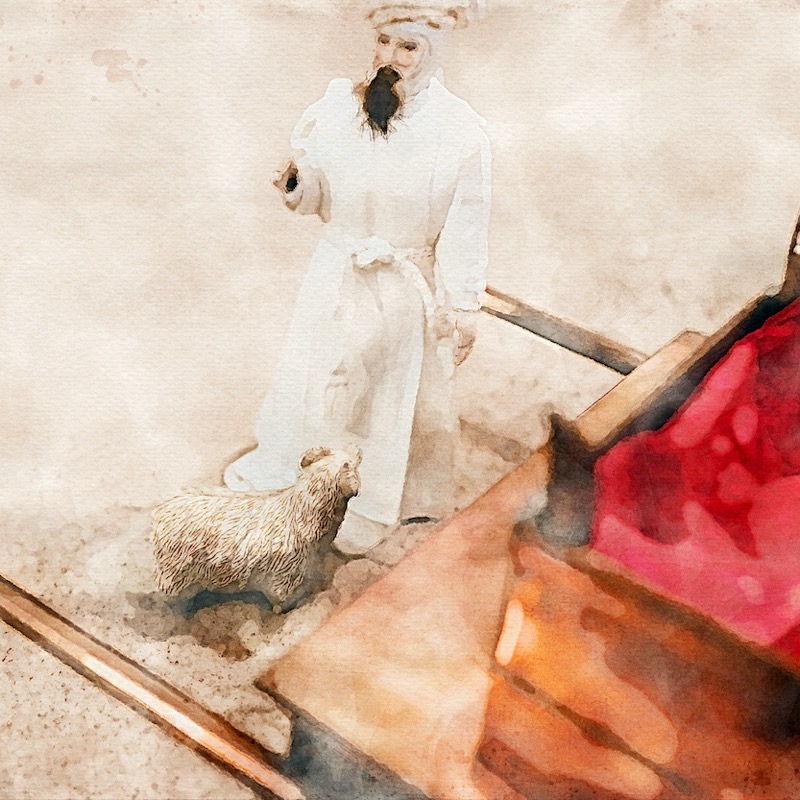
Gooding, David: 8 - The Ark and the Mercy Seat
ID mfh_1087390711Date unavailableBefore 1.87Restored 4.39
We read from the Epistle to the Hebrews, beginning in chapter eight and verse one. Now, in the things which we are saying, the chief point is this. We have such a high priest who sat down on the right hand of the throne of the majesty in the heavens, the minister of the sanctuary and of the true tabernacle which the Lord pitched, not man. For every high priest is appointed to offer both gifts and sacrifices. Wherefore it is necessary that this high priest also have somewhat to offer. Now, if he were on earth, he would not be a priest at all, seeing there are those who offer the gifts according to the law, who serve that which is a copy and shadow of the heavenly things. Even as Moses is warned of God when he is about to make the tabernacle, for see, said he, that thou make all things according to the pattern which was showed thee in the mount. But now hath he obtained a ministry the more excellent, by how much also he is the mediator of a better covenant, which hath been enacted upon better promises. For if that first covenant had been faultless, then would no place have been sought for a second. For finding fault with them, he saith, Behold, the day is come, saith the Lord, that I will make a new covenant with the house of Israel and with the house of Judah, not according to the covenant that I made with their fathers, the day that I took them by the hand to lead them forth out of the land of Egypt. For they continued not in my covenant, and I regarded them not, saith the Lord. For this is the covenant that I will make with the house of Judah, with the house of Israel, after those days, saith the Lord. I will put my laws into their mind, and on their heart also will I write them. I will be to them a God, and they shall be to me a people. They shall not teach every man his fellow, and every man his brother, saying, know the Lord, for all shall know me, from the least to the greatest of them. For I will be merciful to their iniquities, their sins will I remember no more. In that he set a new covenant, he has made the first old. That which has become, is becoming old and waxeth aged is nigh unto vanishing away. Now, even the first covenant had ordinances of divine service and its sanctuary, a sanctuary of this world. For there was a tabernacle prepared, the first wherein were the candlestick and the table and the showbread, which is called the holy place, and after the second veil, the tabernacle which is called the holy of holies, having a golden censer and the ark of the covenant overlaid round about with gold, wherein was the golden pot holding the manna and Aaron's rod that budded and the tables of the covenant, and above it cherubim of glory overshadowing the mercy seat. Verse 15 of that same chapter. And for this cause, he is the mediator of a new covenant, death having taken place for the redemption of the transgressions that were under the first covenant, they that have been called may receive the promise of the eternal inheritance. Finally, some comments at the end of this section from chapter ten and verse eleven: Every priest indeed standeth day by day ministering and offering oftentimes the same sacrifices which can never take away sin. But he, when he had offered one sacrifice for sins forever, sat down on the right hand of God, from henceforth expecting till his enemies be made the footstool of his feet. For by one offering he has perfected forever them that are sanctified. The Holy Ghost also beareth witness to us, for after he has said, this is the covenant that I will make with them after those days, saith the Lord, I will put my laws on their hearts and upon their minds also will I write them. Then he says, and their sins and their iniquities will I remember no more. Now where remission of these is, there is no more offering for sin. May God himself expound his holy word to us. We have come a very long way in our study of the ancient Jewish tabernacle. At the very beginning, we found that the New Testament claimed that the ancient Jewish tabernacle was a parable deliberately devised of God to foreshadow coming things. It was, of course, as we have found in its actual use in the time of Moses, a tabernacle full of symbols through which the Jews learned much about God. But beyond the symbols which the Jews could understand, there was inherent in all this arrangement a divinely and deliberately designed parable, which was written aforetime to foreshadow the coming and the ministry of our Lord Jesus Christ. Details of that parable, I say, were hidden from the Jews. The general scheme was that only when our Lord should have come and performed his great work of salvation, that then the meaning of the parable should become evident. The idea in that again was that when our Lord should come, men should be able to see that he did not come unannounced. This was not just one more prophet springing up with some novel ideas about God. This was the Christ of God, sent by God, whose coming had been foreknown of God, and for whose coming God had prepared various means of forecast. When at last he came, men might be able to take the forecast and the parable and match it up against the Christ himself, and see here additional evidence that Jesus is the holy sent one of God, the unique Son of God, the like of whom there has never been before and never will be again. Our study of this parable has amply convinced us of the wonder of the accuracy of the detail of the parable, or arrangements that must have been meaningless to the Jews who, who, uh, fulfilled them. These arrangements have spoken volumes to us about our Lord, and bear with them, therefore, the imprimature of divine inspiration, for only the God who foresaw the coming of Christ could have arranged a parable so eloquently to describe him. We have used then this parable. Permit me to go over briefly the journey that we have followed, placing in parable form the journey of a soul from a distant, far off place in towards the home and heart and presence of God. Came by the gate, indicative of him by whom we have access to God, by that altar with its shedding of blood and sacrifices, to remind us of the great sacrifice of Christ, by whose blood we find forgiveness. Past this labor, with its washing by water, emblematic of the regeneration of the Holy Ghost, formed in the heart of all who trust the same. Past this door, emblem again of our Lord who leads on his people into the deeper things of God. Past the incense altar here, standing before the veil, a picture to us of our Lord in his present ministry of intercession. Finally, last week, we considered the veil, you cannot see it now because I've taken it down and it rests here on the floor, but the veil that normally hung there, screening the presence of God away from the Israelites. It was there as a screen because Israel's sacrifices were, after all, merely tokens and not the real thing. It was impossible that the blood of bulls and of goats should take away sin. They were only pictures, not the reality. Until our Lord came, the way into the immediate presence of God remained there. Last week we saw how that through our Lord's sacrifice, the way to God's presence has been opened for all who care to come. We are to pass now tonight into that presence. Parable, we shall be coming into this second division, the holiest of all, the very dwelling place of God. In actual thought, the parable will be directing us into the immediate presence of God, encouraging us to come, encouraging us to find our way, encouraging us to come and get used to the very presence of God. Surely one day, as we shall stand before the great judgment throne of God, so surely this evening, let us give heed to God's word, that we might know how we may be prepared to enter the immediate presence of God. Last week, when we were thinking about that veil that hung there, picture, if you like, of the veil that hides the unseen world from the seen world, we recalled a verse of scripture that says that the Christian's hope of salvation is like to an anchor, and that anchor enters into that within the veil. We pointed out the importance for us who travel through this temporary world, that we should have an anchor in the world beyond. Tonight we may come into that world, into the very presence of God, to observe just exactly what it is into which the anchor rests. After all, if you throw an anchor over the side of a ship, you hope that it will lodge securely, maybe in a rock or in the depths of the ocean bed. But we know all too well that very frequently anchors find nothing suitable upon which to grip. They simply drag under the violence of the storm. It's not enough, therefore, that we think we have some vague hope that one day we may be arrive- we may arrive in the presence of God, and God may accept us. We need to know this night that our anchor enters into something solid that will never drift, neither in the storms of this life nor on the uncharted oceans of eternity. What was it then that in the tabernacle existed in that place beyond the veil? Allow me to pick out for you the piece of furniture, or rather the two pieces of furniture that God directed should be put inside the holiest of all. Inside was, first of all, the ark, a box, an oblong box made of wood and pure gold, with a rim running round the top, carried by two staves of wood overlaid with gold. The second piece of furniture was the mercy seat, so-called in our English translations, meaning really, and in the first place, a covering lid, something that covered that box, and at the same time a word which theologically means a propitiation. It was called that because that lid covered the ark and at the same time had sprinkled on it the blood of the sacrifices that were slain at this. There were then two pieces of furniture. Ours now to follow that parable and try to understand their spiritual significance. In the first place, then let us notice this ark. It formed, together with the mercy seat, the throne of God. Many times over the Old Testament, in picturesque human language, speaks of God who dwelled, who sat between the cherubim upon the ark. This is the ark that is called by the name of the Lord, the God of all the earth, who dwelleth upon the cherubim. It was a token throne of God. There then was the nerve center of Israel's community. Here was the throne of their God. Inside that ark were three things put, the chiefest of which, which we concern ourselves this evening, were the two tables of stone that contained the Ten Commandments of God's law. They were there as a summary of the revealed will of God, of the standards of his throne, of his moral and spiritual requirements upon his people. The Ark, in consequence, is called the Ark of the Testimony, because the law, as summed up in those Ten Commandments and deposited there, was God's testimony to men of what God required from men in the way of their behavior. Remember, our Lord Jesus summed up that law in its two chief important points. On the one hand was our duty to God. We are to love the Lord our God with all our heart, mind, soul, and strength. Second, the greatest, the second greatest commandment, like unto it, thou shalt love thy neighbor as thyself. It was called also the Ark of the Covenant, because not only was that law God's testimony to man as to what God required from him, that law was a covenant, an agreement, if you will, a legal agreement between God and his people, the terms upon which he proposed to govern them, the terms upon which he proposed that they should be his people and he should be their God. The covenant ran in this form, that if they kept all his commandments and studiously avoided all the things that he prohibited, then he should bless them. But if they broke his commandments, if deliberately they indulged in the things which he forbade, then likewise his curse would be upon them. It is called a covenant because God wanted his people to know very clearly and exactly where they stood with him. It was a covenant because it bound God to bless them. It was a covenant because God wanted men and women to have security in their relation with him. In this modern world, we have grown even more to see the value of security. We do our best to ensure ourselves, to assure ourselves. We insure our houses against robbers, against fire. We insure our loved ones. Husband will assure his life in case he predeceases his wife or family, that they might be secure. The businessman ensures his business profits, and scarce there's a thing but what men try to gain security for themselves. In it all, there are some things in which we cannot, uh, arrange security. You may, uh, ensure the life of your son. You cannot ensure that your son will obey you, will please you. You can ensure the links, uh, your your life here against your premature death, that your relatives will get compensation. But there's no form of insurance known to man that will, uh, secure man against eternity. So that the most important things of life are, so to speak, beyond our ability to ensure. Here God in his mercy comes out. That thing which is so basic to human happiness, that a man be right with God and be sure of God and know exactly where he stands with God. This thing God offers to men in offering them a covenant that shall proclaim to them exactly where they stand. But it is a matter of common knowledge that the covenant that was deposited in that ark made between God and Israel proved, in some sense, a failure. There had to be substituted for that old covenant, a new covenant. In fact, a great deal of what we shall have to think about this evening will underline how unsatisfactory that old covenant was. Let us then be very clear upon this. When I say that the Ten Commandments proved unsatisfactory, I'm in no way belittling their holiness, their rightness. We know that the Lord is holy, just, and good. But the scripture itself says that that first covenant was faulty. For if that first covenant had been faultless, then would no place have been sought for a second. But it is common knowledge that Christianity does preach a second covenant, a new covenant. When our Lord instituted his remembrance supper, he took the wine and he gave it to his people, saying, this is the blood of the new covenant. He made a new covenant because that old covenant of the Ten Commandments was faulty. Why was it faulty? But here we must, uh, be very careful. Christianity offers us a new covenant, not as something that's less strict than the old covenant. It isn't that God has found that his demands in his Ten Commandments were a bit too severe, a bit too unrealistic, that men couldn't possibly keep them, they were so high in their demand, and that therefore Christianity makes things a little bit easier and a little bit kinder. It is not that at all. We do well to remember it, as we constantly hear Christian preachers preach that salvation is not by works. It does not mean that God has in his old age grown a bit less strict and a bit more sentimental. The God who issued those Ten Commandments, with all their moral obligations, stands by them still. Still they remain the unchanging expression of his divine holiness. We may remember that our Lord enforced this point when he was here on earth. We're told that our Lord, when he lived amongst men, found certain men who, in their self-delusion, imagined they had kept the Ten Commandments. They thought that they had kept them so well that when at last their time came to die and to enter eternity, God would be more or less obliged to receive them as successful candidates in his moral school. I felt it his first duty towards these men to point out to them how they were deceiving themselves. In reality, they had not kept that law at all. They were falling miserably and wretchedly short of God's requirements, and hence Christ directed towards them those telling shafts of his Sermon on the Mount. Gentlemen, he said, you haven't yet murdered anybody. From time to time, you congratulate yourself that you're no thug, you're no Teddy boy, you're no jailbreaker and murderer. You have kept the commandment, you say to yourself, thou shalt not murder. Gentlemen, he said, keeping that commandment is not merely a matter of not putting a knife into somebody. The commandment is spiritual. You may not have murdered, but if you have hated a man, if you hate your brother, if thou should say to your brother in uncontrolled temper, thou fool, thou shall be guilty of the Gehenna of fire. You haven't committed adultery? Oh, good. But if deliberately you have let your eyes dwell upon a married woman, to lust after her, then in God's sight, you have committed adultery. So that our Lord was concerned to show not that God had become a little bit more kindly or a bit more sentimental, uh, somewhat more lax in his moral requirements. The God who gave that law meant it not only literally and practically, but spiritually as well. And the demands still stand. In fact, there is a sense in which Christianity is even more exacting than that old covenant. The old covenant said, thou shalt not steal. The new covenant says, let him that stole steal no more, but rather let him work with his own hands that he may have to give to other folks. And my good sir, if you have more than you need and you don't give, then God's word says that you are breaking his new commandment. Christianity is not merely negative, but positive. Then why should, uh, that old covenant be changed? The answer is this. God found fault with it, because though in itself it was exceedingly good, holy, right, and just, it was, to quote a biblical phrase, it was weak through the flesh. It came with all its demands of perfection to men and women who were eaten through with spiritual weakness. It came to a man whose heart was basically sinful and lustful and said, thou should not covet my man. When the man tried to obey the commandment, he found his heart was already invalid, broken, weak. The Lord stood beside a man, says the New Testament, and commanded him. But in the second place, it could not give him life. The man was weak through his sin. He didn't love his neighbor as himself. He found surging up through his heart envy and jealousy and spite and feelings of revenge. The law said, uh, you should love your neighbor, but then that's all it said. Didn't offer so much as a little finger's worth of help to the man to help him love his neighbor, nor knew it how to infuse into that man's heart a new way of looking at things and a new power, a new life to perform God's demands. The law was weak then because of man's fa- failure and his stumbling steps. The law was unsatisfactory because it could only tell a man what to do, but give him no power with which to do it. The law was faulty in that in the end, instead of bringing a man into happiness and joyous relations with God, instead of making his life a paradise upon earth, in the end brought that man into spiritual bondage. The law said, thou shalt love thy neighbor as thyself. And when the man couldn't love his neighbor as himself by reason of his sinful heart, then the law stood by with utter unfeeling, pronounced upon that man the curse of God's wrath, brought down upon his head the penalty of death. The man wanted to repent. The man wanted to start again and have another girl, but the law stood by unmoved and unmoving and said, but my good man, there's no use. You're promising to do better next time. What about the past? You've done enough already to deserve God's judgment, and there is no moving on until that judgment be exact. It was like a man gone hopelessly insolvent, wanting to start again in business, but the bankruptcy court refusing to acquit him, and therefore the man is permanently hampered by the chains of past failure. The law was faulty, says God. Then why did God ever give it at all? Holy and just and good as it was, if it was so unsuitable to help men, why give it? The answer that God's word gives is something of this sort. That first covenant, that law was given that man might come to know the true state of his heart, and that he might learn through that more the holiness and righteousness of God. God wanted men in his home. God longed to embrace man to his heart. God longed to give to men and women security in their relation with him. And to that end, God must have men and women come to see exactly the truth of things. There could be no true relation founded on pretense. There could be no permanent security with God if it were founded on make-believe. If man was allowed to think himself better than he was. If man was allowed to continue in the idea that sin didn't matter, that God was sentimental. God insisted that men should come to know him as he was in all his unyielding holiness, that they should know themselves in all the bankruptcy of their sinfulness. It was given in a word, man might grow up in his conscience. Man might see what sin is and learn that sin is exceedingly sinful. The man at length, in all the wretchedness of his sinfulness, might cry to God to be delivered from it. Till a man should know his sinfulness, how should he seek salvation? It was like, to borrow a medical metaphor, it was as though a man or woman had begun to show signs of incipient cancer. A cancer which could only be cured if the person would go at once to the surgeon and submit to drastic surgery. But there's a fear in human heart, and so this person tries to cover it up, to smudge it over with ointments, to go in for healthy exercise, to eat fresh vegetables, to do a thousand and one things in the hope that it isn't cancer after all. But you see, as long as we hide our eyes from the facts, so long we shall stay away from the only treatment that can cure us. It would be a kindness on your part if you found your friend in such a state. I say, sir, it would be a kindness. If you could, however severe you might have to be in the process, if you could shatter that person's illusion and bring them to face the stark facts, uncomfortable and fearful as they might be, you would be pandering to their death. You would be guilty virtually of a murder if you smoothed it all over and said, I don't think it's as bad, you know, as men make out. So God, in his faithfulness with men, gave us that first covenant, that its searching commands might probe the very entrails of our being and expose the cancer of sin, bids fair to bring us to eternal perdition. I might add, it's a very difficult thing to do. It took centuries on God's part to prove to Israel as a nation their sinfulness. You will remember, perhaps, their blithe and merry spirit with which they stood under the Mount Sinai to receive that law. Moses went up the law, we read, up the mountain, we read, and received God's holy law in his hands. It ran to us. Thou shalt have no other gods but me. Thou shalt, uh, love thy neighbor. Thou shalt love the Lord thy God with all thy heart, soul, mind, and strength. Thou shalt not covet. Thou shalt not commit adultery. Thou shalt not murder. And it ran in, uh, the paragraphs where its conditions were laid out more explicitly. It ran in this fashion, that if you continued in all the things that were written in the book of the law, then God would bless you. It ran likewise, that if you broke any of those commandments, God would curse you. Moses came down the mount. See him now. He read it out in the ears of the people. These are the words which God has proposed, says Moses. God proposes that you love him with all your heart, mind, soul, and strength, and if you do, he will bless you. God proposes that you will keep every single one of his commandments, and if you do that, he will bless you. God likewise proposes this if you break one of his commandments, then the law will bring down upon your head its sanctions, and the wages of sin is death. What do you say, said Moses to the people? Are you prepared to come to terms with God on those terms. And the people, with a carefree spirit that we find hard to understand, surely, blithely responded to God, all that the Lord has commanded us we will do. Foolish people. Why, five minutes had scarce passed, but what they had broken the very first of those commandments and brought down upon their conscience the guilt, sanctions of that law. And perhaps we can understand them in that early day when life had not given them much experience. How shall we understand our fellow men? How shall we understand enlightened people imagining still that somehow they are going to keep the Ten Commandments and earn thereby eternal life? How can it be possible? How is it possible that anybody should imagine he's going to keep any set of moral laws, and by his keeping them, earn God's favor and blessing? Certainly, they who so think have but a very small idea of sin. They think, some of them, that perhaps they could keep the commandments. And others of them that, well, if they keep sixty percent, isn't that enough? Why, forty percent is enough to pass a university examination. Oughtn't God to be content with sixty percent in his moral school? Indeed, in the popular imagination, the final judgment is going to be like a grocer's shop. God will set up the scales, and he will put the good works in one side and the bad works in the other, and is hoped that if there be fifty one percent good works so that the fifty one percent goes down, then the candidate will have passed. Inadequate. Childishly inadequate. Morally irresponsible thinking, is it? God who lived in this tabernacle, the high God of heaven, is not to be satisfied with a morality that's fifty one percent. The God of heaven has made known his condition. It runs like this, that if you keep the law all and fail in one. Then are you guilty of all? You've broken the law and brought down its sanctions upon your head. You say it's very hard. Maybe it is, but it is realistic. In fact, there are many other situations in life where the same conditions apply. Here goes a man running away from a tiger. He comes to a great chasm. The chasm is seven foot six up across. In his panic, he decides to jump. He jumps it all, except one inch. He jumps seven foot five instead of seven foot six. And gets half saved? No, indeed not. He falls to the bottom and is shattered on the rocks below. A liner is moored to the quayside by a long chain when a tornado arises, and every single link in the chain holds except one. Out the one going, the whole chain is broken, and the liner is broken from the rock. God's law is like that. You keep it all. You break in it in one point, then says God, you have come short, and coming short is sin, you ruin the thing. The sanctions of his law upon sin are banishment from God's presence. You say, yes, I know that, I know that is so, and I realize by reading God's holy law how sinful I am, but may I not be saved this way? May I not come in true repentance to God and say, God, I'm sorry I'm a sinner. Now please, God, give me your grace to do the best I can with your law. But again, God's answer is no. People who think like that, that their job is, in spite of the fact that they're sinners, to do their best to keep God's law and so merit salvation. People who think like that have a wrong idea of what God's law is. They think God's law is a sort of a citizen's guide from the advice bureau, a little advice on how you should do things. And if you do it to the best of your ability but come short, uh, your advisor says, well, you've done very well, but uh, just here and there, and so you went astray. But my good friend, God's holy law is not a little bit of advice. It's a law. It's a law with sanctions attached. You keep God's law seventy five percent, God's law won't say to you, well done, my good fellow. God's law will curse you to your face. Such is sin. Such is God's holiness. But you say, surely we have to try to keep God's law if we would be saved. Nonsense, my friend. I had the flu recently. In order to persuade myself that it was a right and proper thing to do to keep in bed, I got out my thermometer and took my temperature. So did the medic when he came to see me. He made a great show of this thermometer thing, putting it into my mouth and making me hold it there. There never were such uncomfortable things as thermometers. But you know, when the thermometer had done its task of proving to me I ought to keep in bed, I didn't then chew the thermometer in the hopes that it would make me well. Thermometers aren't for chewing, and they who designed them had no thought ever in their head that a man might get well by chewing a thermometer. It was medicine the man gave me, and God's law is a spiritual thermometer. It's not spiritual medicine. It's given us in the words of Holy Scripture, that every mouth may be stopped, and all the world become guilty before God. So was it given. It was never given that a man may keep it and so gain salvation. In fact, there was only one man who ever did keep that law. They were interested in the details of the parable, who recognized at once who it was. Made was that box of wood, incorruptible wood, and pure gold. Figure, as are so many things here, of our blessed Lord, spotlessly sinless as a man, God of very God, and yet truly human. The one who could honestly say, thy law have I hid in my heart, that I might not sin against thee. So from this ark, from this parable, from this that is a picture of the very presence and throne of God, there comes to us this evening, first of all, a solemn call. I have no desire to whittle down its solemnity. It's a call to repent. A call for us men and women in an age when moral standards are lowered and moral judgments are tampered with. A call to repent. There is no being saved without repentance. There is no being healed, save as we discover our disease. It's a call to repent over individual sins. My good man, that sin you do and love is driving you daily further from the presence of God. See to it that its chain is broken somehow, or it will chain you outside the brightness of God's home, in chains of darkness, in eternal frustration and misery. It's a call to repent at even a deeper level, not merely to agree with God that murder is wrong and adultery is nasty. It's a call to face ourselves as we really are. To measure ourselves against God's law and to see that we come short. To realize that in ourselves we have no hope of ever doing anything but come short. To hear the sentence of God's law pronounced against us, that we are miserable sinners. And to own that the judgment of God is just. My friend, let me be bold and forthright. Let me, by God's grace, put the spiritual thermometer into you. If you were left to yourself, and suppose you had done the very best you could, my friend, would you have any hope on that ground of gaining God's heaven? You say, I think I would have a little. I've not been so bad as some. I've honestly tried my best to please God. Oh, my friend, you're ill. You're ill, you don't know how ill. You're so ill that sin has damped your conscience. So ill that you can't see you're ill. The man that has any hope in himself, why, that is the deadliest symptom of all. Say, won't you look at yourself again? God says that you've come short of his law, and your only expectation as of yourself is eternal. Would you agree with God? You must come here if ever you would be saved. To own that if you had your desserts, you would be banished from God eternally. I'm not saying, my friend, that you don't have some good points about you. But you see, a glass made up of pure water and one drop of poison, it ruins. And in the absolute, we've been poisoned with more than one drop, my friend. And the sentence of God's wrath and displeasure hangs over. Would you agree? Oh, come, think it seriously. For we're dealing with your attitude and response to God. This is what God says. Protest if you will. But if you go on protesting, the gap between you and God will enlarge immeasurably. When John Baptist preached, he called upon men to repent. The proud religious Pharisees wrapped their garments around them, and they would not justify God, would not admit they needed to repent. If ever you become a Christian, the first thing Christ will ask you to do is to be baptized in water, to be buried in it. What for? Publicly to profess what you have acknowledged in your heart, that your sins deserve death. You deserve banishment from God forever. Such is the stern note of our message. I thank God there is a happier one. For all who thus will, in realism, face themselves and face God and repent and own their hopeless bankruptcy, God has a wonderful salvation. See it prefigured in this ark and its mercy seat. For it wasn't merely ark and law, it was ark and mercy seat. The mercy seat was a slab of solid gold, no wood there, solid gold. Out of its ends were beaten cherubim, symbols of the executive powers of God, the executive powers of his law. On that one day in the year when Israel's priest, in his garments of contrition, was allowed to enter to the throne of God. Immediately he entered, that priest sprinkled the blood of sacrifice upon that mercy seat and before that mercy seat. The symbolism was this, that God's law was being covered, that the sanctions that it demanded upon the sinner had been in token executed upon his substitute, and blood had been shed and death accomplished, and the death the sinner deserved to die had been died. The blood was brought, sprinkled on that mercy seat, so that the executives of God's law could gaze down thereupon and be satisfied that the right dignity of God's law had been upheld. It's a parable. The New Testament says so explicitly. For the word that is used in the Greek translation of the Old Testament for this mercy seat, ilisterion, is the very word that is used of our Lord. The New Testament says that God sets forth Jesus Christ as a mercy seat through faith in his blood. The language is simple. Though we have sinned, there is a place where God will meet with us. It is not on the ground of our merit, it is on this ground, that whereas our sin deserved eternal death, another has died for us. Another has shed his blood. The wrath of God's law against sin has fallen upon Christ. God will meet us over the blood of his son. See how wealthy is the figure? That mercy seat was the exact dimensions of the law, the ark, it covered that law completely. To provide a meeting place twixt man and God. Figure of our Lord, think only of its glory and expense. There was none other good enough, as your own Irish poetess has it. There was none other good enough to pay the price of sin. He only could unlock the gate of heaven and let us in. See those cherubim, symbols of the executive powers of God's throne, and hear our Lord himself say, all judgment is delivered to me. That blessed man, Jesus of Nazareth, has in his hands the executive powers of God. He it is that one day shall judge. Ah, but see a wonderful thing. As I approach the very throne of God in my need as a sinner, I find that the judge himself, who issued the law, the judge himself, I find, loved me. And whereas he himself had pronounced the sentence upon sin, I see that he has risen from the bench of God's judgment. I see him lay aside his legal robes. I see him stripped, and for my sake bearing the lash of men's opposition, and finally dying upon the cross, crushed beneath the load of God's wrath. Because he loved me. Rather than I should perish, he gave himself up for me. It is not that there is a hard, cruel God and a kindly Jesus. It is that Jesus Christ is God. That Jesus Christ, being God, is the author of that law. That Jesus Christ, being God, hates sin with all the hatred of his heart. He himself it was that pronounced the law and devised its sentence. But it is that Jesus Christ, being God, loves a sinner as God only can love him, though he hates his sin. The very judge himself has come off the bench and off the throne, and has ascended the cross to pay the penalty that he himself laid down upon the guilty. Now there is a way back to God. There's a place where God will meet you, my friend. If only you'll come this night in your bankruptcy, you will find that God has a welcome for you. Because Christ has died, you may be forgiven. You'll come and meet God on those terms. There are no other terms. There was a rim put on that ark. Its purpose was to keep that mercy seat in place, lest it fell off. It would have been a highly dangerous thing for that mercy seat to fall off. There was a time once when that ark was captured by Israel's enemies, and when it was brought home, the men of a place called Beth Shemesh, they took the mercy seat off and looked into the ark. They stood there with God's holy law uncovered. They removed that blood-stained mercy seat and stood by that law, unprotected. The Old Testament says God slew them in their thousands. Oh, my friend, there's a place where we may meet God and be forgiven. There is only one place. It is that blood-stained mercy seat. It is Christ who died for our sins. Take that mercy seat away. Come on any other grounds. And you invite eternal tragedy. Oh, let me speak as compelling as I may. Maybe I speak to some religious heart here this evening, and for many years you have been saying to God, God, incline my heart to keep your law. You've been expecting God to improve you little by little, to give you strength to keep his law, so that at last you may qualify for heaven. My friend, would you stop? Would you stop a practice that is a positive insult to God? The Bible says that if righteousness could come by the law, then Christ has died all for nothing. It is because you cannot keep that law that Christ died. A cover, an atonement, a forgiveness has been provided. Come, my friend, but come solely through him whose blood was shed for sin. I speak to somebody who may be hitherto as careless. You say in your heart, yes, sir, but you care for religion. I don't care for religion. As though this matter were a thing like that you care, you care for fishing, and I don't care for fishing. I care for walking. But my friend, we deal not with, um, with options. This is the throne of God. His invitation to come is a command. But see how wealthy the provision. Measure it there in gold. Ah, but with Christ the mercy seat. Measure it in terms of his dignity as God, of the value of his blood, of the immeasurable cost of his suffering. My friend, you may come, and God will give you salvation. But suppose you stay away. Suppose you take that lovely mercy seat and throw it on one side. My friend, you are throwing away ultimate value. You are throwing away the only thing that will give sense and s- and salvation for all eternity. You are throwing away God. You are throwing away the very love of God. You are throwing away the only thing that will brighten earth and fill sunshine, fill heaven with sunshine. Oh, my friend, the Bible puts it thus. Of how much sorer punishment shall he be thought worthy who has trampled underfoot the Son of God. Then this night let us come. Or if we come to Christ, our mercy seat, there will be no mention of wrath. Nay, rather God's Holy Spirit will speak thus, their sins and iniquities I will remember no more. And again he will say, not only is there forgiveness, but God by his Holy Spirit shall begin to write God's laws on our hearts. Now it shall not be merely advice, but the living personality of the Holy Spirit beginning to write upon our minds and hearts, to inscribe upon our personalities a love for God, God's values, God's way of behaving. The process will be long. We shall not be perfect overnight. That so be it, there is an honest heart that clings to the Savior, then while as his Holy Spirit is writing God's laws on our hearts, and we oftentimes stumble and fail to keep them. Yet, says the Holy Spirit, because you have put your faith in Christ, Christ's death covers the expenses of your mistakes, your sins and iniquities, I will remember no more. See then God's program, a new covenant. He offers you security. If you come through Christ, he will forgive you. He will never cast you out. He offers you ultimate and permanent security. He offers more, saving you freely without your works. He does not propose to let you go on and live as sin doesn't matter. He proposes by his spirit to make you holy. My friend, let me tell you, if you profess to be a Christian and you're still constantly diddling in business. My friend, if you profess to be a Christian and you're constantly blaspheming, my friend, if you profess to be a Christian and you are still hating your brother, let me tell you in God's name, you are no Christian at all. You're no part or not in the matter, for he that constantly sins is of the devil. Christ's salvation is real. If this night you trust him, there is not only forgiveness, but God's Holy Spirit will begin to work a life of holiness in your heart. But he'll do it, and he'll do it free. While you are learning, while you are still making many mistakes, Christ's sacrifice shall guarantee you acceptance with God, security now, security forever, salvation, the home, the heart, the love of God forever.