Gooding, David: 3 - Skins and Coverings
ID mfh_1087390768Date unavailableBefore 1.99Restored 4.69
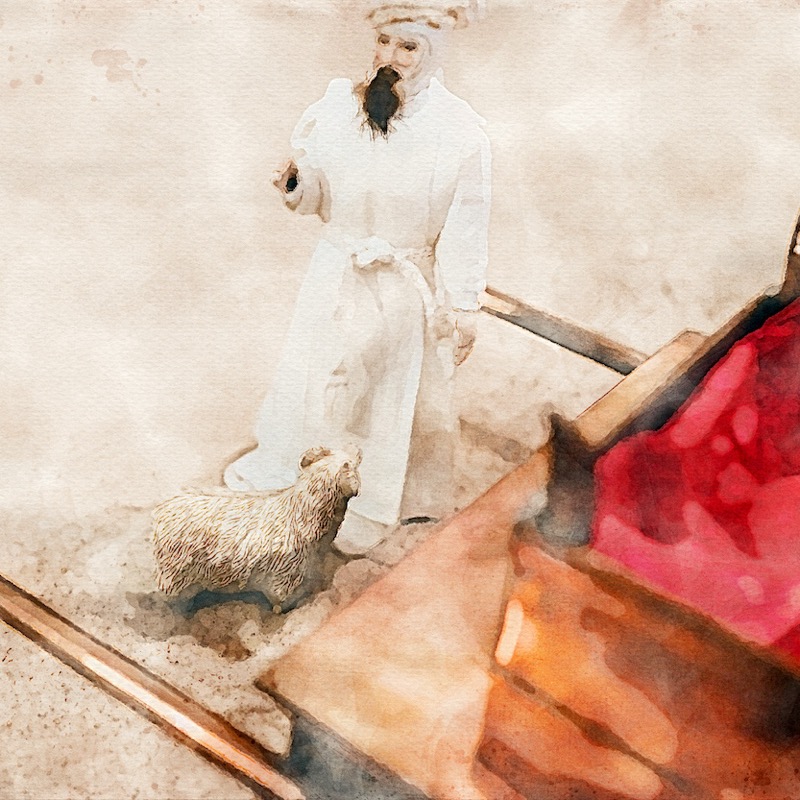
We read this evening from the book of Exodus and chapter twenty six, beginning at verse one. Moreover, thou shalt make the tabernacle with ten curtains. If I might just trouble you with this evening with a few technical terms that will ease our understanding later on. When the scripture here says, thou shalt make the tabernacle, it is using its technical terms very strictly, and is not referring to the whole array of things, court, altar, laver, and all the other furniture that you can see, nor even of the framework that makes the, uh, basic, uh, uh, support for the tabernacle. When it says, thou shalt make the tabernacle of ten curtains, it is thinking specifically of the ten beautiful linen curtains that, uh, are here inside, which, technically speaking, are the tabernacle. Thou shalt make the tabernacle with ten curtains. We shall find that, uh, little observation of some help when now we come down to verse, um, let me see, and, uh, verse seven where we read, and thou shalt make curtains of goat's hair for a tent over the tabernacle. It is of those goat's hair curtains that we shall be thinking at great length this evening, so let's get the technical terms right. When it says now thou shalt make curtains of goat's hair for a tent over the tabernacle, here are, uh, are in in the model, so to speak, here are our goat's hair curtains. They form a tent over the ten curtains of the tabernacle and form, as we shall later see, a protective covering on all sides round. Verse seven then, and thou shalt make curtains of goat's hair for a tent over the tabernacle. eleven curtains shalt thou make them. The length of each curtain shall be thirty cubits, and the breadth of each curtain four cubits. The eleven curtains shall have one measure. And thou shalt couple five curtains by themselves and six curtains by themselves, and thou shalt double over the sixth curtain in the forefront of the tent. And thou shalt make fifty loops on the edge of the one curtain that is outmost in the coupling, and fifty loops upon the edge of the curtain which is outmost in the second coupling. Thou shalt make fifty clasps of copper, and put the clasps into the loops, and couple the tent together, that it may be one. And the overhanging part that remaineth of the curtains of the tent, the half curtain that remaineth, shall hang over the back of the tabernacle, and the cubit on the one side and the cubit on the other side of that which remaineth in the length of the curtains of the tent shall hang over the sides of the tabernacle on this side and on that side to cover it. Thou shalt make a covering for the tent of ram skins dyed red, and a covering of seal skins above. And may the Lord himself interpret his word to us. We take quite a big step forward this evening in our study of the tabernacle, leaving now the court and the arrangements herein, though we shall on Sunday, God willing, have to come back to consider this second piece of furniture that stands in the court. But this evening we are not pursuing our theme of a way into the presence of God. We are considering the tabernacle this evening as a picture of God's dwelling place, a spiritual house. And we come to consider these skins, these coverings and curtains that forms, uh, God his dwelling place, and I want this evening to begin by taking them as a parable of our Lord himself. Now, as you come from the outside to look at the tabernacle, you would be first, uh, uh, you would first notice, in fact, all you would see would be this outer skin of, uh, seal skin. And as you can see, though mine isn't seal skin, seal skin will probably be a bluish gray, um, the outer covering, naturally enough, was, uh, quite dull, monotonous, compared with the gloriously rich tabernacle itself, those ten lovely linen curtains with all their beautiful colorings and embroideries. I say the outside impression would be, naturally enough, fairly dull. It is only as we penetrate deeper and deeper and come to the inner curtains, and at last to the ten tabernacle curtains themselves, that we see something of the glory of the tabernacle, which thing itself surely is apparent. If we are content to stay and observe our Lord from a distance, from the outside, like as not, we shall find him pretty dull and uninviting. It was written of him, he is despised and rejected of men. Men saw no beauty in him that they they should desire him. And as then, so now, they who stand a long way off and are content merely to observe him from the outside, very often fail to find much attraction therein. They who go deeper and look longer are rewarded. So tonight we shall be able to apply a, a little practical test by which to gauge our spiritual experience and progress. As we use this parable as a picture of our Lord, we shall be able to test ourselves as to how much we do in fact see in our Lord Jesus Christ. How deep will our knowledge go? How far shall we be able to keep pace with the messages, the parables that are inherent in these two sets of skins and then the two sets of curtains underneath? Now, first of all, the two skin coverings, the seal skins and the ram skins dyed red. They were, uh, obviously enough, devices to protect the tabernacle and the furniture within the tabernacle. Uh, seal skin and ram skin to protect the inside from the inclement weather outside, to keep, if you like, the outside elements out, lest the inclement weather, the sand, the dust, the dirt, the filth should penetrate to the lovely curtains inside here and spoil them and wreck the delicate and meaningful furniture inside. So also with the sealskin, of course, whose first responsibility it was to keep the outside elements out. How shall we interpret the parable? Well, sealskin, uh, was, as you can see, an animal whose natural habitat is is in the water most of the time, uh, right out of its context, so to speak, right out of its natural element here in the middle of a desert. And clue number two will be the fact that, uh, seal skin, being, uh, waterproof and tough, was in the ancient world used for very elegant and expensive, I might add, uh, very elegant and expensive shoes. It is a picture of our Lord, doubtless. And of him, it can be truthfully said, that he was completely impervious to all the destructive and the defiling elements of this ungodly world. He walked through this world, he was in it, but as he constantly himself declared, he was not of it. He was out of his element, so to speak. He was in the world, but not of it. And as he walked through, he was indeed a pilgrim and a stranger. His feet were, so to speak, forever on the move. We read, for instance, in John chapter eight that after the great celebration of the Feast of Tabernacles, when Israel for seven holi- holy days had been living in booths and tents out in the city to remind themselves that their forefathers had once lived in tents along with this tabernacle in the wilderness, we read that at the end of the feast, every man went to his own home. But Jesus went to the Mount of Olives. No home to go to, in fact. But, uh, a stranger and a pilgrim, as always. A man who gave the very definite impression that he was here, uh, in the world, not of it. Here not to stay, but passing through a pilgrim. We ought to pause and think of the significance of that about our Lord. He certainly was no killjoy. He certainly lived no unnatural life. He ate and he drank. He went to be the guest of fact of the publicans and sinners. What was it, and what does it mean then, when Holy Scripture says repeatedly that he was not of this world? He didn't despise his beauty. He marks the lovely colors of the lily. Indeed, his own mind had invented them. He looked at the birds. He watched the children playing in the marketplace. He wasn't a man going through this world with blinkers on, thinking the world itself was a sinful and wicked thing. God's created world around him was a source of never ceasing joy to him. Was he not its architect? Was it not his idea? What does it mean then when the Holy Scripture says that our Lord was not of this world, and adds that we who trust him and are his people, we likewise are not of this world? What does it mean? And what is worldliness? To understand that, we shall have to picture this world of men and women as God sees it. If we look at it in through the eyes of the Bible, we shall discover that this world isn't quite the innocent place as it might appear at first sight. The Bible, in fact, declares that this organized world of men and women is a world that is far gone from God. Let us not be deceived by its seemingly efficient, uh, political organization. Let us not be deceived by its veneer of social culture and education and knowledge. Nor let us even be deceived by its abundance of religion. The Bible's exposure of this world of men and women gone from God is that behind it there is a sinister power that controls it. There is, so says the Bible, a prince of this world. Our Lord spoke frequently of him. A prince of this world that sets the fashion, the course of this world. The opinions that find public acceptance, the general atmosphere and tenor, these things, says the Bible, are set for this world by a prince of this world, who, setting the course of this world, makes it his task to get men and women, largely unknowing, to walk according to the fashion of this world, accepting without thought its standards of value, to walk aimlessly through this world, alas, not as pilgrims towards the glorious eternity that God has designed for humanity, but to walk through this world aimlessly, to pass over the brink, unsaved and unprepared. The prince of this world, said our Lord. Of course, he was referring to Satan. We should try, if we can, to disabuse our mind of those medieval caricatures of Satan that still linger in people's mind. They picture him as some kind of fiend with cloven feet and a barbed tail, whose job it is to push people into all sorts of gross excess, debauchery and drunkenness and murder. Maybe those things are part of the end product of his activities. Satan, according to the Bible, is far more concerned with what men believe rather than what they do. The Bible tells us that he tries to control people's thoughts and beliefs. He is, says the Bible, the god of this world, and it is a startling phrase, the god of this world, because to be absolutely frank, behind many of the religions of this world and their tenants is not the blessed knowledge of the true God and Father of our Lord Jesus Christ. Behind it is the scheming mind of Satan himself, of whom the Bible warns us that he transforms himself into an angel of light. And if people have a taste for religion, the satanic majesty is not unhappy to let them be religious. So be it only their religion is one of his manufacture, and leads them and lulls them through life without God's Son and without personal salvation. You doubt what I say, well, then I first appeal to the Bible, for the Bible says it. If next you doubt what the Bible says, I submit to you, you do a little experiment. You investigate every- religion you care to. And you test them on two things. You test them, first of all, on what they say about our Lord Jesus Christ. I remember once being brought into contact with a young man that had been out east in the RAF. And out in the east, he had read deeply in Indian philosophies. Coming back to England, he had joined himself to a group of theosophists. Though he told me that what they held was merely the elementary courses compared with what he had learned in India. But as you know, their tenets are that they are not a religion so much as they are the gathering together of all the religions. Why, Christian? Yes, of course you can be a Christian and a theosophist. You can be anything you like and a theosophist. They are the gathering together of the good in all religions. Indeed, they will talk with some of the biblical terms. Yes, you must be born again, and you can enjoy the peace of God? Only a little probing will fi- find that being born again is not what the Bible be- means by being born again. But I took the opportunity to make an experiment. I said to this good man one day, I said, tell me, what do your philosophies say about Jesus Christ our Lord? Would you say, do they say that he is the Christ? Oh no, he said, no, no. I listened very hard because here was a man who knew practically nothing about what the Bible said. No, no, he said, they told us plainly that Jesus is not the Christ. Oh, I said, then what is he then? Well, they said, you see, the Christ is the great world spirit, infinite world spirit, and all the books tell us, the ancient books tell us, that the Christ is coming again. I listened with both ears. But, said he, they taught me that Jesus isn't the Christ. You see, they say you couldn't get the infinite world Christ into the human body of Jesus. No, the Christ helped Jesus and strengthened him for his mission, as he is willing to help us all who will believe in Christ, but Jesus is not the Christ. I said, thank you very much. That, uh, satisfies my inquiry. I said, I wonder if you would mind my reading to you what the New Testament does say on this score. To him, of course, it was absolute news, and I read him the inspired words of John the Apostle, who is the liar? Save he that believeth not, that confesseth not that Jesus is the Christ. The liar. For the Bible is utterly unsparing. It warns us, men and women, that behind a lot of what goes even for religion in this world is a ghastly, sinister, evilly intentioned plot to take men away from faith in our blessed Lord and substitute for it what is but a wrecker's fire to lead men to perdition. And if you would like to make the experiment further, test not only what they say about our Lord, test what they say about the matter of personal salvation. You will find invariably that the mark of religion that is not of the true God is this, that they will preach you salvation by your works, by your efforts, by your merit, by your attainment, and they will stoutly deny that salvation is a gift or that men can be sure of it. Not so long ago, I was lecturing to the students in Queens, and afterwards I received a packet. It was the Bible brought here by missionaries of a certain persuasion. My good friend, the student informed me that this Bible was equal in its authority to Holy Scripture, and that in fact, if I would be really saved and, uh, uh, and properly, uh, uh, uh, orientated towards God, I must read this second Bible. It was rather a thick book. So I invited the student to come along and have a chat together. And I said, now, my good friend, thank you very, very much for your interest in giving me this book. I said, it is rather a ponderous volume, isn't it? And I, I must confess I haven't read it yet, only bits and pieces here and there. I said, but tell me, what in all your new Bible, as you say, what have you got extra to what I've got? I said, you know, I only have the ordinary Bible, and yet through that Bible it's brought me into the knowledge of Christ as my personal savior. I am forgiven, I am justified with God, I have peace with God, I have the gift of salvation and eternal life, and I am utterly sure I have the gift of eternal life. Oh, but you can't be, she said. Oh no, but you can't be. What do you mean? Oh, but nobody could be sure of salvation. I said, now here's a very funny thing. You're wanting me to read your second Bible. And yet, uh, according to you, by the time I've done, you will have taken away from me the most precious gift that this Bible was written to bring to men. So you haven't got as much as I've got then. In fact, you would take away from me what this Bible says can be mine. Ah, it is a cruel thing. It makes use of men's, uh, ignorance of Holy Scripture and plays upon their zeal and religious, uh, turn of mind to get them zealously affected after a religion that, when all is said and done, will tell them they mustn't be sure of salvation. I have no hesitation in saying that it emanates from him whom the Bible calls the God of this world. It's his satanic majesty himself. And I have wandered from my subject, excuse the, uh, the digression, but it began by this, by thinking of our Lord as in this world, but not of it. In it, yes, naturally, enjoying it naturally. It was the world of his own creation, but when it came to the world in the sense of the organized world of men and women, led by the unseen power of the prince of this world, held captive by the notions and beliefs propagated by the god of this world, then our Lord would maintain, I am not of this world, said he, the prince of this world cometh, and he hath nothing in me. It meant, of course, to the world at large, he was a bit of an oddity. He didn't fit into their schemes. As he himself once put it, the world hateth me because I testify of it that its deeds are evil. The world looked upon him as an oddity. They saw no beauty in him. They at last had enough of him and put him to a cross. But, um, having thought thus of our Lord, let us not be like the many men who pass him by and are not interested because he doesn't immediately fit into their scheme of thinking. Let's, uh, come a little bit deeper. And underneath this seal skin, see there, uh, ranskins, dye red. And at once you see the things are getting a bit more colorful, a little bit more attractive. Not much variety, of course, as you see, but now just a bit more attractive. It's a skin, it's still there, of course, for the same purpose as the other one was, to keep the outside elements out, to protect this holy dwelling place of God. How shall we interpret the sim- this, the symbol? Well, let us first notice that it is ram skin, ram skin. And that is fortunate for us because the ram has, by common consent amongst many nations, been a symbol of perseverance and determination. When two rams are fighting for their lady love, ha, they will meet in the agreed place, so to speak, walk backwards so many paces, put their heads down, and charge, and they'll charge each other until one drops. Because of that kind of dogged persistence, the ancients, uh, when they made their battering appliances to batter down the walls and the gates of the enemy cities, they would fashion on the end of of their, uh, device a ram's head. And in Latin and in Greek, as of course in English, they call those long devices by which you slammed the door of the city until it broke down and gave in. They called the thing a ram, aries in Latin and crios in Greek and battering ram in English, likening the weapon of war to the characteristics of the ram itself. So I'm going to take, uh, your leave to say, first of all, these ram skins are a picture of our Lord's persistence, his resolute determination in fulfilling the task that God gave him, his devotion to God and to the church. Then we noticed that they were not just raw ranskins, they were ranskins dyed red, and here just a little bit of a, a lesson in Hebrew and color schemes. Dyed red, these, uh, skins up here, a different color from the scarlet on that gate. That scarlet, you may remember, was made by crushing a little worm. It is called worm scarlet in the Hebrew. This is a different color here. This is dyed red, dyed the color of earth, dyed the color, if you don't mind my saying it, of Adam, whereby hangs a tail. The first man of our race had as his personal name, you know, Adam, and gave his personal name to the whole species. We who sit here in this room tonight, for instance, we are neither lions nor tigers. We are men. We belong to the genus man. If we were Hebrews, we should say, uh, we were sons of Adam. And Adam gets his name because he was made out of the Adama. Adama is plain simple Hebrew for the ground. And man, you may remember, was made of the dust of the ground. So the ground is Adama, and man is Adam. So far, very simple. Only it would appear that the ground he was made from must have been a ready sort of a ground like we have in Cheshire in England, and uh, consequently this word for ground and the word for man also are the word for a kind of a reddish color. So that when we read of these skins that they were dyed red, it's, uh, they were dyed the color of the red ground. They were dyed the color of the man who came from the red ground, if you like. And having got that far, I should have thought the parable is very easy to follow to its conclusion. We are to think of our Lord in his deliberate and resolute persistence, in the task he had on hand in doing the will of God, in protecting and saving his people. And I suppose if we think along that line, the first scripture that will come to our mind is that beautiful description of our Lord given by Paul in the second chapter of his letter to the Philippians. It tells of our Lord who, being in the form of God and therefore not thinking it's a, a thing to be grasped after, to be equal with God, emptied himself and took upon himself the form of a servant, being found in fashion as a man, he who before was God and ever remained God, but now being found in fashion as a man, having taken the red color of Adam and of the earth, being found in fashion as a man, became obedient unto death, and that the death of the cross. What a sublime statement of the devotion of our Lord, who was God, knew not what it was to serve any, but always was served. Humbling himself in the first place, not merely to become a man, but humbling himself from being the one who ever was served by the creation, the one who took upon him the form, the mean, and attitude of a servant. And in the course of his service, being obliged to become human, and being human, served still and became obedient, obedient unto death. That the extreme, the death of the cross. To this day, he stands in men's minds, even in the minds of those that do not trust him and believe him. He stands in men's mind as the world's greatest example of the devotion of love to God and to men. Has not his cross been changed for the world at large from a symbol of shame to a symbol of self-sacrificing devotion? He became obedient to death, even to the extent of the death of the cross. But of course, this, uh, skin was there for the purpose of, um, protecting that house, protecting the house of God. So therefore, though we might take endless examples of our Lord's devotion that we read of in the Gospels, let me just select one in this connection. You will remember that when he went up to the temple on the first occasion, uh, in his public ministry, he found, according to John, in the temple courts, those that sold oxen and doves and the money changers sitting. He made a whip, uh, of cords, and he drove them out of the temple, saying, take these things hence, make not my father's house a house of merchandise. And we read the disciples understood this not at the first, but afterwards they remembered. They remembered the scripture that said, the zeal of thine house hath eaten me up. The figure we have is not some indulgent, soft, spineless, backless creature. The man whose love for God, whose zeal for the honor of God and the holiness of his house was so intense. See, the holiness of God outraged by men's money making and profanity moved his anger. He drove them out with a whip of cords. Devoted to God. In another evening, we shall be thinking how this tabernacle here is a picture of all who trust Christ, who are built together to form God a dwelling place, so that this tabernacle is a picture of believers. Permit me one more illustration of our Lord's devotion, if you will, of whom it is written that he loved his own which were in the world. Having loved his own which were in the world, he loved them to the end. All the wonderful comfort that we find in that dogged, resolute, persistent Christ. A man not moved by a mere surge of emotion, but a man who came to Calvary's cross with all the background discipline of a life of obedience to God behind him, and a calm resolution to do the will of God and to save his fellow men. You'll remember how, when at length he kneeled in Gethsemane in prospect of that great sacrifice, how when the thought of being made sin produced in his holy soul a veritable gale of emotion that blew hard in the direction of running away from the cross, you will remember how his resolution and his determination triumphed over his emotion. Though he sweat great drops of blood, says he, nevertheless, not my will, but thine be done. And so Christians, and so perhaps the world at large, they look long enough to find it easy to see in our Lord the perfect exhibition of devoted, determined love towards God and towards his fellow men. But there's something deeper still. In fact, if you only get so far in your knowledge of Christ, you've scarce begun. This skin, the ram skin dyed red, and this seal skin, you will observe in the Holy Writ that both of them are d- are dismissed in a very short verse, comparatively unimportant. I say comparatively, not in themselves unimportant, but comparatively unimportant. They were only the protective coverings, the outside of the much more detailed and glorious things that are inside. I wonder if now we can all, uh, come this next bit deeper. We agree that Christ was a devoted man. He loved his fellow men, loved his neighbor as himself, loved God with all his heart, mind, soul, and strength. The very paragon of devoted self-sacrifice. But have we got deeper yet? Oh, how much more there is in Christ than that. Let's come then at once to, uh, these next and theory recoverings. Let's pause a moment and get the, uh, the details clear in our minds. Here was, in the third place, the tent, technically so called. The tent to go over that tabernacle. It was made of eleven curtains, and we have, uh, the representation of eleven curtains anyway, Six on this side, one, two, three, four, five, six, and five on this side, one, two, three, four, five. Uh, Uh, they're joined lengthways, and lengthways, that is that way, they were 30 cubits long, and this way they were four cubits each, and five of them were joined together in one set, and six of them were joined together in another set. Then the two sets were joined together, as you see, by fifty loops, uh, on the edge of the selvage in each of the sets, and then, uh, through the loops went ca- clasps of copper. They were made of goat's hair. So the first thing we've got to do is to interpret that item of the symbolism made of goat's hair, not goat's skin, goat's hair. What will that tell us? Well, the goat is used elsewhere in parables in the new, in the Bible. I refer just now to the parable that our Lord spoke in Matthew twenty five, for those of you who are taking notes. Matthew twenty five, a parable in which our Lord spoke of goats. He said that when the Son of Man comes as king in all his glory at the end of his age, and he sits on the throne of his glory. Then shall the nations be gathered together before him, and he shall separate the sheep from the goats. Then he interpreted the parable. For our Lord shall say to the sheep, come ye blessed, inherit the kingdom prepared for you by my Father from the foundation of the world. He shall say to the goats, depart ye cursed into everlasting fire prepared for the devil and his angels. In that story, goats are a very clear picture of sinners. Well, there's another way in which the Bible, uh, talks of goats, nearer at home, perhaps, to this tabernacle that we are studying. For goats were frequently used as sacrifices in Israel, and notably, par excellence, the sacrifice that was used for a sin offering. You could bring a lamb or a kid of the goats. Putting two and two together, I'm going to say that these goat's hair curtains picture our Lord not as a sinner, for he had no sin and there was none in him, but they are a picture to us of our Lord, whose mission on earth it primarily was to give himself as a sacrifice for sins, whose mission it primarily was to take the sinner's place and to bear our sins in his body, to be made sin, as the New Testament has it. For God has made him who knew no sin to be sin for us. Here we are coming to the very heart of the gospel. That is why I asked just now whether our spiritual experience was keeping pace with our study. For there are many who find it easy to see in our Lord and in his cross an example of exceeding devotion, of self-sacrifice, of self-giving. Alas, there are far fewer who have gone deeper to see the far more important thing, that our Lord's cross was the place where he took the sinner's place, bore our sins in his own body on the tree, and was made sin for us, that we might be made the righteousness of God in him. Story lingers in my mind of a young man that came up to a famous preacher once. He said, Mr. Preacher, if you don't mind my saying, I object to your preaching. You're constantly preaching about the death of Christ, he said, and the blood of Christ, the sacrifice of Christ. I think that's a bit off-putting, a bit, uh, gory, you know, all this talk about the blood of Christ. So why don't you preach Christ as our example? He said your congregation will find it much more pleasant, and you would serve people to follow the Lord, and they would be attracted to him, to follow his noble example. This is the thing that you want to preach before men, Christ's devotion, his loyalty to God, his self-sacrifice, his giving of himself to the needs of others, but not this substitutionary stuff, all this matter of shedding his blood for sinners. Oh, said the preacher very wisely, I see. But he said, young man, suppose I do change my teaching. And, uh, suppose I do start now to preach firstly Christ as our example. Would you be willing to follow Christ as your example? I said, of course I would follow Christ as my example. Why then, he said, let's start now. So the preacher opened his Bible and read that verse in the Bible, for Christ died, leaving us an example that we should follow his steps, who did no sin. Now man, he said, will you take the first step? Oh, well, he said, I, I, I can't, I mean, no, he said, I, I don't say I do sin, you see. Uh, no, I couldn't follow exactly. Ah, but that is the first step, he said. Who did no sin. Now man, said he, if you can't follow that first step of Christ as our example, then what you need first is not Christ as your example, but Christ as a savior from sin. Oh, how lovely we should tell it to our fellow men. The biggest thing about Christ is not his devotion and his kindness to others, lovely as that is. The biggest thing was the fact that he came to give himself as a sacrifice to God, to bear our sins in his body, to suffer the wrath of God, to take the sinner's place and make atonement for sin. Have we found him as such? Have we despaired of following him as our example? Have we discovered that as we try to, we've become, we are sinners? Have we come with faith and relief and repentance to put our faith in him who took the sinner's place? Why then, if we have, let us see how much there is in this thing. Well, the feature I wish to dwell upon now at the close of this meeting in these goat's hair curtains is not tonight their fifty loops on the one side and fifty loops on the other, and their fifty clasps of gold, uh, of copper. We shall have to come back to that. The feature I wanted well on now is the dimensions of these curtains. They are told us in relation to the dimensions of these curtains. These curtains here, the tabernacle curtains, you'll see, were twenty eight cubits in their length. That is going across this. They were twenty eight cubits. In consequence, when they hung over the tabernacle, this being ten cubits and that ten cubits and that ten cubits, the twenty eight cubits missed a cubit that side, and they missed a cubit that side. All right? These curtains here were thirty cubits. So on the side, they hung over the tabernacle to see, if I could hold these two up like this, you see one will be bigger than the other. When it says that on the side they they hung over the side of the tabernacle, this is the tabernacle, these curtains hang beyond it, over the side of it, you'll see, on both sides a cubit. Then these curtains, these beautiful curtains of the tabernacle, they were ten, uh, uh, of four cubits broad. These were eleven of four cubits broad. So there was an extra one of these, and in consequence they doubled the goat's hair curtain over the front, as perhaps you've seen us doing if you've arrived early, uh, these nights. They doubled it over the front, presumingly, presumably making a protecting edge like that at the front so that the delicate curtains should not get soiled. And at the back, of course, as you see, there was an extra half curtain in length at the back to cover the back of the tabernacle, that is the back end of the ten beautiful curtains. To sum it up in a word, compared with the tabernacle, there was much more of these goat's hair curtains, much more. And the point of there being much more was that it should guard this lovely tabernacle curtains. It should guard them from damage. It was the first covering, immediate covering there to guard it from any damage ever coming to those lovely curtains. And from that we take our clue. We are thinking of our Lord as the one who took the sinner's place to save us who form the house of God, to save us from damage, spiritual. Oh, how much there is in his sacrifice. My brother, have you learned to revel in it, in all the wealth of the provision of that sacrifice? I'm going to take courage in both hands and keep you for ten minutes now, while I point out to you what the New Testament says on this score. I refer to that famous chapter, the fifth chapter of the Epistle to the Romans, which gives itself to discussing the security of a believer in the Lord Jesus. This is the chapter that begins, you may remember, by saying that being justified by faith, we have peace with God. Peace with God. We may not have peace about ourselves or our circumstances, but the person that has believed God, has trusted the Savior and received him as their sacrifice for sin, such a person is counted right with God and may enjoy unclouded peace with God. And then the Bible goes on to tell us that such people receive God's Holy Spirit. And the Holy Spirit's first task within them, as he comes to fill their hearts, is beautifully described this way: The love of God has been shed abroad in our hearts by the Holy Ghost. His first task in a believer's heart is to get the love of God, so to speak, as a man might get a glass of water and pour it all over till it runs into every nook and cranny of the place. So does the Holy Spirit in the heart of a believer, pouring over God's love to us, the love of God to us, that is, till it fills every nook and cranny of our minds, conscious and subconscious, and begins to argue to us, to get us to see how much there is in this death of Christ, how much more there is in the sacrifice of Christ than perhaps ever we imagined. In fact, the apostle uses the terms. You may care to check it in your scripture when you get home. He says in verse nine: much more than being now justified by his blood, we shall be saved from the wrath of God through him. And he says again in verse ten: much more being reconciled, shall we be saved in his life. And he says in verse fifteen, much more did the grace of God and the gift by the grace of the one man, Jesus Christ, abound unto the many. And as though that weren't enough, he says in verse 17, much more shall they that receive the abundance of grace and of the gift of righteousness reign in life. And when you think you've got to the end of the much mores, he comes in last with another much more. For where sin abounded, grace did much more abound. Oh, the loveliness of God. God's great millionaire hearts. All that we can awake out of our poverty. See what a glorious God he is. How much more there is in the sacrifice of Christ for sinners than so many people commonly realize. There are some believers, you know. I say this in all kindness, but they do have niggardly ideas of God. They think God deals out his salvation very begrudgingly. They think God will save a man today, but give him no guarantee that he'll be saved at last. They think it's possible to trust the Savior now and in the end to be lost. But that's a travesty, that's a caricature, that amounts to a slander on the God who gave his son a sacrifice for sin. Is it just what I say? Is it some sort of fantastic theory of mine, or is this not what the Holy Spirit says? Listen to him argue. Come now, he says. When did God love you? Answer it plainly. When did God love you? And tell me, what was the biggest expression of God's love that God could ever possibly make towards you? Well, you say there's no doubt about that. The biggest expression of God's love towards me was when he gave his son to die for me. Could there be anything bigger? He so loved, he gave his only begotten son. Ah. So that was the biggest gift. Very good. Tell me, God must have loved you a lot to give his son for you, but um, when did he give his son for you? I should think it was after you got converted, wasn't it? After you had begun to improve your life. He didn't give his son for you while you were still a drunkard, surely. While you were still a sinner, while you were yet unconverted. He couldn't have loved you then, did he? Wasn't it when he saw that you were improving a lot and that you were becoming quite righteous and quite holy that he said, now, now, now, now, now it's becoming a little bit possible. Now I think I could possibly begin to love that person now, as she keeps going on improving. I will give my son for her. Nonsense, nonsense. Scarcely for a righteous man will one die. Per venture for a good man some would even dare to die. But God, he commendeth his own love toward us in that, mark the term, while we were yet sinners, Christ died for us. Long before we had begun to improve, while we were still sinners and sinning, he commend his love towards us. But surely, you say, only a little bit of his love. Nonsense. He commended his love for us in that while we were yet sinners, he gave the very best gift that ever he'll give. Gave it for us while we were yet sinners. While we were yet sinners, Christ died for us. You still sin on occasion now, don't you, my brother, my sister? Failing mortal still. But, uh, putting aside mo- modesty, there's a difference now in your life, isn't there? You trusted the Savior. You're no longer a sinner in that sense. You trusted the Savior, beginning to experience his power within you. All right? At any rate, you'd been, you'd put it this way, wouldn't you? You've been justified by faith in the Lord Jesus, and because you've trusted the Lord Jesus, his blood has accounted for your sins, purged their guilt, and you are right with God. Ah, yes, you say, but I'm not quite sure how I shall end up, though. And sometimes I grow afeard whether I shall come under the wrath of God. My dear believer, would you not let the Holy Spirit do a bit of arguing with you? God says that if when you were a sinner, God loved you and gave his son for you. Do you think now that you're justified by his blood, that God will give you up and let you suffer his wrath? Well, that would be absurd, absolutely absurd. Now the Bible says, if you have been justified through faith in Christ, well then much more shall you be saved from the wrath of God through him. Not much less, much more certain it is. Oh, how lovely. The only uncertain thing, my friend, is if you have trusted the Savior, if you come as a guilty sinner, if you dare to come as a bankrupt and put your faith, your only trust and hope in Christ, the one who took your place and died for your sins. That's the only uncertain thing, but if honestly before God tonight you say, yes, as a bankrupt sinner, I have put my faith in Christ and Christ only. Then, says God, you are justified already. But let me tell you, says the Holy Spirit, much more shall you be saved from wrath through him. You say, that's clear enough. No, it isn't, says God, because the human heart is so niggardly and miserable, you know, it will find some way around that if I don't say it again. So here we come again. Says the Bible, and says the Holy Spirit, now tell me please, when did God give his son for you? After you were a good deal improved? No. While we were still enemies, we were reconciled to God by the death of his son. Oh, I love the nicety of the phrase, by the death of his son. It always recalls to me the words of the parable, the man who let out the vineyard, and he sent servants to collect the fruit, and the servants were beaten and killed. At last said he to himself, I have one son, one only son. I'll send my son. Per adventure they will reverence him. But the vineyard keepers were sworn enemies of God, and they took his own son and murdered him. If there was any time or moment when your salvation was in doubt, my brother, the moment was when your sins were laid on Jesus Christ and God saw his son writhing in the spiritual torment, dying for the sins of those who were still his enemies. I tell you, God was strained to the very limit. I wonder that the earth was not convulsed and smashed to smithereens. A world of men so hostile to God that they could murder his son. If ever your salvation was in doubt, it was just at that moment. But the marvel is that God allowed it to happen. Through that death of his son, the basis has been laid by which we can be reconciled to God. And you've come, haven't you? You're not an enemy still? Haven't you come? Haven't you laid down the arms of your rebellion? Haven't you given in? Haven't you received Christ as Lord? And now, my good brother, if when you were an enemy, you were reconciled to God by that which causes him pain, the death of his son, now you're reconciled, now you're a friend. Is it logical to think that God would give you up and throw you out? What nonsense it would be. No, indeed, says the Holy Spirit, if you were reconciled by the death of his son, much more you shall be saved through his life. Oh, but sin is a bigger thing than you might think too. Our modern recipes for healing sinners are pretty shallow. They tell a man to do the best he can, oblivious of the real need of his heart, shallow indeed, a mockery, a frustration of men. For the disease, uh, is not an odd speck here and there. If you had an orchard, one day you went into that orchard and you saw a tree and it got a rotten apple, absolutely rotten, right through, rotten to the core. You say, what a terrible thing. And quick as lightning, you pluck it off the tree and throw it away where it wouldn't do any more damage. Yeah. And suppose you found a half a dozen rotten apple- apples in all your orchard, right disgustingly rotten apples. Well, you throw them away, and that would be that. You'll say, ah, but the rest are all right. Yes. But suppose you went into your orchard one day and you came across the first apple and you got a nasty little brown speck on the side, only a speck, but a speck. You say, how unfortunate. And you looked at the next apple, and that had got a speck too. And you went all over the tree, and lo and behold, every apple on that particular tree was specked, some more, some less, but all of them specked. You would say, though, this is poor job, this is serious, this. And suppose you went through your orchard and you found that there was never a single apple on a single tree, but what was specked? Some were absolutely rotten to the core, but not one that had some speck on it. You would say, ah, no, no, that's far more serious than a few absolutely rotten apples, that every one be specked. Do you know the seriousness of man's condition isn't that now and again there rises up a terror like Hitler, rotten right through to the core. The seriousness of the human situation is that there's never an apple you can find, never a man you can find, that is somewhere, but what is somewhere spent. The nicest woman you'll meet is a sinner. How do you account for it? Oh, says the Bible, the account for that is that men are born sinners. Born sinners, not because they intended to be, not by their own effort, not by their own behavior. They were born sinners because the father of the race, Adam himself, fell and infected the race at its root. And how will God deal with that? Says somebody, why should I be judged because Adam sinned? Why should I be lost because Adam sinned? You won't be, my friend, you won't be. But God hastens to tell us what his answer is. You were born a sinner, not because you tried to sin yourself or because of your own fault. You were born a sinner because you couldn't help being born a sinner. Well, then God's ways are equals, equal. You will be saved if ever you're saved, not by what you do. You'll be saved by what somebody else has done. It's equal. In fact, says God, no, it isn't. It's more than equal. For though you've been born a sinner and under terrible disadvantages by being born in Adam's race a sinner, yet if you will trust the Savior, you will be saved by what another has done, and the benefits that will come to you through salvation will be much more, once more we get the term, than ever the damage that came to you through Adam. Because you were born of Adam's race, death reigns, and that has been the sad story of humanity. Death has reigned. By one man, sin entered into the world, and death by sin, and so death passed upon all men, and death has reigned, an utterly irresistible tyrant, despite of all the medics have ever done, maintains his kingdom. They scarce have abated it an inch. Death has reigned irresistibly. The little babe dies, not its own fault nor its own personal sin, but it dies. All die. Not their fault, but because Adam sinned. But listen, my friend, God has hope for you. He says that if you'll trust his son, you'll not only be forgiven for Christ's sake, you'll not only be saved because of what Christ has done, but you shall reign in life. I know more than that. That just, just like death has reigned, much more shall you reign. You will be given an eternal life, utterly irresistible and sovereign. Much more shall you reign in life. You will reign eternally. Okay, see that God's ways are equal. Let us get this right clear and plain, that we might see the difference between Satan's gospel and God. Satan tells men that, uh, they're sinners and it's their own fault, and they must pull themselves together and do their best to get saved. And God says no such thing, says God, the disease is too serious. It was by one man's disobedience that men were made sinners. Not by what they did themselves, but by what somebody else did, by Adam's one disobedience, many were constituted sinners. And how is a man to be saved? By the exact same method, of course. Not by what you do, any more than you became a sinner by what you do. You become a saint, you become one of God's children, you are saved, if ever you're saved, totally because of what somebody else does. By the obedience of one, that is our Lord, by his one great act of obedience when he died as a sacrifice for sin, by his great act are the many constituted righteous. God's word is not encouraging us to sin. When we come back in a fortnight's time, if God will, to consider these curtains again, we shall find in this mysterious symbolism of fifty loops and fifty tatkas of copper, and the union of these two, God's open secret for how a believer is to live a holy life and overcome sin. But my friend, you'll never begin, and you'll never get anywhere with living a holy life until you get this first bit settled, that becoming right with God is not by your effort, it is by what Christ has done. Only so can God begin the disease with you, begin to put the disease right and make you holy. Let us hear then the final much more. Where sin abounded, grace did much more abound.