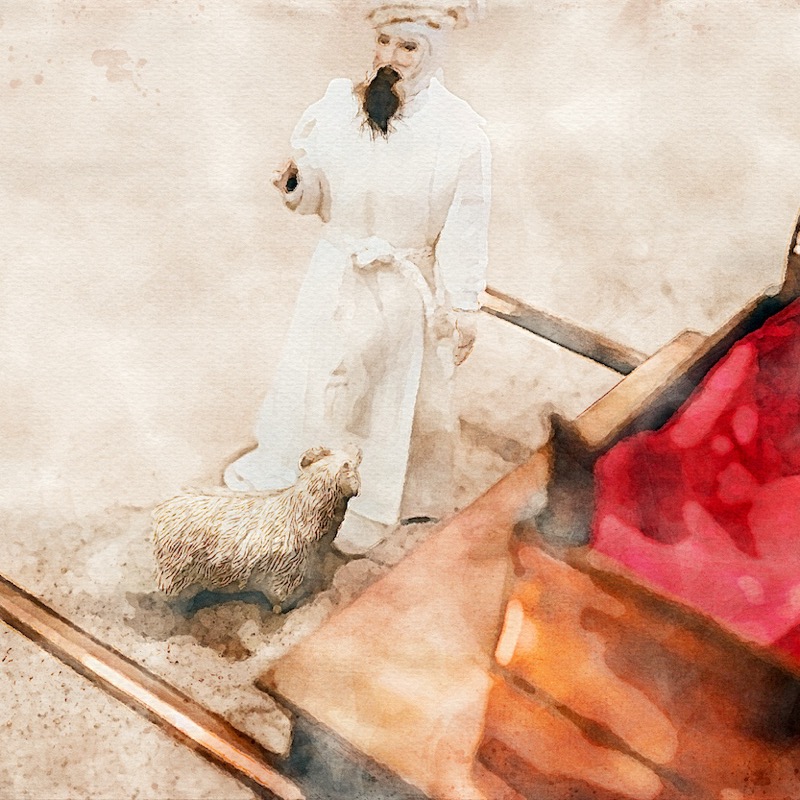
Gooding, David: 4 - The Altar of Sacrifice
ID mfh_1087390753Date unavailableBefore 2.10Restored 4.64
Now shall we read in the book of Exodus in chapter twenty seven. And thou shalt make the altar of acacia wood, five cubits long and five cubits broad. The altar shall be four square, and the height thereof shall be three cubits. And thou shalt make the horns of it upon the four corners thereof. The horns thereof shall be of one piece with it. And thou shalt overlay it with copper. Thou shalt make its pots to take away its ashes, and its shovels, and its basins, and its flesh hooks, and its firepans. All the vessels thereof thou shalt make of copper. And thou shalt make for it a grating of network of copper, and upon the net shalt thou make four brazen rings in the four corners there are, and thou shalt put it under the ledge round about the altar beneath, that the net may reach halfway up the altar. By your leave, I pause there to make a little explanation. For I'm well aware that there will be many experts on tabernacle topics here present this evening, who may be interested for, uh, me to try and justify the way I have made this model. The verse that we have just read talks about the grating that was made for this altar, and, uh, in all honesty, the Hebrew which it represents is somewhat difficult to interpret. I therefore want just to mention it now, for I shall not, uh, mention it later in the exposition of the passage. I take the words to be saying this, verse four again, and thou shalt make for it a bra- a grating of network of copper, and upon the net thou shalt make four copper rings in the four corners thereof, and perhaps you cannot see from where you are, but there is a ring on each of the four corners, not of the altar, but of the net, on the net of the grating. That is one of the reasons which convinces me that the grating was not inside, for the staves were put through the rings on the grating of the net. And then again it says, thou shalt put it, that is the grating, under the ledge, round the altar beneath, that the net may reach halfway up the altar. Thou shalt put the grating then under the ledge, and as you'll see, we have a ledge running round the altar, and the grating is under the ledge, not inside resting on top of a ledge, but outside and underneath the ledge, and, as the revised version has it, reaching halfway up. Let that suffice, for I do not intend to appeal in what follows to this part of the parable, seeing that the actual specifications are open to different interpretation. But let us read on. Verse six: and thou shalt make staves for the altar, staves of acacia wood, and overlay them with copper. And the staves thereof shall be put into the rings, and the staves shall be upon the two sides of the altar in bearing it. Hollow with planks shalt thou make it, as it has been showed thee in the mount, so shall they make it. One more verse or two in chapter forty and verse twenty eight: And he put the screen of the door to the tabernacle, and he set the altar of burnt offering at the door of the tabernacle of the tent of meeting, and offered upon it burnt offering and a meal offering, as the Lord commanded Moses. And he set the laver between the tent of meeting and the altar, and put water therein to wash withal. May God help us to understand the significance of this lovely parable. We have found so far in our study of this model that God designed the Old Testament tabernacle to be a parable for the time now present. A parable so designed that by using its imagery, we might find what is the way to God. We noticed last week that anybody who began on the outside at some distance from God would first come through this gate here at the front, a wide gate, some thirty cubits wide, whereat there hang a linen screen embroidered with blue, purple, and skullt, wide and attractive, that all may see it and all may find the door by which a man finds entrance to God. In our interpretation of it, we said that that gateway was a parable of our Lord, through whom we have access nowadays into this grace wherein we stand. He obviously is the door, or did he not himself say, I am the door, by me if any man enter in, he shall be saved. Let us only suppose now that our experience is keeping pace with our study, and that we have seen our Lord as the doorway who will bring us into salvation and to God. And let us pray that God's Holy Spirit has urged it upon us, and we have come, and by faith we have entered in, as we have come to the Savior and received him for our own. We shall notice that if we so come, the next object on the line of approach towards God's presence is this large copper altar, called the altar of burnt offering because the burnt offering was the chief offering that was offered thereon. Called also the copper altar because copper was the material on the outside of the wooden frame. Its purpose was, of course, that thereon should be offered Israel's gifts to God. Thereupon sacrifices should be offered which would make atonement for their soul. We ought, however, not to be misled by the fact that this altar here in this model this evening looks shiny and bright and attractive. Israel themselves saw it mostly, begrimed with smoke and ash, gory with blood, offensive in its smell, as large portions of raw flesh were burned, not roast, but burned upon the incessant flames of this altar. It must have been, at first sight, a repulsive thing, a stenchful thing, a grim object, as its foul-smelling smoke rose up incessantly. It must strike us odd as we remember that, for all the rest of this dwelling place in which God was pleased to dwell was glorious with gold and silver and beautifully embroidered, telling us that a- that God is the God of the beautiful, that the home of God is beautiful beyond all delight, all imagination. Strange that in the forecourt, you say, should be an object so repulsive. What shall it teach us? It shall teach us first, in parable, what it taught the Israelite by token and symbol. When an Israelite sinned, he was obliged to bring his offering for his sin before the Lord and kill it, and its blood was shed. It taught those early farming people, those herdsmen, that sin is an expensive thing, that sin is a killer. That is very difficult for us always to remember, and particularly for us who are younger, for sin appears so often attractive. When it is begun, it has a charm. But in the end, says God, observe that the wages of sin is death. Leave off sin before it be meddled with, says Holy Scripture, because of its tremendous price, because of its awful consequence. But not only did it teach that Israelite and us along with him that sin leads to death, it taught him something of the character of God. It taught him something of the holiness of God, as those living flames express the wrath of God against sin. For you see, it is not only that sin of itself leads to death, it does that. Sin will harm us physically, as we all know. The man that persists in drinking his methylated spirits will in the end ruin his body. But it isn't merely that sin has nasty consequences of its own right. It is that God is angry with sin. The Lord is angry with the sinners every day, says Holy Red. Nor let us count it strange. Though I am aware that many moderns have tried to tell themselves that this altar, with its shedding of blood and its gruesome fires, was an antique and ancient thing, thought up by people who were sunken in superstition. And many there are that nowadays would, so to speak, discard this altogether from the parable and say, look, God doesn't need blood and fire before he will, uh, admit his erring children back to his presence. Surely, they say, our Lord Jesus has told us that God is a God of love. And when the prodigal comes back, however far he has wandered, he will find a doorway open straight into the heart of God. They would remove, so to speak, this altar and all that it stands for. But their reasoning is shallow. For the God, uh, who directed that that altar be built and those sacrifices be offered, that God is an unchangeable God. He doesn't grow kind with the passing of the centuries. He doesn't grow old and feeble and relax his standards and become more indulgent. He doesn't improve with the passage of time and grow more loving. For God is the great unchangeable God. What he felt about sin in BC two thousand, he feels about sin in AD nineteen sixty six. fires that burned on that altar under the express command that they were never to go out are a symbol to us of the undying and unswerving holiness of God and his wrath against sin. Let us not think, however, that God's wrath against sin is somehow a contradiction of his love. It is because God loves men that he is wrought with sin. A doctor loves his patient, but the more he loves his patient, the more he will hate the hideous cancer that kills him. If a doctor does not hate disease, if a doctor is not sworn enemy of disease, if he will not fight it with might and main in a war that knows no giving up, then he is no doctor. A doctor that says disease doesn't matter has ceased to be worthy of the name of doctor. And a God who would say that sin doesn't matter would cease to be God. See that lovely, lovely model. Model of an exceedingly beautiful tabernacle. It was glorious and beautiful because it came from the mind of God. It was glory and glorious and beautiful because in the mind of God, there is no room or tolerance of sin. And therefore we come to God. It surely is evident that we must come softly and humbly. Who, when we come, come the best of us, weighed down with a memory of sin and guilt. Not only did they learn something of the holiness of God as they came to that altar, they learned in that very selfsame altar something of the love of God. For the God whose holiness burns, so to speak, there against sin was the very God who instituted for Israel the possibility that they might bring a substitute for themselves. And though they had sinned personally themselves and deserved to be consumed by the wrath of God, God's grace allowed them to bring a substitute, a lamb to die in their stead. It was, of course, but a picture, but a symbol. As they brought those lambs and goats and bullocks and killed them, their blood actually did nothing at all. For it was impossible that the blood of bulls and of goats and the ashes of a heifer, sprinkling the unclean, it was impossible that that blood should take away sin. It was only a token, but a valuable token, for it pointed to the purpose of God one day to bring into our world him whom the Word of God calls the Lamb of God, the love gift of God to men. Come into a world of men bowed down with the guilt of sin and at a distance from God and fearing his wrath. Come himself to bear their sins in his own body on the tree. Let us read here the love of God. We who live now in this favored age. Read here the love of God, not that God says that sin doesn't matter, and though we have sinned, he will in some sentimental fashion turn a blind eye thereto. No, no. Let us read here the love of God. That God, being what he is, his holy wrath burns incessantly against him. That same God so loved the world of sinners that he gave his only begotten son. And that son bore our sins in his own body on the tree. That is the love of God. Not careless sentiment, but deliberate sacrifice on the behalf of those who had committed the very sins that his soul abhors. Therefore, this evening, I propose to take this altar here as a picture of our Lord. Not of the cross upon which he suffered. I'm not at all sure that God, um, is pleased with what the scripture calls the accursed tree. But as a picture of our Lord, who gave himself a sacrifice for our sin. So taking it, let us notice first that that altar was formed of two materials. You cannot see it from where you sit, and you wouldn't see it if you came here. Our model does, in fact, follow the scriptural pattern. There is a wooden framework inside there, and the wooden framework is covered over with copper. This is an interesting feature because we shall find it recur throughout this tabernacle. There are several other pieces of furniture in the tabernacle that are made of two materials. The others are generally made of wood and gold, or wood and pure gold. This one is made of wood and copper. And I'm going to propose that this is a parable of our Lord, who had in himself two natures, in that he was human and at the same time divine. But lest you think me fanciful, I must turn aside and justify my reason. I say that the wood, uh, wood is a picture of our Lord's humanity. For that, I find support in the picturesque way that the ancient Hebrews used to talk. For instance, the ancient Hebrew says that the wicked are like a bay tree, a bay tree that spreads itself and makes a big show today, but is unstable and is gone tomorrow. Isaiah the prophet announces in one of his passages that there is going to be a day of the Lord upon the cedars of Lebanon and a mighty shaking on the mountains. And none of us is so silly as to think that he really meant it was the literal cedars of Lebanon that were going to be disturbed. For the cedars of Lebanon in Isaiah's poetry are symbols of the great ones, the proud of earth, that he goes on thereafter to describe. Those stately cedar trees, with their tremendous height and strength, seemed a very fitting symbol to the ancients of the great ones of earth and the proud. Come, if you think it fanciful that I say this acacia wood is a picture of our Lord, what will you say to our Lord himself when he says, I am the true vine? If it is difficult to your western way of mind, then please try to be a Hebrew. For you see, as the ancients looked at these different types of trees, they saw in them pictures of different types of individuals. So that we notice that this was made of wood, and then we inquire of what wood? It was made of acacia wood, a wood so hard that the Greeks called it the incorruptible wood, and therein give us a hint as to its interpretation. Hard, incorruptible wood, fitting emblem of him who was without sin, who did and thought no sin, neither was guile found in his mouth. It is no accident that that wood was used there. For it was imperative that if our Lord was to die for us, men and women, he must himself be a man that he could be our substitute. It was imperative that if he should die for sinful men and women, he himself must be sinless and utterly uncorrupt. For had he known but one sin, instead of being our savior, he would have needed a sacrifice for himself. We praise God for that utterly sinless human life of our Lord Jesus Christ. There is glory in his manhood. I beg leave to read to you what the Epistle to the Hebrews says about our Lord's manhood, that we might derive therefrom its tremendous comfort. There is a passage in Hebrews chapter two that discusses why our Lord had to become human, and part of it runs like this: Since then the children are sharers in flesh and blood, he also himself in like manner partook of the same, that through death he might bring to naught him that had the power of death, that is the devil, might deliver all them who through fear of death were subject to bondage. What a bondage that has been that has gripped the human race from its beginning. Fear of death. When I was a little fellow, I didn't care much for school. I was always better at doing holidays. And, uh, I found that in the long vacation, the first part of the holiday was very good. But when it got to about the last week, the last week was always spoiled somewhat for me. I couldn't help thinking, you see, on the last Monday or Tuesday of the last week of holiday, yes, this is very nice, but um, where shall I be this time next week? And the thought that next week I should be doing Latin proses was dismal in the extreme. Have you thought where you will be? fifty years from now? forty years from now? Ah no, for some of us I must change my figure. ten years from now, my friend. It casts a kind of a coldness, doesn't it, and a, a gloom. It begins for many to take the fun out of life. Our sad world, into which sin has introduced death and the fear of the beyond. These lovely verses tell us that we can be set free from that fear. It tells of one who, being equal with God, became human because the children were partakers of flesh and blood. He himself likewise partook of the same, that he might die and face man's enemy, death. That thereby he might disannul him that has the power of death, that is the devil, and deliver them who through fear of death were all their lifetime subject to bondage. You see, the fear of death springs in large part from a guilty conscience. The sting of death is sin. Departing indeed is sad, maybe, if we leave loved ones behind, but the sting of it is a guilty conscience that makes the step into eternity full of dread and awe. A conscience that is not reconciled to God. A soul that isn't forgiven. A soul going out irreversibly into the great beyond, uncertain and insecure. Sting of death is sin. And the strength of sin is the law. God's holy law entabled here in the tabernacle, or enshrined in men's consciences, refuses to let us think that God will say sin doesn't matter. Tonight there is a way of being freed. For Christ has become man, and Christ has died, borne the penalty of human sin, and broken the power of Satan, and risen again, and offer us forgiveness, complete forgiveness, and assure us that for us who trust him, to depart from this body is to be immediately and forever at home with the Lord. Then it was not only wood. The wood was overlaid with copper for the very good practical reason that if the wood had been uncovered, the wood would have been consumed with the fires that burned within that altar. And so there had to be found some substance that could endure the heat of those sacrifices and those flames. And copper was chosen because of its ability to protect that wood, to be strong against the fire. Our Lord was human, but not only human. The Bible assures us that he definitely was human, but the Bible nowhere says that he was only human. He is not to be thought of as a perfect man, and that's all. For in him two natures, mysteriously enough, combine. He is human. He is divine. For none other would have been strong enough to bear the pains of Calvary, to meet the wrath of God, when God made to meet upon him the iniquity of us all. In dying, he left us an example, says Scripture, but he left us much more. Let us not primarily think of our Lord's death as an example for us. Let us find in it first this tremendous fact that we have redemption through his blood, because he who died on Calvary was the image of the invisible God, the firstborn of all creation in this sense, that all things were made in him and through him and to him. In him all things hang together. We preach no cheap example, no human prophet doing his best to improve his fellow men and women. We preach that he who threw the stars into space and holds their countless atoms together until such time as he pleased to let them dissolve in one almighty atomic fission. But he for whom it all was made humbled himself, and still God became man for the sin of humans met the wrath of God as he died upon a tree. We have an interesting testimony from the officer in charge of the execution squad. He had seen many men die. He had never seen a man die like this. When after those, um, hours of unutterable anguish and crucifixion, when normal victims are too weak, scarce to say, utter anything. We read, our Lord cried with a loud voice, said the officer in charge of the execution squad when he saw that he so cried out, surely this is the Son of God. Though what a touching thing it is, for how it comes to the very inmost recess of our heart to meet our deepest need, that God's own Son should die for me. We know we ought to be better men and women. We scarce need anybody to tell us. Our basic trouble is not that, uh, we don't know we ought to be good. Our basic trouble is that we know that we have sinned, and in spite of our greatest efforts, we cannot live a sinless life. The problem is beyond us. Thank God for a God who has provided not some cheap advice, but a God who himself has done something, something colossal, something beyond all dimension. The Son of God has grappled with the problem of sin. What a wonderful thing, sinful, poor and insignificant as we are, to be able to say with Paul the Apostle, write it is our only hope for heaven. The Son of God loved me and gave himself up for me. But see, that altar on its four corners had horns. Perhaps you cannot see them from where you sit, but there are horns here on the model to represent the horns that were made on the, uh, original altar. Horns that were made of one piece with the wooden frame and then overlaid with copper. One interesting use of those horns may detain us just for a moment. In the ancient world, when a man had accidentally killed his fellow man and was in danger of being himself killed by that man's kinsman, he could run to the sanctuary and take hold of the horns of the altar. And so long as he held those horns, he was safe. The avenger of blood could not touch him. He was safe indeed until the elders came and examined the case. And if he were found a genuine case, that the accident had been a genuine accident, then he might go free. It was his refuge to run and lay hold of the horn. Of course, it was found that he was an imposter, that he had deliberately killed his fellow with malice aforethought, then he would simply be dragged from the altar and executed. But the horn became a place of refuge for the man who had sinned indeed, sinned unintentionally, couldn't help it. How beautifully does it express for us that there is at Calvary a refuge for sinners? God speaks of our Lord and of the hope of his gospel that he holds out to men in these terms. He says that Christians are people that have fled for refuge to take hold of the hope that is set before them. It reminds us that we have no business lingering in the world and lingering in our sin. There is an avenger on our track. There is an adversary of our soul whom our Lord warned us to get quit of as soon as we can. There is only one way for sinful men to get quit to the great adversary of their soul who seeks to drag them down to perdition. That is to run and take hold of the hope that is set before them through the sacrifice of our Lord Jesus Christ. I like the direction that says that the horns should be of one part with it. If they had been just stuck on, like my horns are in fact just stuck on, it might have been that when the man grasped hold thereof and his enemies came to drag him away, the, uh, the horn gave way and came away in his hands, but not so. It was of a peace with the altar. The man was safe and secure as he laid hold thereupon. And how shall we praise enough that security that God gives to those who have fled for his son, to his son for refuge? English very often is somewhat poor when it wants to make negative statements. It can't pile up its negatives like other ancient languages can. There is a verse in the New Testament that says on God's own word that he will never leave us and he will in no wise let us down. In its original statement, it is bung full of negatives from one end to the other. So much so that one of the hymns, to try and get it across into English, to express this tremendous security that God gives to those that lay hold upon the sacrifice of Christ. And he put it this way: The soul that on Jesus has le- leant for repose, has fled for repose. He'll never, he said it, desert to its foes. That soul, though all hell should endeavor to shake, he'll never, no, never, no, never forsake. Five negatives that fill out the sum in their Greek original, ensuring to all who trust the Savior eternal security in the love of God. And then we read that they had, along with this altar, several vessels of the ministry. There were, for instance, pots for the ashes. The sacrifice would be put upon the altar. The flames would do their deadly work, till at last the sacrifice was consumed utterly and nothing left but dust and ashes that the fire could no longer burn. When the fire had reduced the sacrifice to ashes and it could burn no more, reverently, in special garb, they brought along these pots for the ashes, and with their shovels they filled the pots, and they took the ashes out to a clean, special place outside the camp, and there reverently they deposited the ashes. You'll see it was a symbol. You imagine a sinner that had come with a guilt of sin upon his conscience, and an offering had been made for him. He watched the fires that, so to speak, should have burned him, burn his substitute, till at last the sacrifice was burned to ashes and the fire could burn no more. Even then it was a symbol. Those ashes, they spelled out the fact that the judgment was finished, the sacrifice complete. Yet how meager was their message compared with what the Holy Spirit tells us. For though those sacrifices were burned to ashes, the people concerned never really had a conscience that was made perfect. In fact, the New Testament puts it this way. Allow me to read you the actual text of scripture. For the law, having a shadow of the good things to come, and not the very image of the things, they can never, with the same sacrifices year by year, which they offer continually, make perfect them that draw near. So though they came frequently, their sacrifices could never make them perfect. Else, that is, if the sacrifices had made them perfect, else would they not have ceased to be offered? If the sacrifices had done their job perfectly, the sacrifices would never have been offered again. Their sins, all of them, would have been forgiven, and no more need for a sacrifice. But, you see, those sacrifices couldn't do it. If they had been able to do it, the worshippers, having been once cleansed, would have had no more conscience of sin. As it was, however, in those sacrifices, there is a remembrance made of sins year by year. So he came one year and offered his sacrifice, and, uh, when it was finished, he hoped his sins were forgiven. That's as much as he could do. If you had said to him, my friend, tell me, are you right with God? Are your sins forgiven? He would have said, well, they're forgiven up to the moment. And what about the future, you would say to him? Well, he said, I could, of course, I couldn't say anything about that. Next year, he says, I shall come again with my sacrifices on the great day of atonement, and I hope God will be merciful to me, and so it will go on. But of course, I could never be sure. I couldn't anticipate the judgment day. I don't know how it will turn out in the end. That's what they said in Judaism. That says the Holy Spirit, laboring this point in a very, very long paragraph of holy writ, that is not how it is now. Oh, my good friend, if you, if this point now seems a little bit, uh, uh, obscure to you, please now give it your thought. The Holy Spirit says that now it's different from what it was then. They could never be sure. But now? Wherein is the difference? Well, if those sacrifices had been able to take away a man's sin completely, they would have ceased to be offered. So they went on being offered because they never finished. Says the Holy Spirit, this man, our Lord Jesus, he offered one sacrifice for sin forever, and he's now sat down. He's never going to offer another sacrifice for sin. Never. He has sat down, and it's finished. But you say, how can the Lord Jesus sit down like that? The answer comes back indicted by the Holy Spirit himself. God says of those that trust Christ, their sins and iniquities I will remember no more. Now, says the Holy Spirit, if God isn't going to remember your sins anymore, where forgiveness of these is? There is no more offering for sin for the simple reason that there need be no more offering for sin. The offering that Christ offered here once and for all, my friend, it covered your sin if you trust the Savior, all of it! Mark you, if it hasn't covered all of your sin, past, present, and future. If it hasn't covered the whole lot, then, my friend, you are bound to perish miserably. For Christ isn't going to offer another sacrifice. And if there are sins of yours, or if there will yet be sins of yours that are not covered by his sacrifice, then your own works will never pay for them. And Christ isn't going to offer another sacrifice. You must perish miserably. Oh, the joy of this gospel that God gives us. It's not like that, he says. You don't come today and then live in uncertainty for the rest. You come to this Christ, and Christ says that he once died. When he died, he died for all your sin. The Bible tells us that there's only going to be one judgment. God doesn't hold court every day of the week. There is one judgment, just as man is appointed to die once, and after death the judgment comes only once. And at that judgment, it might be a man's whole life comes up. Listen, says God. Listen, says the judge himself. You may anticipate that judgment. For the judge himself has said that in view of that one great judgment after death, Christ has once suffered, once offered himself, has offered one sacrifice for sin, and that one sacrifice, already complete, is enough to cover the sins of the whole of a man's life, gave him acceptance with God. Oh, I love to look at the ashes. I think of all my sins. I pile them high. I think of all that may be. And I come again to his cross, and I see my Savior bear my sin in his body and cry at the end, the triumphant cry, it is finished. And the Holy Ghost whispers in my ear, there will be no more sacrifice now. For God says your sins and iniquities, he will remember no more. My friend, why are you contented to live with a guilty conscience in uncertainty. When this night you might come to God's Christ and be utterly forgiven and assured of God's acceptance eternally. They had a basin that they used to collect the blood and right reverently to transport it to the very throne of God and, uh, sprinkle that blood upon the throne. There are some today who affect to speak slightingly of the blood of Christ. They call it the doctrine of the shambles. My friend, be warned of how much more a punishment, says God, shall he be thought worthy who has trampled underfoot the blood of God's Son. That is our only means of salvation. That precious blood of Christ, symbol of his death, who died to pay the guilt of our sin. The blood of Jesus Christ guards us, cleanses us from all sin. That and much more I ought to say, but time has defeated me. Perhaps I've said enough to make it clear at least that the gate of heaven, the gate of God's heart, is wide open this very moment. And you who have already fled for refuge to the Savior, God comfort your hearts with his exceedingly great and precious promise. As you see, the sacrifice that was made for your sin is already complete, your acceptance with God undisturbable. Do I speak to somebody who is not yet saved? You play with fire, my friend. You play with fire. The Bible tells us that our God is a consuming fire. In his great love to men, he has offered them a sacrifice which makes perfect peace with God for all who will come through Christ. But ah, my friend, if you affect independence and you have no time for Christ and his blood, I tell you, you play with fire. Our God is a consuming fire, and it is a fearful thing to fall into the hands of the living God. Mark it well, when his own son kneeled in Gethsemane's garden in prospect of meeting the holy God on account of human sin, that strong son of God sweat in his tortured soul, till it was as though it were drops of blood falling so heavily to the ground. He didn't die for nothing. My friend, if you bypass that altar, you will walk straight into the everlasting burnings of the wrath of God. Oh, come now. Be not so foolish, so obstinate, so proud, as longer to stay. See, my friend, there's a way back to God from the dark paths of sin. There's a door that's opened that all may go in. At Calvary's cross is where you begin when you come as a sinner to Jesus.