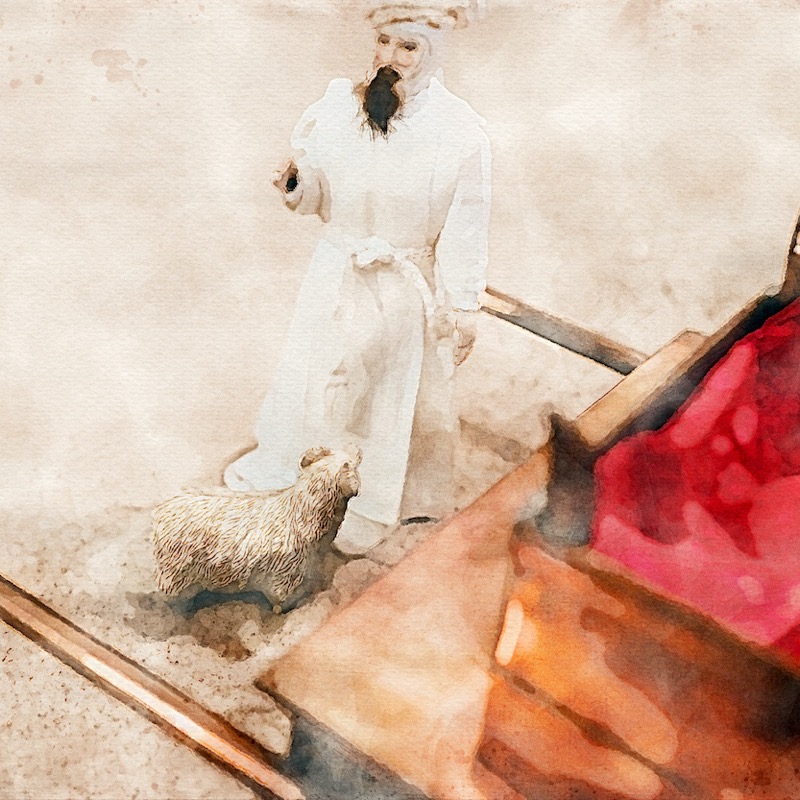
Gooding, David: 5 - The Incense Altar
ID mfh_1087390741Date unavailableBefore 1.51Restored 4.45
Exodus thirty and verse 1. And thou shalt make an altar to burn incense upon. Of acacia wood shalt thou make it. A cubit shall be the length thereof, and a cubit the breadth thereof. Four square shall it be. Two cubits shall be the height thereof. The horns thereof shall be of one piece with it. Thou shalt overlay it with pure gold, the top thereof and the sides thereof round about, and the horns thereof. Thou shalt make unto it a crown of gold round about. And two golden rings shalt thou make for it under the crown thereof, upon the two ribs thereof, upon the two sides of it shalt thou make them. They shall be for places for staves to bear it with all. And thou shalt make the staves of acacia wood and overlay them with gold. Thou shalt put it before the veil that is by the ark of the testimony, before the mercy seat that is over the testimony, where I will meet with thee. And Aaron shall burn thereon incense of sweet spices. Every morning when he dresseth the lamp, he shall burn it. And when Aaron lighteth the lamps of even, he shall burn it a perpetual incense before the Lord throughout your generation. He shall offer no strange incense thereon, nor burnt offering, nor meal offering, and he shall pour no drink offering thereon. And Aaron shall make atonement upon the horns of it once in the year, with the blood of the sin offering of atonement, once in the year shall he make atonement for it throughout your generations. It is most holy unto the Lord. May God himself explain his holy word to us. In the ancient Jewish tabernacle, there were two altars, and we shall scarce, uh, be in danger of confusing them because of their comparative size and position. One of them was outside in the court and was an exceedingly large altar. The other stood inside in the holy, uh, place and was comparatively small. Actually, they did have some connection i- i- in their function, in that the blood of the sacrifices that were offered here at this altar was quite frequently brought in and smeared on the horns of that little incense altar. But apart from that, their functions were completely separate. For on this altar, no sacrifice was offered. Here they burned incense. Of course, the burning of the incense was but a symbol, a token, and the meaning of that symbol to the Israelites we can discover in the course of their history. You may remember, for instance, the story of Zacharias and the angel in the temple when the birth of John the Baptist was announced. On that occasion, we read that Zacharias had received the lot to burn incense, for in those days it was the custom of the priests to draw lots for this high honor of being allowed to burn incense in the temple upon that little altar. And this day it was Zacharias, uh, uh, lot to burn the incense. And we read, uh, according to Luke the Evangelist, that while he burned the incense inside the temple, the whole multitude were praying outside the temple at the hour of incense. The idea was, you see, i- in the picture symbolic, uh, act, that as the prayers of Israel ascended towards God, they would come up to God's dwelling place, enshrouded in the delightful smelling incense. Of course, it was only a symbol. Not even in those far off days were people so childish as to think that the God of heaven would be disposed to listen to people's prayers because he smelled a nice smell of incense. Uh, no one was so childish even then, and let's hope we're none of us so childish today to think that ourselves. Even in those days, it was only a symbolic token. Nowadays, in our Christian churches, we don't use incense. We have no need, for we have the reality of which that incense was a symbol only. The counterpart in our day is this, that when we pray as Christian people, we are authorized by our Lord Jesus to pray in his name. Said he to his disciples as he was about to leave them, hitherto you have asked nothing in my name, but now when you come to pray, you are to ask in my name. Ask, he said. Try it, gentlemen. Exercise your privilege, and asking in my name, you will receive, and your joy will be full. If we want to know what it means to ask in the name of Christ, then we get a picture, so to speak, in the, uh, old Israelitish ceremony. They prayed, the sweet smelling incense encompassed their prayers and wafted them up to God to make their prayers acceptable. We pray, and as we pray, we mention that name in which resides all value and all merit and all fragrance before God, and our prayers come up to God enveloped in the fragrance of the lovely name of God's own Son, and we are heard for his sake, and our prayers are answered according to his merit. Happy are those people that have begun to understand what a tremendous thing it is to be allowed to use the name of Jesus Christ, our Lord, in their praying. It isn't that we just add the formula at the end of the prayer, you know, because it sounds nice and makes a convenient way of finishing praying. It is an incalculable authority and privilege. Suppose I go down to the bank, for instance, and I ask to see the bank manager, and I say to him, now, I'm very poor, you know, I wish you'd give me a thousand pounds. Give me a thousand pounds for the sake of Lord Nuffield. He will say, well, don't be quite so silly. What's that got to do with it? Why should I give you a pound for the sake of Lord Nuffield? Ah, but supposing that good man, before he went, had authorized me to use his name, and I go down to the bank manager, uh, at the bank where Lord Nuffield's vast fortunes are lodged, and I say, give me a thousand pounds, I ask in the name of Lord Nuffield. He'll say, have you any right so to do it? I produce the letter from my pocket, letter of credit signed by Lord Nuffield himself. Whenever this man asks in my name, he's doing it by my authority. It is as though I were asking. And when the bank manager sees that, he'll scurry off to get the thousand pounds. For asking in the name of Lord Nuffield is to ask as though Lord Nuffield were asking. Now, of course, it's not quite as simple as that. I don't come to God, for instance, and say, oh God, please give me a silver cloud in the name of Jesus Christ, our Lord. But I'm not likely to get a silver cloud, not ordinarily under those terms. Because merely to ask that I might spend it on my own personal desires, this, you'll see, would not be in accord with that name. And if Lord Nuffield had ever been so generous as to give me permission to use his name with the bank manager, I fancy Lord Nuffield, at the same time as he was generous, would be wise and tell my bank manager, now look here, you'll be very careful to ask what he wants the thousand pounds for. And if he wants it for something sensible that will promote the interests of the Nuffield Corporation and all its heirs, if he asks in my name something consonant with my name, well, of course you give it when he asks in my name, if it's agreeable to my name and interests. But if in my name he asks something that is against my interests, of course you won't, uh, give him that. And something like that happens when we come to God with our prayers, with the incalculable privilege of asking not merely for the sake of the Lord Jesus, but in the name of the Lord Jesus. We shall be answered when what we ask is not only by his authority, but consonant with that name and with his interest and purpose. But it ought to make us spiritually bold. When we come to pray on God's interests, that we might see the unconverted brought to the Lord, shall we not remember that our Lord has been given a name which is above every name, both in this age and in the age to come? Let us not come to God as though we had to persuade God to be interested in men. Let us not come to God as though it depended upon our merit to persuade God to save. Let us ask ourselves now, what is the Lord's attitude? When I think of that name Jesus, let me ask myself, what does that name stand for? It stands for saving men. The very name means savior. I ask myself, is it in accord with his interests that I should save, that God should save men? When I say to myself, before he left, did he not commission us, say, go and make disciples of all men, and I shall be with you? What then is it that stops men being saved? This is none other than the power of the prince and the god of this world, the evil powers of darkness. Into our hand and our use, God has given a name which is above every name. Oh God, open our eyes to see its tremendous power. God, open our eyes to see the positive, pulsating energy and the determined resolute purpose of the lovely man that bears that name. And God, give us the wisdom to pray, not according to our faltering method, met- merit, or slender attainments, or meager holiness. Let us learn to pray in the name, the irresistible name of Jesus Christ, our Lord. While we're thinking of our praying, we may do if we think of this altar, for thereat all sorts of priests came in their turn to offer the incense and to pray. Why, Zachariah, you may remember, he had a, a personal, uh, prayer to make. He prayed for a, a child. He and his wife were old and had no child. They longed for a child. And here were men, a man and a woman that were prepared to devote that child to the Lord, not for merely their own interest and satisfaction, though of course that was part thereof, but also for God's kingdom's sake. And God heard the prayer that had been offered at that altar for such a homely thing as that. While therefore we are thinking of our praying to God, we might care to notice the positioning of this little altar i- in the tabernacle. It's stood here, if you can see it, opposite that veil, and the passage of scripture that we read stressed its positioning, it stood before the veil, which was before the Ark of the Testimony, and over that Ark of the Testimony there were the, uh, there was the mercy seat, and the little altar of incense stood immediately opposite on the direct line of approach to God. You'll see, for instance, that in our moving forward this evening, we've neglected two pieces of furniture. They stand one on that side and one on the other. Um, the one we're interested in is the one that is on the direct line of approach to God and stands immediately opposite the veil and again immediately opposite the throne of God. So that when a man came to pray at that altar and burn his incense, he was facing the Most High, facing the very throne of God. Between him there came a veil. Now that is interesting, for that veil was, literally speaking, a mediator of something that came between the man and God. It's a symbol, of course, like all else, and as a symbol, it is very interesting. That veil, we are told in the New Testament, in the Epistles of the Hebrews, is a type of our Lord's humanity, our Lord's flesh. It is a type that reminds us that our Lord became truly man. The veil, that is to say his flesh, that is to say his humanity. Moreover, that veil was suspended on four pillars that were placed in sockets of silver, and that silver, we are further informed, was gotten from the ransom money that the Israelites paid for the redemption of their souls. Now you put the thing together. In the ancient days, the man faced God to pray. There was a mediator between him and God, and we ask, and what was it, and who did it represent? Oh well, it, uh, represented our Lord as a man, and it speaks of a silver of redemption. There's a very interesting verse in the New Testament that, uh, may serve us as a commentary upon that. It runs like this. There is one God and one mediator between God and man, himself a man. The veil, that is to say his flesh, who gave himself a ransom for all men. A testimony to be revealed in its own time. Therefore, when we come to God, this tabernacle type shall help us remember that we have a mediator, and it shall help us, I trust, to see clear again who that mediator is. We come direct to God through Christ. We need, thank God, no other mediator. It's nice if our friends learn to pray for us, but, uh, we have no need of anybody to come in between us and God, save Christ only. There is one mediator. Oh, that we all would learn the lovely privilege we have. There are some folks, they stand away in the dark. They feel that they cannot come directly to God themselves. They must come through some holy man, some minister of God. And my friend, it's a right given to all men if they will, for there is one God, there is one mediator between God and men, himself a man who gave himself a ransom for all. And every one of us here now present before God has a right to come direct to God, so be it only he comes through Christ. But this evening we want to concentrate not so much upon our praying and our coming to God. We want to take what is in fact the major lesson from this altar of incense. For at that altar of incense, the most constant minister in the ancient tabernacle was the high priest himself. Other priests sometimes offered incense there, but every morning and every evening the great high priest himself came and offered incense upon that altar. We too have a high priest, a great priest, who's ascended into the heavens, ministering not in a sanctuary made with hands, but in heaven itself. And it is of his intercession that we wish to speak this evening. This, of course, is the major lesson, because I say once more that this incense altar stands on the direct road of approach to God, and it tells us firstly of an integral part of the great salvation that God has prepared for us. Just like that gate speaks to us of Christ, it tells us of our Lord by whom we may enter in and be saved. Just as that altar there speaks of Christ and reminds us of his one sacrifice for sin, by whose blood we are brought nigh to God. And just as that labor provides us with that holiness without which no man shall see the Lord by the labor of regeneration. And just as that door represents our Lord, the one who admits us into closer fellowship with God, so this altar here reminds us of our Lord, but our Lord as our great intercessor, the one who has been appointed a great high priest for us, and because of whose intercessions we shall be saved. The New Testament has it after this fashion, that because he ever liveth to make intercession for us, he is able to save to the uttermost those that are on their way to God through him. And here we come. We are on our way to God. We need not only his blood to atone. We shall need his intercessions that we might find our way to God, know ourselves eternally secure in his holy presence. I want us to grasp this. What we speak of tonight in the intercessions of our Lord is an integral part of our salvation. It will help us all, of course. It, uh, may in particular help any of us who are not yet Christians, or who perhaps are Christians and still lack assurance of salvation, to see how we can be utterly sure of our salvation, and utterly certain that God will never cast us out. Let me repeat to you the verse of Holy Scripture. He is able, so it says, to save to the uttermost all that come unto God by him, seeing he ever liveth to make intercession for them. Or again, you may remember that wonderful verse in Romans chapter eight that goes like this: Who shall, uh, lay anything to the charge of God's elect? Why, when it's God that justifies. And who is he that condemneth? Shall Jesus Christ, who died for us? No, rather that he's risen again, who is also at the right hand of God, who maketh intercession for us. We are urged to see how secure we are, how permanent and immovable is our salvation, because not only did our Lord die for us, but he lives to intercede for us. Why is it necessary for him to intercede for us? I mean, why in this sense? When we came by that altar, we found that our Lord's one sacrifice for sin was sufficient to put away the guilt of our sin forever, and we had the assurance that God would never remember our sins again anymore. The man that comes to our Lord in sincere repentance and faith and receives him, that man, if he not, is justified before God once and for all. And the Lord assures us that we shall never be cast out. Then somebody will say, why then do I need something more than that? Why does our Lord need constantly to intercede for me? And anyway, what difference does it make? Shouldn't I remain saved even if he didn't intercede for me? Well, obviously, it stands to reason his intercession is exceedingly important and vital, else he would not do it. Let us ask ourselves, rather, what does it do for us? And what does he pay for when he intercedes? We may discern at least two things. I want to submit to you that the first great ministry he exercises as our high priest in his intercession is directed towards the maintenance and the increase of our personal faith. You remember what he said to the Apostle Peter, will you not? On that fateful evening, when in the kindness and truthfulness of his heart he had to warn his disciples of the impending temptation, he said to them all, Satan has desired to have you, all eleven of you, that he might sift you as wheat. And then singling out Peter from the band, he said, and Peter, I have prayed for thee. And what did he pray for? Now, it is very instructive to notice he prayed, says he, I have prayed for thee that thy faith fail not. Our Lord had seen the tempestuous sea of temptation through which Peter was to pass. Our Lord, with his foreknowledge, had seen the tremendous pressure, the subtlety that Satan would build up against this foremost apostle. And our Lord had foreseen with what a terrible fall Peter should blot and almost destroy his testimony. Before the temptation began, our Lord set himself to pray for Peter, and he prayed not that the man, uh, should not lose his testimony, and not that the man's courage should survive intact. Those things were to go, shattered and blown to the wind. But he prayed that the man's faith should not fail. You see, this is an exceedingly basic thing. What would have happened if Peter's faith had failed? We talk, do we not, in evangelical circles, very commonly, of the security of the believer. And we try to show it to any Christian friends who believe that a Christian can be saved and lost again. We try to labor the point with him that once a man is saved, he's saved for always. And we sum up often the situation and the doctrine in the words, the security, the eternal security of the believer. But of course, that phrase begs the question, doesn't it? Of course the believer is eternally secure. Verse after verse in Holy Writ tells us that time and time again, he that believeth hath eternal life. But then mark you, the condition is he that believeth. But what happens if a man's faith gets broken and lost? It would be idle then to talk about the security of a believer, wouldn't it? Therefore, in this tremendous struggle that confronted Peter, and in all the overwhelming shame, the frustration of his fall, our Lord went for the thing that was absolutely vital, relief that made that man with God, and spelled out his eventual restoration, and spelled his eternal security. Says he, Peter, I have prayed for you that your faith should not fail. And we know that Peter's, Peter's faith didn't fail. Everything else went. Know how sad and difficult was the path for Peter thereafter. You just imagine, having taken such a prominent place amongst the preaching, being known throughout Galilee as one of the foremost disciples of the Lord, how he had boasted of his faith in the Lord and of his certainty that Jesus was the Messiah, and told people all that Jesus Christ could do for them, and he could make them strong, and he could make them well, and he could forgive their sins, and he was the very Messiah of God. How he had boasted, uh, in the midst of his fellow disciples, saying, I'll never deny you, Lord. And then it came, that unsuspected hidden weakness in his makeup, that devilishly cunning set of circumstances, all unexpected, and the man's nerve went, and he cursed and he swore to prove to everybody that he wasn't a believer at all. How easy it would have been for that man thereafter to have given up, to have said to himself, well, I'll never say again, I'll never say anything again. I'll never profess to be a Christian anymore. I have made such a terrible mistake. I'll never open my mouth again. I'll never claim to be a child of God. I'll never lay claim to salvation. I'll never certainly lay claim to be an apostle. I'll just give up. And if that man had thrown away the confession of his faith, what would he have been? It was bad enough, wasn't it, in the high priest's court when the maid came and said, are you now Peter? Tell us plainly, are you a Christian? And he said no. That was bad enough. But suppose you had found him forty years later and you'd have said, Peter, are you a Christian? And he said no still. It would have been a little idle talking about the eternal security of a believer, wouldn't it? Therefore, our Lord set himself to his gracious ministry of prayer. And Peter came back, and Peter found the nerve and the courage to face his fellow Christians, and they don't always make it easy for a backslider to come back, you know. And he found the grace and the courage and the humility to preach again. And your fellow Christian will make it sometimes even more difficult for you to preach again in public. And he found the grace. Because at rock bottom, for all his contradictious statement, the man remained a believer. Why he had scarce got the words of denial out of his mouth, and the Lord turned and looked upon him, and with a broken heart of a man who deep down loved the Lord and did believe in him, he went out and sobbed bitterly. And his faith, the anchor hold of his faith held, the cable that attached him to God remained unbroken because our Lord paid. We may take courage from that. I read in the letter to the Hebrews, in chapter four and verse fourteen what is to be the practical outcome? One of the first major practical outcomes for us of our study of this fact that we have a high priest to intercede for us. It runs like this. Having then a great high priest who has passed through the heavens, Jesus the Son of God, let us, let us do what? Let us hold fast our confession. That is the confession of our faith. There's need for that. Just you would let you remember once more, painting on your imagination the historical circumstances of this letter. This letter was written to Jewish Christians, and many of them had found the Lord in days of quite a bit of spiritual excitement. The Holy Ghost sent down from heaven had distributed his miraculous gifts, whereby to authenticate the gospel message and its preacher. Many miracles and signs had been done, and for the moment Christianity looked absolutely irrefutable. In Jerusalem itself, the apostles had dared defy the rulers, Caiaphas and Annas, and to go on with the preaching, and the people were with them in a great surge of conversions throughout the length and breadth of Jerusalem and Judea. And many folks were converted then. And they fondly hoped in their hearts that Jesus Christ was coming back again. They believed he was Messiah. They confessed he was Messiah. They got baptized in his name. They joined themselves to these Christians. And they said to themselves as they met, you know, yet a little while, oh, ever such a tiny wee little while, and he that shall come will come and will not tarry. They wove pictures in their imaginations of the nation getting converted and the Lord returning and sitting upon his throne, and all the world would be at his feet. And then Jesus Christ didn't come back. And the apostles and the older Christians passed away. And the nations didn't, nation didn't get converted. And the enthusiasm and the popularity died away. And instead of it being a glamorous thing now to be one of these new Nazarenes who could perform miracles, it began to be a very shameful thing to be associated with a little company that met perhaps in an upper room instead of in the glorious temple at Jerusalem. And then the pressure began to be put on. The new converts could be expected to be cut off from their parents' homes. And Saul of Tarsus and his ilk arose to persecute the Christians, and they lost their jobs, and some of them lost their homes and their furniture. And he persecuted them, forced them to flee and run to other cities, and there even they weren't at risk, but they were followed by his persecutor. And then suddenly the rabbis began to put the pressure on theologically. And they came up to a young Christian convert, a bright young man, and they said, you know, are you sure, after all, that you're right? You were putting up with a lot of this confidential, and your career is going to be ruined. Are you sure you're right theologically? You say that Jesus is the Son of God? Now, you know, really, that's blasphemous. For a man to call himself God, they said, you know, the Bible says that the Lord our Lord is, is one God. It says it in black and white in Deuteronomy. How can you possibly say this strange, strange theological thing that Jesus the man is the Son of God? It doesn't make sense. Whatever do you mean, they said, leaving off these Old Testament sacrifices, don't you, don't you think you're a bit impertinent? And don't you fear God? You know it was God that commanded these sacrifices in the Old Testament. It was the inspired word of God that commanded it. And who are you to say that what God commanded in his inspired word should now be set aside in favor of some newfangled arrangement taught you by the carpenter from Nazareth. Then some of the young men and some of the young women began to be a bit shaky. Oh, it was a cruel, desperate situation. The pressure of shame, the persecution and the cost, then the insidious theological doubts. Many of them began to give up. They didn't come out to the meetings very often, so it says. And then that raised another heart qu- heart searching question. If they weren't coming out to the meetings, where were they going? They weren't going back to the temple, were they? For how could a man who believes in salvation by faith, not by the old covenant, but by the new, how could a man like that go and attend the temple permanently and listen to the men preaching salvation by works? And how could a man who professed that all his salvation rested in the sacrifice of Christ, how could he go and, uh, attend as though he approved of these animal sacrifices? What did it mean? It could mean, of course, that they were apostates from the faith, men that never were genuine, veritable Judases with no real experience of God, people that had received the word with joy, but immediately persecution arose with it away because there was no root in them. But also it could mean that they were genuine men, but like Peter, for the moment, under the pressure, they had begun to act inconsistently. The writer has inspired a God to write. Because you know well, one of the major themes that occupied this dear man of God, whoever he was, that wrote to these people, was his sympathetic understanding of the difficulty and his urging upon them that in these mountainous seas of temptation, they had an anchor, they had a high priest that was passed through the heavens. A high priest that gave himself daily for them, interceding that their faith should not fall. Oh, my belovedy says, don't, don't, whatever you do, don't give up your confession of faith. Hold fast that firmness of faith. Let everything else go, but hold your faith. Faith is the sine qua non, as the lawyers have it. Without faith, it is impossible to please God. Let your faith go, and you're lost. And then he says, if you're a genuine child of God, you'll never be lost. For my daughter, listen. Under that old system, you had imperfect priests. But under Christianity, God has given you a priest of this sort, that because he ever liveth to make intercession for you, he is able to save to the uttermost them that come unto God by him. So then, for us too, he intercedes to maintain and increase our faith, which, if it broke, would put us outside the condition, he that believeth has eternal life. And then the scripture indicates that by his intercessions he does something else. But to explain this, lest I mislead some who hear me and I get in consequence charged with false doctrine and heresy, I beg leave to turn aside for a moment from the idea and imagery of a priest to another imagery that John the Apostle uses in his letter to his fellow believers. He talks of our Lord not as a high priest, but as an advocate. He pleases to use a legal term rather than a religious, and there probably is very good reason for that, for John was writing to the Christians in Asia Minor, perhaps particularly to Christians in Ephesus. These, for the most part, would be Gentile Christians, and if you talk to them about a priest, I would know very little about what God's true priests in the Old Testament stood for. If you mentioned the word priest to them, but it conjured up in their minds some evil, impure, immoral man who ministered in the great, uh, temple of Diana, Diana the Huntress that was ever a virgin, but somehow was the mother of a child. And the Holy Apostle was guided not to use to those folks the term priest. It might well have misled them. Instead, he uses what was quite a safe analogy. He uses the analogy of an advocate. And he writes to these dear Christian people, and he says, now I'm writing to you that you don't sin. But now, if a man sins, if any man sins, what happens if a man sins? Ah, this is an important question. It's an important question to us who have already found the Lord. I find it is a question that runs in the minds of people that are not yet Christians. I have known people hold back from trusting the Savior because they didn't know the answer to this one. They have said to themselves like this. I don't feel ready yet to receive a Savior and say I'm a Christian. Why not? Well, look, I know right well, being realist, I know right well if I trusted the Lord tonight, and I do my best tomorrow, but I couldn't live up to scratch. I still feel that I would sin on time. And I wouldn't like to make an empty profession and to say I received the Savior and yet, um, carry on sinning like that. And those kind of people sometimes feel it extraordinarily priggish in us who say we are saved. They have a look at us and they see us from time to time do something that is wrong, and they shake their heads with amazement. How do those people dare say they're saved when they must know that they still sin? Yeah. How well is this way round? It is God's intention, as we have seen, God has made provision for us who are Christians that we should not normally sin. But God is a realist, and he knows that every one of us will in fact sin. Indeed, if we say we have not sinned, we make him a liar. If we say we have no sin, if we say that we have progressed so far that we no longer have any potential to sin, the truth is not in us. Realism will have it, and God will have it, that even after a man has received the Savior, he still has within him potential to sin, and in many things he still sins. What happens if a Christian sins? Well, what happens is this, says John, but if any man sins, we have an advocate with the Father, Jesus Christ the righteous, and he is the propitiation for our sins. You say, what does that long word mean? Well, it's specially chosen, it is a bit of a technical term, I'll admit. When we read a propitiation in scripture, we are thinking of Christ's great sacrifice, but from the special viewpoint. We are thinking of that sacrifice that holds back the wrath of God, even though that wrath is justly deserved, but holds back that wrath of God and allows God to parley and talk with sinners until such time as God's Holy Spirit may lead them to repentance. See here, for instance, we shall come to this in another night. This was the ark, and on the great day of atonement, as we shall one night study, the high priest came in here to make propitiation. The blood wasn't shed here, the sacrifice was offered at that altar, the blood was shed at that altar, but that wasn't the end of it. Having shed the blood at the altar, the high priest came in here through the presence of God, and he sprinkled the blood upon that mercy seat. What for? Well, the reason was this, that all the year long God remained with that people. They sinned. They sinned in things they knew. They sinned in many things they never knew were sin. They sinned often without knowing it. How could a holy God carry on in the middle of a people that were sinning like this? The answer was because of the blood on that mercy seat, the blood that had made propitiation, held back the righteous rock of God from that people until such time as that people, people could be brought to repentance and personal faith and forgiveness. So our verse says that our Lord is the propitiation. In fact, he's not merely the propitiation for our sins, he's the propitiation for the sins of the whole world. Would you like to know why it is that this Christian age has run somewhere about nineteen hundred and thirty years? Will you ask why it is that God's judgment has not long since descended and blotted this world out in all its wickedness? The reason is not that man's sin is a light thing, or that God doesn't mind if people sin. God is angry with the wicked every day, says the Bible. But the reason the wrath doesn't come is because the mercy seat above is stained, so to speak, with the blood of Christ. He is the propitiation for the sins of the world and holds back the wrath of God while the Spirit of God seeks to bring men to repentance. There will come a day when the world, having rejected that offer of marriage, that, uh, period of, of grave, the offer God put forth will come. Just although does he act for a straying believer, a believer straying, long before, uh, uh, he even knows he sins, or even before he's been brought to repentance and confession, Christ's intercession begins before the throne of God, and his blood pleads that God do not deal in discipline with that erring believer. But that God hold back his discipline until such time as the Holy Spirit is able to bring that man to a consciousness of his sin and to genuine repentance before the Father. Oh, what a lovely thing it is. And I take it in that meaning too that Hebrews two tells us that we have a faithful high priest, faithful in things pertaining to God. What for? That he might, uh, make propitiation for the sins of the people. And not only did he die from the cross, but he's gone into the presence of God in all the value of his blood. That means that there is always given to his people opportunity to repent and to confess and to be restored into happy fellowship with the Lord. Well, if that be so, and these are indeed great things, let us just now briefly as we can take our little altar of incense and learn a few more lessons from its symbolism. We are told, first of all, that that altar was made of two materials. It was made of wood, acacia wood as usual, and pure gold. One more article of furniture made of two materials, reminding us that our Lord had two natures. There's the wood representing his humanity, the pure gold representing his divinity. But it's important to see that fact in connection with his intercessions. First the wood, his perfect, spotless, incorruptible humanity symbolized in the incorruptible acacia wood. This is indeed valuable and a comfort. To know that the one who intercedes for me when my faith is being attacked, the one who intercedes for me in the moment of temptation, the one who intercedes for me in those moments when unfortunately I fall. What a blessing to know that that one is truly human. He understands, my brother and sister, and understands not merely from the theoretical knowledge of divi- divinity, but knows what it is to be tempted from the practical knowledge of humanity. The Bible says he's a faithful high priest of God, but he is a merciful high priest to us because he has suffered being tempted. We have not an high priest, the Bible repeats that matter. We have not an high priest who is incapable of being touched with the feeling of our weakness, but as in all points tempted like as we are, apart from sin. He was tempted. Ah, but the verse says more. Being tempted, he suffered. It doesn't mean that he just experienced temptation, you know, but that in the process of being tempted, he suffered. He suffered more strain than we shall ever suffer because we often give in before the temptation is at an end, don't we? He went on to the end and never gave in, and therefore knew its maximum strain. We ought not to think that because he was the Son of God, that lessened the suffering, it increased it, didn't it? We remember the tempter came to him in that first of the three remarkable temptations, and he said to our Lord, if thou art the Son of God, make these stones bread. Skillfully, he had chosen the time, for our Lord had been a hungered now for forty days, eating nothing, and the Bible says explicitly that at the end of the forty days he was hungry, ravenously hungry, with an overwhelming impulse to eat. I remind you, of course, that's not a sinful appetite to feel. That's quite a good and wholesome and holy appetite, that longing for food. There's nothing sinful, and he felt it in its extremity. Without overpowering her craving for food, he was met by the devil's temptation. Now, if thou art the Son of God, make these stones bread. Now, you'll see the point of it, won't you? As against those who say our Lord was merely a perfect man and and wasn't God, this verse shows conclusively he was the Son of God at the same time as being man, because if he wasn't the Son of God, there would have been no point in the temptation, would there? It was the fact that he was the Son of God and had the power to make the stones bread that gave point to the temptation. You come along to me, for instance, and you say, now, you go along to your friend's party tonight and show off. Well, that's a possibility. I'm silly enough to do that. You say, ah, you go along to your friend's party in your silver cloud and, uh, wait till everybody's there and then drive in in your massive silver cloud. And I should say, don't be so silly, don't. I'm got a silver cow. I can't show up like that. You say to me, hungry? Well, make those stones bread. I should say, don't be silly. No temptation to me that, because I can't make them bread. Ah, but this time he was son of God who was being attacked, and he could have made the stones bread. And the very fact he could increase the power of that temptation. But though he was a son, he was not going to act as son. He was on a different mission. He said to Satan, ah, but Satan, man, man shall not live by bread alone. I'm going to live here as man, he says. Though I am son of God, though I am possessed of all the powers of divinity, I have come here to live as man in humble dependence and obedience upon God. How we, with our little power, how we have grasped at independence. We stand in admiration that deepens to worship of him who was equipped with a limitless power. I kept it in a bag and obeyed and lived in dependence on God's moment to moment direction. He learned obedience practically, what it costs and how tough it was by the things which he suffered. And because of that, we are guaranteed of sympathy and understanding as we come in the moment of our temptation for him who intercedes for us. Let that comfort us who are not yet Christians. I remember once a lorry driver, and he said to me, David, you know, boy, he said, I could never be a Christian. I said, why is that? Well, he said, you see, it's all right for you. You're in a university, you know, and that's different where I work. I'm a lorry driver, he said. My van gets filled up in the morning at the factory, and I know right well that, um, they're putting on more than they should. And of course, when I get to the other end, I, I, I, I've got all the, the cases that are on my way bill, and I've got a few more put in on the fly for Bob Jones and Tom Smith. He said, what am I going to do? He said, I can't take them back to the factory. All the men would be on me, my life would be a hell on earth. I fought the devil, he said. And then when I tried to be a Christian, I- I- I- I- I got to diddle, I got to deceive, I got to cheat. And I'm not going to be a Christian so long as I got to cheat. What I tried to say to that man was something like this, well, granted you for a moment, a university is a nice place, and you don't get tempted in a university, we'll leave that aside. I said, you think I'm inexperienced, don't you? And I am very largely poorly experienced at the world and its ways. But the favor I offered you is experienced enough. And was tempted along the whole gamut of human existence, tempted in all points. And with realistic knowledge of what it means to live for God in a sinful world like this, he bid you come to him. And if he come, if you come, he'll save you now. A guarantee that he will never lose you. And in the thick and fight of temptation, he will pray that your face pale not. And should you fall, he will bring you back to God and save you to the afterworld. Fear not to come. For if you come, he guarantees, realistically guarantees, to save you in the practical temptations of life. And so for us who know him. And we are tempted to rebel at the strange providences of God in life. Bereavement touches our hearts and makes us wonder, after all, is there anything in Christianity, after all? And does God really care? We are on the point of murmuring. Then he intervenes, who trusted God every step of the pathway and found the life of faith led him to a cross where God abandoned him and cried in the bitterness of his soul, God, I trusted. Why hast thou forsaken me? Our fathers trusted in thee, and they were very poor up on the whole, and when they wandered away, they called and they cried, and you heard them. I was cast on thee from the womb and from my mother's belly. I trusted you. God, why did you abandon? Being made perfect, he's able to succor them who find themselves perplexed by the strange providences of God in their Christian lives. Our high priest, our intercessor is human. Not only human, but he's a pure gold. He is divine. And what comfort will that add? Why this, that our Lord, as the writer to the Hebrews skillfully argues it, is a priest not after Aaron's order, but after Melchizedek. Now, Melchizedek, you know, in Old Testament, he comes onto the page of scripture unannounced, and he goes off without any record of his death. He is neither beginning of life nor end of days, in the record of scripture, that is, and in that particular, therefore, he is made like to the Son of God, the ever living, the eternal Son of God that had no beginning and shall have no end of days. He ever liveth. He has no infirmity now, as men know infirmity. Days were when indeed he went to sleep in a boat and was hungry, and now he is the risen Son of God, enthroned in the majesty of the heavens, and he ever liveth. There is therefore no change of priesthood. You see, if you were an Israelite and you came to, um, uh, your altar, and you came, at least you weren't allowed to your altar if you were an ordinary Israelite, you had to come to a priest, and you poured out your sorrows and difficulties into the ears of that priest, and you felt the priest understood, and he offered the sacrifices, and he told you what to pray and say and do, and you felt somewhat eased. You came up next year to the same priest, though he wasn't there. Died. Oh, you came up the next year and you found the priest, and oh, did he, did he, did he me. He was a veritable hot man, Phineas, and had gone off into immorality himself, and you said to him yourself, for what good is that my telling me his, my fathers, telling them to him when he can't look after himself? He'd need somebody to offer a sacrifice for him, wouldn't he? What good is he to me? Ah yes, the law made men priests that had infirmity, but the word of the oath maketh the Son who is perfected forevermore. It means the bringing in of a better covenant, formed and founded on better promises, the bringing in of a better hope by which we draw near to God. He ever liveth. He ever liveth to make intercession, unwearing, never failing. Neither night nor day does he slumber, mighty in his knowledge. A man can only encompass a little of my mind and my thoughts, and I, as I struggle to tell him things I scarcely understand myself. Ah, but this priest I come to reads my heart. He knows the hidden neurosis. He knows the hidden tangle. He knows the thing I want to say and can't. He knows the very inward impulses. Not that he ever felt those kinds of things as a man, but a son of God, he reads my heart, and there's nothing hidden from him. I shall never come and find him unsympathetic. He's able to gird his feelings in. Have you ever tried to teach anybody something, whether it was to drive a car or or to to cook a rice pudding or something, and you thought you explained it very well, and then they go and get it all wrong, and you say, no, no, not that way, stupid, not this way. And then he makes it even worse. And you say, oh, I can't think how you can be so silly. Do it this way. And by this time he's exceedingly flustered. You'll never come to Christ like and find him say that. You say you made the same mistake again? Ah, well, now this is how it should be. And he's able, all perfect himself, to control his feelings, the Bible says, towards them that are ignorant and out of the way. What a lovely priest he is. He doesn't have any infirmity, you see. Never loses his patience. Mighty Son of God. How I thank God that my ultimate salvation rests on no mere man, not even as an intercessor. There was a time, says Jeremiah in his history book, there was a time when Jeremiah set himself to intercede for Israel, and Jeremiah was perhaps the greatest of the Old Testament prophets. And God said, no, Jeremiah, sorry, no, I'm not listening. In fact, these people have sinned such a great sin now, Jeremiah, he said, that even if Moses and Samuel stood before me, I should not listen. Let him go. Why, Moses was a great intercessor. Israel nearly lost themselves in the wilderness, you know, but Moses went in to intercede and to make propitiation for the people before God, and God listened to Moses and gave him another chance. And Samuel was a great intercessor, and when the people sinned, Samuel said, God forbid that I should sin against you and seeking to pray, and he prayed, and Israel was spared. There came a time when Israel sinned so grievously that said, God, though Moses and Samuel stood before me, I couldn't listen. And now in my heart as I know it, I could well conceive that there came a day when I should so sin and blot my copy book that were my salvation dependent on a mere man, God would listen no more. Oh, thank God that we have a great high priest, Jesus, yes, his humanity, but Jesus, the Son of God, because he lives in all the limitless might of his divinity, and by the power of an endless life he shall save to the uttermost them that come unto God by him, seeing he ever liveth to make intercession for them. Then can you notice it had horns, four horns on the four corners, and the horns were smeared with blood. Now think me not fanciful when I say these horns represent the power of this altar. If you do, then for five minutes now you must turn yourself into a Hebrew and learn to think in oriental fashion. The word horn in Hebrew is a term used metaphorically for power. Uh, was it Elizabeth or was it Zachariah, I forget now which, or was it Mary, who in their joy at the birth of John the Baptist and Christ, uh, talked in this fashion, that, um, God has raised up a horn of salvation. I didn't mean a literal horn, you know, Rhinoceros's horn or something, did I? Now, uh, the horn of salvation was a way of describing our Lord Jesus, and you used the word horn because you meant a powerful savior. A horn of salvation. So do the horns on this altar represent the strength of our Lord's intercession, wherein lies their strength are not merely in the horns, but in those horns smeared with blood. We refer to John's statement, we have an advocate with the Father, Jesus Christ the righteous, and he is the propitiation for our sins. Therein lies his power. You come to Christ and ask him to accept your case. He will, like honest lawyers ought to, he will ask you to tell him everything. He knows anyway, but he'll ask you to be realistic. And if you try to cover up yourself and make yourself appear better and try and excuse yourself, the Lord will say, no, look, have done with the excuses. Let me know the worst. For when he intercedes for us before God, you know he is righteous. Doesn't plead extenuating circumstances or things like this. He admits the very worst. Then how does he prevail? He prevails because his love cleanses from all sin and answers all the wrath and indignation of God against him. Let it comfort us who are believers. We can be open-hearted. We needn't try and pretend to be better than we are. We can admit the worst. And on those times, so be it, we're genuinely repentant, Christ takes up our case. But my friend, if you're not yet a Christian, would you be helped by this? You think you've got to try and show God how good you are, and you think that if only you could tell God and bring God's attention to the fact that you tried to stop swearing, and you do see after the children as best you can, a- a- a- and you're a good neighbor, and you do what social work you can, that you'll somehow build up a good case for yourself before God, and God might be persuaded to save you. No, my friend, no, no. Now, if you would have Christ as your savior, you do the opposite. You don't come spinning stories about your good works. You come to him, admit the worst. You tell him what he tells you, that you are a hopeless, bankrupt, spiritual bankrupt. You admit the very worst. And if you do that, then, but only then, will Christ take over your case and plead your cause before a holy God. That's lovely because that means you could be saved right now where you sit. You don't gotta wait till you improve. You could come right now and say, Lord, you know me inside out. I'm an, I'm a hopeless bankrupt spiritually. No good to plead. Lord, I believe you died for me. Will you take over my case? And he says, him that cometh, I will in no wise cast out. Finally, let us notice that this thing had to be transported. Of course it did, for the Israelites were going through a wilderness, and they would never reach a time when they didn't need the intercessions of their priest. And because it had to be transported, it was, uh, fixed with a device. Round the top, we are told, was a crown, made it look handsome and glorious, kingly. But right near to that crown, so the text says, there was, um, a ring on each of the sides. And through that ring, which was near the crown, these staves were put. And if I might, uh, illustrate the matter very simply and down to earth, the technique of transporting that altar was just this, that the priests came along and they took hold of the ends of those staves like that, and they put their shoulders under and heaved it up. But as you can see, that wouldn't have been any good, would it, if the altar itself didn't get hold of the staves. So then the staves would have come away in their hand. The technique was, therefore, that not only did the priests get hold of this end, but the altar got hold in the middle by those rings, and the rings were near the crown. What is the parable trying to tell us? Oh, it's trying to tell us this, that our high priest is always available, but Mark Perth, he's calm. He's a royal priest, made after the order of Melchizedek, a king, king of righteousness, king of peace. The great high priest sat down amidst the royalty of the throne of the heavens. Marvelous, you say. What that man that sat in Peter's boat? Says Martha to herself, what the man I cooked the pudding for? What sat in my drawing room? He's the son of God, enthroned on the majesty at the right hand of the majesty on high. That's wonderful for him, says Martha, but, um, I wonder if he begin to feel. Oh, I suppose he'd want to come and sit in my drawing room now, would he? Happens, you know. Some men are pleased with your hospitality while they're up on, you know, on the bottom rung of the ladder. The supposed success hits them and they rise to the top, then they wave you a distant hello as they go by in the street, and they don't need your little drawing room anymore and your kind attention. What we say of him, how he was glad of our boats and our cottages when he was here, but now he's risen and found in the majesty of heaven and wants for nothing. May I still approach him? And when I come with my need, will he still listen? There's a lovely answer to this in Hebrews chapter three. It says, wherefore, brethren, consider the apostle and high priest of your confession. Consider him now as he is in heaven, and consider not only that he was faithful to him that appointed him. So that's true, but there's no reason why you shouldn't translate the Greek like this. Consider him being faithful, and I like that a lot better. Now exalted in heaven, and I still fail upon earth when I come to get hold of the stage because I need intercession. I find there's a hand stretched forth from the very throne of God, and it grips the altar here in the middle. My hand feels his hand on the other end, because though I can't see him, he abides. Faithful. The Lord stir our hearts. Maybe if we have wandered a bit, and who of us haven't? God encourages to come boldly to this throne of grace, that we might find mercy and grace now to help in time of trouble. And if we have not yet come at all, oh my friend, there's no reason on earth or in heaven why the very moment where you sit, you shouldn't come. Come as you are, and this great Son of God will take over your case and give you forgiveness now and guarantee you eternal security, for he will save you to the uttermost in that he ever liveth to make intercession for you.