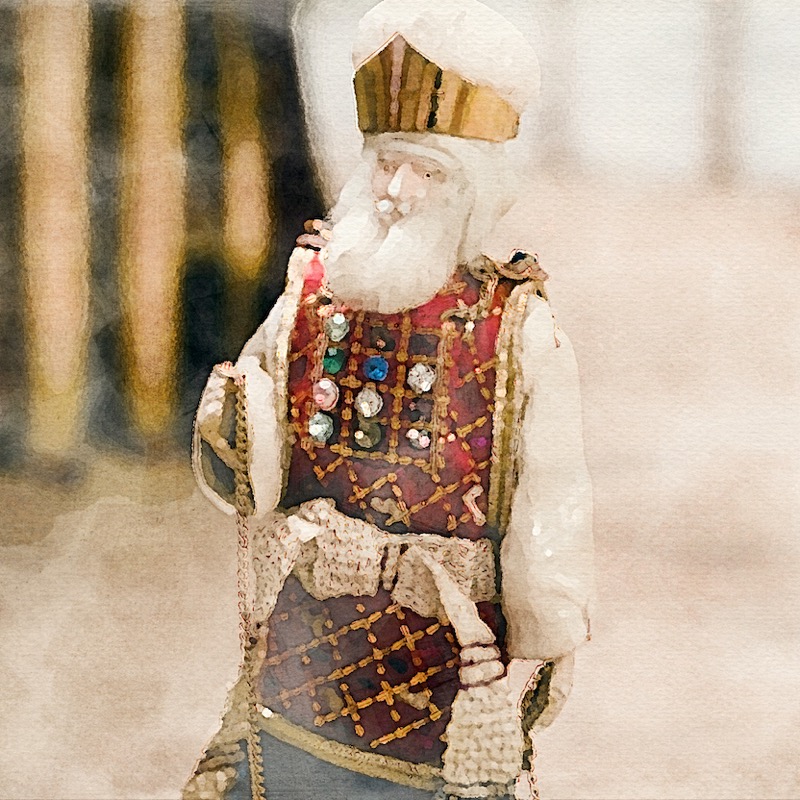
Gooding, David: 4 - Melchizedek, a Model
ID mfh_1141114780Date unavailableBefore 3.15Restored 4.66
So let's begin this afternoon by reading, uh, from our epistle to the Hebrews. Somebody read for us, please, so kindly, chapter seven, verses one to four. Chapter seven, verses one to four. For this Melchizedek, king of Salem, priest of the Most High God, met Abraham returning from the slaughter of the kings and blessed him, and to him Abraham apportioned a tenth part of everything. He is first, by translation of his name, King of Righteousness, and then he is also King of Selam, that is, King of Peace. He is without father or mother or genealogy, and has neither beginning of days nor end of life, but resembling the Son of God, he continues a priest forever. See how great he is. Abraham the patriarch gave him a tithe of the spoils. Thank you very much indeed. Yes. So now, uh, we remember, those of you at least who aren't here this morning, let's tell you what we were doing. We began this morning to think about our Lord Jesus Christ as priest. And we thought from chapter five of Hebrews what it is that priests need to be able to do for us, and what kind of people they have to be. And then we thought of our Lord and who appointed him. And we asked the questions and found them answered in chapter five. Who appointed him? And when was he appointed? And how was he appointed? We found the answer to be God appointed him, of course, at the resurrection, with all the tremendous pomp and glory of our Lord's ascension into heaven and his session at the right hand of God. And then we found out his qualification. His appointment then, now his qualification. Eh, and we thought of his experience and how, from what he suffered in his experience, he learned not to obey, but he learned what obedience involves. And thus it is, has become for us responsible for the author of eternal salvation. Now, if we were to read chapter five verses eleven to fourteen, we should find the writer is having a little word in the ears of those to whom he writes, and pointing out to them that they do really need to get hold of what he's saying about this Melchizedek. Only he says, some of the things we've got to say is very hard to take in, of whom we have many things, he says, chapter five verse eleven, to say, and hard of interpretation. Do you see? And that interests me because maybe we shall find it also a little bit hard, some of the things that are said in the course of these chapters, a little bit difficult to take in. And we shall be inclined to say, well, that's okay, what that chap's saying, but what has it got to do with me, and I don't see how it applies to me and my situation, and why should I really bother? Ah. We shall have to resist that kind of feeling because, you see, uh, let me tell you about these people. These people now were in the middle of very severe persecution, and some of them were going to find even bigger persecution, and one thing they needed to know, they needed supremely to know about the Lord Jesus as their great high priest after the order of Melchizedek. The thing that would help to keep them and to buttress their faith and to bring them through the tremendous pressures of that, uh, temptation and persecution was knowing about our Lord as high priest and experiencing his high priestly power, so that they might go to him to find the strength that they needed. Ah. Now the persecution was on them, and the very thing they needed to know, they didn't know. And yes, it was a bit difficult for them when they met it the first time to learn all this about Jesus as their High Priest. It seemed to them to be so strange. But then that's a little lesson and word in our ears, isn't it? Not only about this, but a lot about other things in the Bible. We come to the Bible and find certain things very difficult. We can't learn everything at once, can we? But even when we come across things that are difficult, Josie, it's not always wise to give up and say, well, I, I, I, I don't see the point of that. You say, right, I'm going to read it anyway, going to see what it's about, and if I don't see what it means at the moment, I'm going to notice it's there. Because you see, the Lord who knows what we're going to face in the future, to see, is telling us what we need to know. And we're wise to learn it even if we don't see the immediate relevance of it. Because one of these days, when the need comes, when the temptation comes, when the trial comes, when the pain comes, then it could turn out to be vital. So that, by the way, and let us now come to chapter seven and the passage we read. We thought of our Lord, his appointment as high priest, his qualification as high priest. Now in these verses, we're going to get an Old Testament model to think with about our high priest. Because the writer, do you notice that in Psalm one hundred and ten verse four, when God announces the appointment of his son as our high priest, he says, thou art a priest forever. And then he adds, after the order of Melchizedek. Yes? What does he say that for? Well, to turn our minds back to the Old Testament, where we read about the priest called Melchizedek, and who he was and what he did. And as we read that story, we are being given a model by God to use, to think with, that will help us think about the Lord Jesus and what one of the things he can do for us in his high priestly ministry, and to see illustrated also who the Lord Jesus really is. Now, that's an interesting thing. Let me say this again, by the wayside. When we, uh, come to know the Lord Jesus and necessarily we, we want to know his word and we start Bible study, and it can be a little bit difficult. What I like about the writer to the Hebrews is you can actually catch him at his job doing his Bible study. It's a really interesting thing to watch other people doing Bible study, isn't it? I don't know if you'd like people looking over your shoulder when you're doing your Bible study, how you go about it. But this writer, he, he makes it pretty clear how he goes about Bible study, you see. He first of all says, now, uh, look at that verse, it says, thou art a priest forever after the order of Melchizedek. Well, who's saying that? Oh, it's the same person that says, thou art my beloved son, do you see? This day have I begotten thee. Ah, and he puts two and two together, and he says, when was that said? And we find the psalm says, oh, I know when that was said. He said, first of all, sit at my right hand, and then he said, thou art a priest forever. He's doing his Bible study, you see. So now he comes across this bit in the Psalm, thou art a priest forever after the order of Melchizedek. Melchizedek, yes, who knows Melchizedek. You see. I don't know whether he had a concordance or whether he knew it off the heart. I don't know whether you would. Where to find Melchizedek? But eventually he found him, of course, and said, I must look into this Melchizedek fellow because our Lord is a priest after the order of Melchizedek. That's an interesting way of doing Bible study, isn't it? And we shall notice this from time to time. I will take a verse of the Bible and will concentrate on every word in turn, emphasizing this word, then the next word, then the next phrase, then the next sentence, until he has squeezed all the juice, uh, he can out of that particular orange. So we better follow him, hadn't we? Our Lord is a priest forever after the order of Melchizedek, righto? Let's take the hint and read about Melchizedek. It's found, of course, in the book of Genesis, as you know, and, uh, in chapter fourteen. Let's take the story bit first and then look at the extra things this writer observed. Here is the story of Melchizedek, and it's in chapter fourteen. which tells how, uh, Abram's nephew Lot had been captured, uh, by some raiders, some raiding kings, and Abram had gone out and rescued Lot and brought him back. And here we are now, early morning the next day, and Abram is coming back with all the spoil, you'll see. Somebody read, please, the the delightful story. It's uh Genesis fourteen from verse seventeen onwards. Any hard words you come across, you can say wheelbarrow in the place, because they are. The king of Sodom went out to meet him after his return from the slaughter of Keraleomer, and the kings that were with him at the vale of Shaveh, which is the same as the King's Vale. And Melchizedek, king of Salem, brought forth bread and wine, and he was priest of God Most High. And he blessed him and said, Blessed be Abraham, uh, of God Most High, possessor of heaven and earth, and blessed be God Most High, which hath delivered thine enemies into thy hand. And he gave him a tenth of all. And the king of Sodom said unto Abram, Give me the persons, and take the goods to thyself. And Abraham said to the king of Sodom, I have lift up mine hand unto the Lord, God most high, possessor of heaven and earth, that I will not take a thread, nor a shoe latches, nor aught that is thine, lest I should say, I have made Abram rich, save only that which the young men have eaten and the portion of the men which went with me, Aner, Eshko, and Mamre, let them take their portion. Thank you very much. So what a delightful story it is, and I'm sure the writer won't mind if we take that in first, an illustration of the Lord's priesthood and what he can do for us. He's after the order of Melchizedek, and here is the earthly Melchizedek and what he did for Abraham. And the situation, if I might sketch it in very briefly, is this, that Abraham, uh, had gone out and rescued his nephew Lot and had come back with Lot and the, uh, his wife and then all the goods, you see. Abraham being quite a large, uh, a very, very powerful sheikh in those days. He had a servants, about eight hundred of them, that he could form into an army, and he'd won this battle against, uh, united kings. Uh, do you see, he was some, uh, big chief, was Abram. He wasn't just a little grocer man from around the corner. He was a big, uh, sheikh, do you see, uh, almost a king himself. But anyway, he had won this battle. He was coming back with the spoil, and unbeknown to him, the king of Sodom was about to come out and make Abram an exceedingly tempting offer. He was going to say to Abram, all right, Abram, you, you take the goods and you give me the persons. And that was a tempting offer, wasn't it? You see, the goods that Abram brought back, they, they belonged to Sodom, so to speak, and Sodom was saying, now, Abram, I give you the goods. Now I'm not now going to discuss, well, that would take us a long while, what would have been wrong in taking those goods. Though, as you hear Abram say at the end, I'm not going to take a penny, not a farthing, not a shoelace. Thank you very much, much, your Sodomic majesty. I'm taking nothing. Lest anybody would say that the king of Sodom has made Abram rich, and that would be a, a ticket to go to bed with, wouldn't it? Imagine that getting round, uh, Lurgan or Cookstown or anywhere else, the king of Sodom has made somebody rich. There's a lot of richest pickings to be got out of certain kind of trades, gentlemen. And sometimes the temptation comes very strongly, doesn't it? Mm. And here is Abram going to be under this colossal temptation with all these goods. He's not going to himself going to be involved in doing what they do down in Sodom, but Sodom is going to enrich him. And he's going to be a- made to ask the choice, you'll see, take the choice. You take the goods and let me have the persons, says the king of Sodom. He's always saying that, is the king of Sodom, for in the end he'll take the persons and ruin them. So Abram was going all of a sudden to be faced with this great temptation, and after a battle he'd taught- gone all night and taught up with his army and and and slaughtered them, and coming back now, victorious, of course, but absolutely tired out and worn out, I suspect, now going to meet this exceedingly subtle and tremendous pressure of temptation. How would he come through? At what was, as we re- find out if we read the whole story of Genesis, an exceedingly critical moment in his life. He was going to choose now between going for goods, money, chattels, or for persons. Just like our Lord would later say, centuries later, what shall a man profit if he gained the whole world and lose his own soul? Yes. What shall a man give in exchange for his life? So Abraham was coming up to this temptation, and what would have happened to him, I wonder, had it not been for this that God saw it in advance? And just as we might say in the nick of time, though God had planned it, out came from apparently nowhere this, um, king of Salem, and he was priest of the Most High God and met Abram as he was returning, just before the temptation assailed him, and ministered to him, and gave Abram the strength to meet the temptation and come through with flying colors. And how did he do that? Oh, well, listen again to what the story tells us. This, uh, Melchizedek, he was priest of God Most High, and he blessed Abram and said, blessed be Abram of God Most High, possessor of heaven and earth. And you know, that wasn't just words. It wasn't just a question of reciting a prayer book or something. When the great priest Melchizedek came out and led by God and by the Spirit of God, he pronounced the blessing of God on you. He made that blessing real to you. And there as old Abram stood, tired and weary with his journey, suddenly there came in front of Abram's eyes this, this vision, this comprehension, this sense of God Almighty, founder and possessor of the whole universe. And in that moment, there filled Abram's soul a sense of the vast wealth of God. This was the God that was going to say to Abram a few days later, in chapter fifteen, and the early verses tell us, fear not, Abram, I am thy shield and thy exceeding great reward, Abram. And Abram fortified by that, this vision, this sense of the reality of God, possessor of heaven and earth. That when next Sodom's king came and said, look here, you take the goods. Abram, I did what, I guess was a temptation. Goods? What do I want your goods for? Listen to what he says. Uh, you'll see. Abram said, verse twenty two to the king of Sodom. Now listen to what he says. I have lift up mine hand unto the Lord, God most high, possessor of heaven and earth. You say, where did he get that idea from? He is, he's just echoing back what Melchizedek has told him. Only not like a parrot. Ah. Abram now has come into the good, uh, uh, in his soul of God as possessor of heaven and earth, and he says, I've lifted up my hand to the God, most high possessor of heaven and earth, and Melchizedek's ministry has done its job, and in the strength of it, Abraham says no to Sodom's paltry goods. Wouldn't take a shoelace from you, he says. Don't need it. Yes, and I fancy that is what our Lord still does, doesn't he? How does he help me in temptation? He can't take the decision for me, can he? As it wouldn't be my decision. He can't stand in my place and take the temptation instead of me. He's got to allow me to decide. Oh, but he comes. And his ministry to make God so real in my heart that I'm strengthened in order to make the decision and take the right decision. Yes. And that's a model, says Hebrews, that we could use to think about, uh, the ministry of our Lord Jesus. Very interesting, isn't it, to, um, see where the Lord Jesus himself used that phrase. He did, didn't he, when he was here on earth. Ah, do you remember where? Oh. Well, let's see if we can find it. Let's go a hunting, and, uh, uh, the gospels, uh, all have it, do see, and some of it, um, some of them have it slightly differently, uh, from others. Uh, let's see. Yes, Luke chapter ten is one place. Luke chapter ten, verse twenty one. Would somebody like to read it? Verse twenty one and twenty two. Luke chapter ten, twenty one and twenty two. At that time, Jesus, full of joy through the Holy Spirit, said, I praise you, Father, Lord of heaven and earth, because you have hidden these things from the wise and learned and revealed them to little children. Yes, Father, for this was your good pleasure. All things have been committed to me by my Father. No one knows who the Son is except the Father, and no one knows who the Father is except the Son and those to whom the Son chooses to reveal him. Ha, very good. Here's our Lord using the very same phrase as Abraham used, and Abraham got it from Melchizedek of the Lord Most High, uh, possessor of heaven and earth. And you see the context? The early part of that chapter tells how he had been rejected, verses thirteen, fourteen, fifteen, and sixteen, how he had been rejected by the big cities, Chorazin and Bethsaida and Capernaum in his day. And here he was standing by the roadside, so to speak, uh, with a few disciples, uh, they were a poor bunch, to say the best, weren't they? A few fishermen and and so on, and oddments that he collected. And the big, polished, civilized cities of Capernaum generally had rejected him. Our Lord isn't down in the mouth, rejoiced in spirit. How's that? Oh, well, he says, I thank thee, Father, Lord of heaven and earth. All things have been delivered unto me of my Father. Yes. And you, you picture the sense of wealth coursing through the Savior's heart at that very moment. And the sense of his authority. No man knows who the Father is, save the Son, and he to whomsoever the Son willeth to reveal him. That sense of his unsurpassed wealth in the knowledge of the Father and his ability to impart that wealth to others. And seeing in that, as you notice, a secret of victory over Satan. Look at verses seventeen, eighteen, and 19. As the disciples come back recording their victories over the power of the enemy, and he says, I've given you authority to tread upon serpents and scorpions and over all power of the enemy, and nothing shall in any wise hurt you. Yes, victory there on the roadside in Galilee. The Son knowing the Father, sovereign Lord, possessor of heaven and earth. And he who in the days of his flesh learned obedience, now a high priest forever after the order of Melchizedek, does precisely that for you and me. He puts into our hearts the sense of the wealth of God. And that is a good thing to let the Lord do that for you, you know. Says Paul writing, uh, his first, his letter to the Christians at Ephesus. He says, I pray for you that God would open your hearts. What for? So that amongst other things, you might see what is the exceeding greatness of his riches, of his inheritance in the saints. That sense of wealth will take you through many a crisis and many a persecution and many a difficult decision and many a suffering when the Lord will call on you to suffer loss and pain for his name's sake. Allow yourself, allow the Lord to get across to you the wealth of God. Yes, but to come back to to, uh, Hebrews. Hebrews seven, There are other respects, says the writer, in which this ancient figure, uh, uh, Melchizedek is a model of the Lord Jesus. He take, for instance, he says his name, verse two. He is king of righteousness, then he is also king of Salem. And in case you don't know Hebrew or Aramaic either, in his kindness of heart, he translates it for you, for Salem means peace, he says, so he is king of peace. Mel, you say, where did he get the righteousness bit? Oh, he's interpreting the man's name. Melchizedek, king of righteousness. You say, what did that mean? Well, I suspect that the first Melchizedek who had the name, it really meant originally he was the lawful king. You see, as a sink, say, from a man of sin who is the unlawful imposter, this is the king of righteousness, he is the true and lawful king. But it also surely will mean that he is a king of perfect justice, perfect righteousness, and perfect peace. How can he be both? You see, our Lord is a king, he's a king priest. He brings us into peace, but it will be on the basis of perfect righteousness. We needn't say more about that now, need we? But, uh, even as we think about that, all sorts of memories of the Epistle to the Romans will come in. How can we have peace with God? Well, it's a peace, says Paul, founded on God's very justice, that God might be just and yet the justifier of him who believes in Jesus, so that God can give us peace and we have peace with God, not because God has brushed our sins under the carpet and forgotten about them pro tem, but because God has found the perfect answer to our guilt in the sacrifice of Christ, and with perfect justice can give us perfect peace. King of righteousness, king of peace. And then says the writer, verse three, he's made like unto the Son of God. What do you mean he's made like unto the Son of God? Well, he is in the story of Genesis, that's what the writer is talking about. That in the story of Genesis, this Melchizedek, he suddenly comes on to the stage of history. There's no warning, there's no introduction. We're not told who his father was or who his mother was or anything like that. Vus, he comes onto the stage of history, he ministers to Abraham, and gone, he's gone. You never read of him again until you come to the Psalms. And says the writer, you know, it's not only what scripture says is important, but sometimes it's what scripture doesn't say that is important. And in telling us this story about this Melchizedek, who himself did have a father and mom, of course, and did have beginning of life and end of days, but that isn't the point. In telling us the story, the Holy Spirit has told us the story in such a way as it becomes a model of the Lord Jesus. And so you're not told who his father is and who his mother is, and you're not told when he was born, and you're not told when he died. Because the Holy Spirit is not only recording what happened, but is recording it so it should become a model for our thinking and point us to the Lord Jesus, who is a priest forever after the power of an endless. And he has this testimony that he liveth. Jolly good. We can, uh, pass over that now. We shall find that having made those points from Genesis, the writer will come back to that later on, so we can tuck it up under our cap, so to speak, and proceed down as we work down chapter seven and come, uh, to the end of the chapter. And he now makes one more point from the story of Genesis. Look, he says, that ancient story of Genesis shows you, doesn't it, that our Lord Jesus is better than Aaron the high priest and all those priests that worship in the Jewish temple. You see, even that story in Genesis shows you that. You say, how does it do that? Well, he says, look at our great ancestor Abraham, that when Melchizedek came out to him and gave him bread and wine and blessed him, Abraham responded by giving to Melchizedek a tenth of all the spoil. Do you see? And paid tithes to Melchizedek. Melchizedek must have been the more important figure then. And then, says the writer, you notice what the story says, that Melchizedek came and it was Melchizedek blessed Abram, if you please. It wasn't Abram blessed Melchizedek, was it? So again, Melchizedek was more important than Abram, and Abram owned his superiority by paying tithes to him. And now then, says the writer, you will see that our priests, our Jewish priests, come of the tribe of Levi, Lai. They are descendants from Abraham. Yet the man from whom they descended owned that Melchizedek was more important. More important than Abraham, more important than any of his seed here on earth, which Abraham acknowledged. This Melchizedek, therefore, more important than Abraham and Levi who descended from him, becomes a picture of our Lord Jesus. If our Lord Jesus' priesthood is after the order of Melchizedek, it is far more important than any other priest who comes from the family of Abram. Yes, and you say that doesn't mean much to me. Perhaps it doesn't. It meant a lot to the Jews. Ha, and we're not Jews, so never mind, let's push on. For now you're going to watch the writer do a very delicate thing. Ah. And you'll see the skill with which he does it. He's just been talking to them about the Lord Jesus, these Hebrews, and they were born Jews, born under this system of worship. They were born Jews. Now they've come to see that Jesus is the Messiah, and he's been telling them about Jesus the high priest, that marvelous, and he's even more important than Aaron. Oh, that is marvelous. Yeah. And I suspect some of them were saying, well, we're fortunate, aren't we? Now we've got two priests. Ha! We can have Aaron and we can have Jesus, you see? Good, isn't it? The writer's got to get it across to them. No, you can't. You can't have both. Because that's a ticklish thing to do. I don't know if you've ever tried to do it with a Jew, because they don't go much for Aaron these days, didn't they? But you imagine it. How on earth will he do it? So let's follow, and even if it doesn't mean anything much to us, because we're not Jews, let's watch him at the job. It's a lesson in how to handle people, isn't it, Watho? For it says in verse eleven, if there were perfection through the Levitical priesthood, for under it the people has received the law. What further need was there that another priest should arise after the order of Melchizedek and not be reckoned after the order of Aaron. To say, for the priesthood being changed, there is made of necessity a change also of the law. Argument number one. Why did God have to have this second priest after the order of Melchizedek? If the first priesthood had been good enough, you wouldn't have needed a second one, would you? Why did God introduce the second one? The implication is, of course, that the other one wasn't good enough. And always he's going to show later on, of course, it wasn't good enough. It could never bring you forgiveness of sins, that other thing. The sacrifice wasn't good enough. So, uh, yes, it wasn't good enough. The answer is that perfection was not by the Levitical priesthood. Why mention the second one? Because he says, you realize, don't you, that if the priesthood is going to be changed, then the law has got to be changed. You say, how's that? I don't see that's followed. Why can't we still keep the old law? Ha. And, uh, have Jesus and the Old Testament priest as well. No, you can't. Do you see, because if our Lord Jesus had been, uh, uh, uh, on here on earth, and that old law was still in force, he couldn't have been a priest in the Jewish system, could he? For the law said that, uh, and here we go on, you'll see, uh, uh, verse thirteen: for he of whom these things are said, that's our Lord, belongs to another tribe from which no man hath given attendance at the altar, for it is evident that our Lord has sprung out of Judah, as to which tribe Moses spake nothing concerning priests. And you see what he's pointing out to the dear Christians? You know, if the Lord Jesus, when he was here on earth, had attempted to go into that temple and take the place of the priest, they'd have executed him, wouldn't they? He couldn't be a priest in that system. Now he's a priest, the law will have to be changed then. Yeah? You can't have any system of which he isn't the high priest. You can't have two high priests, can you? Because one would have to be the higher priest, wouldn't he? You can't have two high priests. If Jesus is going to be the high priest, says the writer, the law will have to be changed. And that does away with Aaron as high priest. They'll have to choose. And what we say, says verse fifteen, is more abundantly evident if after the likeness of Melchizedek there ariseth another priest who has been made not after the law of a carnal commandment, but after the power of an endless life. For it is witnessed of him, thou art a priest forever after the order of Melchizedek. And now here's our man, he's gone back to his verse in Psalm one hundred and ten verse four, Thou art a priest. Now thou art a priest after the order of Melchizedek. And now he's fastening on the middle words and underlining them in his thinking. Thou art a priest. Oh, he never ceases to be priest. Well, what does that mean then? Well, he takes the example of Melchizedek in, in, in Exodus and, and Genesis and says, look at that, here is a priest, not beginning of life nor end of days, he abideth a priest forever. What does that imply? Well, look, you'll see, when this dear old chap, he was made priest, he hoped as soon as he could. He didn't want his father to die too soon, but then he would like to be priest, you see, so he hoped his father would die reasonably soon, you know, well, seventy or perhaps sixty or, you know, if he went at fifty five, well, you know, it'd be a great pity, but then that would let him be priest. And he was a high priest. And then, of course, when he got to ninety nine and a half, he died as well, and he passed on, so then there was another high priest. What would you do if he lived forever? That would be the end of all other high priests, wouldn't it? That's the end of Israel's system. Because our Lord never ceases to be high priest. He never passes on the high priesthood to anybody else. Yes? That means the Old Testament law will have to change then, won't it? Because the Old Testament law said that the high priesthood had to be handed on to one and the other. Not now. One high priest only. And he never hands it over to anybody else. Doesn't need to, because he lives forever. So the old Jewish law then has got to be changed. And so we come to our lovely verse. There is a disannulling of that old commandment. Oh, thank God, for we shan't shed any tears ourselves, shall we? Perhaps if the Jews shed a few tears, we shan't shed any. To see that that old system is gone because it was weak and unprofitable, there is the bringing in of a better hope by which we draw near to God. And having gone through the difficult things, now let's sit back and enjoy the easy things, oh, because they're delightful. Our high priest, therefore, he automatically makes obsolete all other high priesthoods. For see, he is superior. Now we come back to this idea that our high priest is better. Look at verse twenty. And inasmuch as it is not without the taking of an oath... And then a parenthesis, verse twenty one. For they, that is the Jewish priests, indeed have been made priests without an oath, but he with an oath by him that saith of him, the Lord swear and will not repent, thou art a priest forever. Look at that, there's our man at his Bible study again. There he is back in Psalm hundred and ha, verse four, and he's not only noticed God saying, thou art a priest, and not only noticed and underlined it in red, uh, after the order of Melchizedek, and when he got back from Genesis, uh, fourteen and thinking about that, then he noticed the words in the middle. Oh, forever, ha ha. And then he's, oh, another bit to this, and he noticed that the Lord has sworn and said, and will not change his mind, thou art a priest forever. And he says, look at that, he was made a priest with the swearing of an oath, whereas those Jewish priests weren't. There was no oath when they got, uh, installed as priests. So now what's the significance of this? Why, when God appointed the Lord Jesus as priest, did he swear an oath, by myself have I sworn, says the Lord, and not change his mind, thou art a priest forever. What does that indicate, therefore? Well, the writer tells us what it indicates. Verse twenty two: By so much also hath Jesus become the guarantee of the new covenant. Yes, so this now, now's begin to affect us, doesn't it? Notice, please, the word not, it doesn't say here the mediator of a new covenant. It says the guarantee, the guarantor of the new covenant. And you say, what is the difference? Well, the mediator is a man that comes between two people, like a solicitor when you're trying to sell your house. Uh, I not always, uh, understood all the details that cost so much, but never mind that at the moment. Uh, do you see, you're selling a house, and here's Joe Blow's got the house, and he's got the man's got the money, and the solicitor comes in between, and he has a lot of organizing and signings and things to do and hard, difficult words he writes down, do you see? Uh, uh, he's the mediator between the two. Yes, but this isn't that. This is the guarantor of the new covenant. And what that new covenant is, it's a tremendous program. We shall think about that tonight. Uh, the new covenant that's got to be put into operation. It's the new covenant that spells our salvation, that God will write his laws on our hearts, and their sins and iniquities I will remember no more forever. How serious is God? You want to be saved? You come to this Jesus for salvation. You've heard that God has got a salvation and God has got a scheme. It's called the New Covenant, actually. It talks about God writing his law on our hearts. It talks about God's forgiving of our sins. But how serious is it? And will it work? And will we see it through to the end? Who's going to? Ah, that's right. Hmm. Because if it were only somebody, uh, selling a house and you were going to buy it, you'd want to know you got the cash to see it through, wouldn't you? You're coming to buy my stately home for two and a half million? Oh, that's very nice. And we're going to sign on the dotted line here. Excellent, sir. Now, would you mind, uh, telling me, uh, who your bankers are? Do you see? Because it's all right you signing on the dotted line, old chap, but if you ain't got the cash to pay it, uh, we're not interested in you. Put it bluntly. You make a lot of promises about you'll pay it by weekly installments. You, you don't buy stately homes at two million and a half by weekly installments. Who's your guarantor? That the whole scheme is going through. Ha. And we come to God for salvation, because some scheme, isn't it? It starts here, and it's going on to eternity. Who's going guarantor? To see the scheme is going to be put through. God, that's a thing, isn't it? Not just to start, but to bring us through life and through life's temptations and through all life's testings and trials, and bring us not only to worship God now, but bring us at last into the very presence of God, physically and bodily and perfectly like Christ for eternity. A colossal great salvation. Oh, it's only, uh, it's all right making promises, but who's going to guarantee that they're going to be fulfilled? And here is the wonderful assurance of God's word. He was made a high priest with an oath, it says, for God himself. You say, well, how did he come into it? What was he, was he swearing an oath for? Well, the high priest is God's provision for the likes of you and me, so that we shall come to him and trust him, and that the high priest will keep us through our temptations and bring us through life and bring us home to glory. And God says, I guarantee to you that this salvation will work and that it will last, for I'm going to provide you with a priest, and what is more, just to settle your mind and give you the courage, um, this priest will not, uh, suddenly go fat or fade out or abandon you. I'm taking an oath on it, says God. Thou art a priest forever. The Lord has sworn and will not change his mind. Oh, what a thing to get hold of, isn't it? God's oaths. There's one of them in chapter six, and we shan't have time to talk about that, and this is the second one of them. God's oaths for our security, for God wants us to know that we are eternally secure. So he is not simply the mediator then, but being appointed with an oath, the oath shows that he is the guarantor for the fulfillment of all that great new covenant. And then look at verse twenty three onwards. Somebody be so kind as to read verses twenty three, twenty four, and twenty five just to remind us of the verses that we know so well. Now there were many of those priests, since death prevented them from continuing in office. But because Jesus lives forever, he is a permanent priesthood. Therefore, he is able to save completely those who come to God through him, because he always lives to intercede for them. And now the writer is picking up that bit that we found before, that he lives, he has this testimony that he liveth. The Psalm having said, thou art a priest forever after the order of Melchizedek. When the writer went back to the story of Melchizedek, he saw their indications, how the Holy Spirit had inspired the record of the story to get across that this priest lives forever. And what is the significance of that? Why is that important? Well, because he lives forever, you'll see, he doesn't have to give up his priesthood and hand it over to somebody else. You'll see, let it be anybody you like. You know a delightful believer, and you come to him in your sorrows and tribulations, and you ask his advice or her advice, and they give you their advice, and they pray with you, and they pray for you, and you feel very comforted, and you lean on them and come back next year, and they died, run over of a car or something, or died. And there's you all standing by yourself, and you say, but nobody knows me, and I do talk to people don't understand me. She understood me, but... Ah, that'll never happen to you in Christ. She never dies. Never grows weary. Never gives up. And because he ever lives... to make intercession. His intercession is ceaseless, and therefore he is able to save to the uttermost those that come to God by him. And you know what? You have his undivided attention. Do you see? Look at what the chapter finally says. For such a high, although somebody read it there, lovely verse, somebody read verses twenty six to twenty eight. Such a high priest meets our need. One who is holy, blameless, pure, and set apart from sinners, exalted above the heavens. Unlike the other high priests, he does not need to offer sacrifices day after day, first for his own sins and then for the sins of the people. He sacrificed for their sins once and for all, and when he offered himself. For the law appoints the high priest, men who are weak, but the oath which came after the law appointed the Son who has made perfect forever. Mm-hmm. And that is pointing to this simple fact again, that in Israel, if you came as a sinner, uh, to God, uh, and you wanted to get right with God, so to speak, and you came to a priest, well, poor priest was a sinner himself. He couldn't always attend straight away to you, he'd got to attend for himself. Been knocked out of action because he was defiled by sin or some other ceremonial defilement or what have you, so he was off action that day. He got his own sins to worry about. Huh? We need a high priest that can give us undivided attention, you know. He hasn't any sins of his own to worry about. He doesn't need first to put himself right. Now, don't mistake what the, the, the Greek is saying of that verse, wasn't it? When it adds this he did once, it's not saying that he once upon a time had to offer a sacrifice to put his own sins right, for he never did have anything. But, you know, he doesn't have to say, well, I shall have to look around for a sacrifice, my good man. No, that's already been done centuries ago. This he did once. Oh, what a lovely thing. How can God, I wonder how you have, if you were God, how how would you go about assuring folks' hearts more than he has done? Of the tremendous salvation and assurance that he offers you in Christ. Such a high priest, now should we notice the verb, became us, was suited to us. That's an extraordinary statement. God has fashioned a high priest, so he should be absolutely suited to us. Exactly what suits us and is becoming for us, who himself is absolutely holy, undefiled, separate from sinners. There's no corruption in him. If you look at the world's religions at large over many centuries, gentlemen, I'm not throwing stones at anybody, but if you are anything of a historian and you have looked at the world's priesthoods of all kinds and sorts of religions, Christendom not accepted, one of the major scandals has been a corrupt priesthood. Men telling those that come to them it doesn't matter. Why? Because they themselves are guilty of the same thing. What use is a priest like that? Such a high priest became us, who himself is absolutely holy, harmless, what does it say? Uh, do you see? Holy guileless. Undefiled, separated from sinners. And yet that holy priest will never compromise with our sinning, has no underlying sin himself that would want to make him compromise, yet gave himself once as a sacrifice for our sins, and now lives to be our intercessor, responsible for eternal salvation, and the guarantor of the new covenant. And you'll see he doesn't have to do it a second time. He doesn't need daily to offer up sacrifices for himself. No. Verse twenty eight finally makes the point that whereas the Old Testament law appointed men high priests who had weakness, the word of the oath that we've read of from Psalm one hundred and ten verse four, it appoints him who is the Son of God, perfected forevermore. And we've already seen what the word perfected means. Qualified. He has been through all the experiences necessary to qualify him as our high priest. He doesn't have to go through them again. His sacrifice is finished. Yeah, yeah, we know that. We've known that for years. Yes, but his qualifications are finished. The path he lived on earth, the life he lived, demonstrated him perfect, sinless, holy, harmless, and undefiled. The temptations that he went through tempted a whole gamut of experience as we are, and proved sinless. Gethsemane and Calvary overcome. Then that's finished forever. He's qualified for all eternity. I don't know what you're proposing to get going two and a half million years from now. What kind of schemes you'll be at. And what kind of needs you will have? What are you talking about? When I get down to heaven, I shan't have any needs. You won't. Oh, you'll be independent of Christ then, I suppose. So when you come through the door of heaven, you'll say, well, thank you very much, Lord, for having supported me all this while. Now I shan't need your help anymore. Yeah? Fancy not. Whatever your needs are to the remotest bounds of eternity, learn this, that your Lord is already qualified to see you through. Tremendous, isn't it? And of the point I'm saying, says the writer in chapter eight, verse one. now do get hold of it, if you hadn't noticed, now the chief point in what I'm saying is this: we have such an high priest. Oh, my brothers and sisters, let it ring in your heart as the chief point of this part of scripture. It is a fact we have such an high priest. Well, now I'd just like to throw it open to any comments, maybe things they've learned through what Dr. Gooding has said, or maybe questions, but I suppose firstly comments. I, I, I have a question that I would like to ask about, uh, eternal, eternal secure. Mm-hmm. How do I know, uh, that I'm eternally secure here when the, the scripture also says, uh, in Revelation, he that taketh away from the words of this book, the prophecy of this book, I'll take away his name out of the Lamb's book of life. Mm. And that's one of the things that he said, rejoice not in that the spirits are subject to you, but rather your names are written in heaven. Mm. And also it says in, in Galatians, where it says there, I think it's Galatians, where it says, um, he that is once enlightened and has tasted a heavenly gift, if he turn away, it's, uh, impossible to renew him onto repentance, he is crucified. Mm. So how, how does that work in with, with... The idea of being a town we secure? Yeah. Yes, well, that's a very good question. That is exceedingly good question. And I fancy to answer it, uh, adequately, uh, as you would want it answered. Yes, we ca- we cover the New Testament. It's not one of those things to be, uh, answered very superficially, is it? It's a very profound question. In fact, between you and me in the gatepost, I'm trying to write a book on it at the moment. You, uh, do I gather you yourself feel that, uh, no, you, we can't really be eternally secure? Remember, numbers of very sincere Bible students take the view, no, you can't be sure of salvation in that sense, you can't be eternally secure, saved up to the moment. I, I, I used to, I, I, in my previous background, I have been brought up to believe that, and, and was very strong advocate for saved and lost, but recently, uh, over a period of, I suppose, two years, I've rethought the thing out, and I can't make a a comment on it. I I'm just leaving it that if one person says yes, eternal secure, and another person says no, I I I can't have scripture, uh, to say either way. Uh, you get the verse where it says, um, he that believeth in me shall not come into condemnation. Mm-hmm. And then you get the verse that says in, in John, I, I am the true vine, and, and it said, uh, every branch that beareth fruit purges it, and, and those that don't, he takes them away. Mm-hmm. And they're burned Mm. in the fire. Would that be suggesting then that, that you weren't there at any stage? You're bound to be there at a stage, you see, because the fact that you were branches, you were branches, and they took them away. Mm-hmm. Mm-hmm. Well, those are scriptures that I... No, surely, yes, yes. Um, yes, I, I think it's a very pr- uh, I, I, this is a thought that occurs to me. Would it be an idea to have a session on this? Let's do that. Would you be interested to have a session on it? Yes. Yeah, everybody, everybody votes. Two hands? Well, we'll have a proper session on it. Yes, and have folks, um, because here's one good man's been thinking, obviously some of you have been thinking. Uh, let's all pool our, what the Lord has shown us. Yes? And, and have a real session on it. It comes, you see, uh, as you'll see, has come out of remarks I've made, but what I've made, uh, has come out of, as this passage, I understand it, this tremendous emphasis of God about his guarantee, do you see, and why we have a high priest. And it is interesting to me that it is this very same epistle that from which you quote those that fall away. Yeah. Do you see, and so forth and so on. So why don't we do that? Why don't we devote, uh, a a a a full session on this, or as long as it takes, and have, you know, not just quoting an odd text here and there, but really going into the thing quite substantially to see as far as we can what scripture does teach on this matter. It's a question rather than a comment. Which do you want first? Let, let's have the comments first, if anybody has a comment. Anything that struck them off. Anybody? John? I was just thinking earlier, but it's maybe it's a bit irrelevant on the another hit piece, that you said that Milchizadek had neither, neither parents, you know? Mm-hmm. Uh, it seems somewhat of a mystery riding Milchizadek. Sure does, yes. Am I even seeing that? Mm-hmm. No. Oh yes, that is true, and some people have felt that, uh, Melchizedek was literally without father and mother. They take Hebrews s- uh, 7 to mean that he was literally without father and mother. And when it says he was made like unto the Son of God and abides a priest forever, they say, yes, this must be nothing short of a theophany, that he wasn't human. And this was, uh, uh, a appearance of God, a Christophany, if you like. Just like, for instance, the angel of the Lord came to Jacob. And when Jacob said, what is your name? He said, why do you ask after my name? It's secret. Or like the angel of the Lord came to Noah and his wife. And when they asked him his name, he said, no, it it is wonderful, it is secret. And if you offer a sacrifice, you must offer it to the Lord. And when they offered the sacrifice, he put forth his staff, and the fire came out and consumed it, and the angel of the Lord went up in the smoke to God. And they realized at once that this was not an ordinary prophet, this was, uh, the angel of the Lord. And Manoah said, we shall die because we've seen God. Do you see, and some people have felt that Melchizedek that suddenly comes out into, in, uh, to meet Abraham and disappears, and you'll never hear any more of him in Genesis before or afterwards, was an appearance, a theophany, appearance of the angel of the Lord, second person of the Trinity, before his days of his incarnation. Do you see? Some people hold that view. It seems to me, however, that there's a one very big difficulty in that view. It is said he is made like the Son of God, says Hebrews. Hm. Can't be the Son of God then, can he? He's made like the Son of God. Do you see? And then he was, of course, King of Salem. And though you can't pinpoint it on the map, presumably that is the name of what later became Jerusalem, but, uh, he's King of Salem. So while you're not given his genealogy in Genesis, you are told his location. Do you see? So for my part, yes, I respect the other view that, uh, some people feel he's a theophany. I point to the phrase he's made like the Son of God. Not was the Son of God, but made like him. And if you say, in what sense was he made like him, then I think what the writer is saying is that in the story, the Holy Spirit has so selected the details about him as to make him a vivid picture of the Son of God. Yes? The being made like is, uh, being made like in the record of Genesis. Mm-hmm. In the same way as the Holy Spirit has so selected the material about the story of Hagar and Ishmael, that Paul in Galatians can say, well, of course, this is also an allegory, and Hagar represents Jerusalem under the, under the old law, and Sarah represents the Jerusalem which is above, that is the mother of us all. The story is so told in Genesis, the details so selected, as it can be now used as God intended it, as well as a historic event, as also an illustration of higher things. Yeah, but... Hmm. Thank you. A- any other comments at all? Or questions? Professor Good, I might be jumping the gun here. I'm not sure what you intend to move on to, but if I am jumping the gun, please just tell me to hold it. Um, as I want to clarify something, first of all. If I've heard you correctly and understood it correctly, then the high priest was the only one who could enter into the Holy of Holies. Yes. The only one who could enter into the very presence of God. Well, then I was reading a few verses attached to a reference you used earlier on today. It's in Hebrews ten, Yes. And it starts at verse nineteen. Therefore, brothers, since we have confidence to enter the most holy place by the blood of Jesus, by a new and living way opened for us through the curtain, Yes. that is his body, and since we have a great high priest over the house of God, let us draw near to God with a sincere heart and full assurance of faith, having our hearts sprinkled to cleanse us from a guilty conscience and having our bodies washed with pure water. It's just this analogy between Melchizedek the high priest and Jesus Christ the high priest. Yeah. It's just like, is there not a very important difference here in that Melchizedek would have gone in to present the petitions of his people to God, whereas through Jesus we actually go into the very throne room of God to present the petitions ourselves. Ah, yes, very good question, sir. Very good question. We are not, as far as I know, because the record of Melchizedek in Genesis is deliberately short, as you've heard the writer say. So we're not told what kind of a temple he would have served in. As far as archaeologists can show us what kind Canaanite temples were, and he would have, if he were a real person of those times, he would have been a Canaanite. We have some idea what the shape of Canaanite temples would have been, do you see? Uh, we've dug some of them up, and uh, I said the archaeologists have, but their uh, holy place and then their most holy place and steps leading from one into the other and um, uh, incense altars on the steps and so on, do you see? So we know a thing or two about that kind of temple, do you see? But to, to start with the Jewish one, which is now what the writer is doing, yes, uh, we should come at it tonight. There's no harm in just preparing our minds for it. In chapter nine, where the argument begins. Eh? We have a description of the tabernacle, the sanctuary that was put into operation by the Old Covenant. Yes? Even the First Covenant had ordinances of the divine service and its sanctuary, a sanctuary of this world. Yes? And you have a description of it from verse two onwards. And we're told in verses six and seven, now these things having been thus prepared, the priests go in continually into the first tabernacle accomplishing the services, but into the second, the high priest alone, once in the year, uh, uh, not without blood, which he offereth for himself and for the errors of the people. So start first, that'll be easiest. Start first with the, um, old Jewish tabernacle. See if I can find you... Mm-hmm. A picture here, perhaps. What your Hebrews passage is saying is, uh, that, um... There was a tabernacle made, Hebrews chapter nine, this is the first. Here's the tabernacle. The first is this bit here, the holy place. Here is the veil. So there was a first, and into that the priests go every day of the week, says the chapter, but into the second division, that's the most holy place, no, only the high priest, and that not without blood, which he offered for himself and for the errors of the people. So normally the high priest couldn't go in, and certainly nobody else could go in. Yes. Let's have a look at that. When you got so far inside, then you were met by that veil that said, please keep out. Reminiscent, of course, with its cherubim of the ancient story of the Garden of Eden, that when man sinned, he was cast out from the fellowship of God, and the cherubim were put by the gate of the Garden of Eden to keep the way of the tree of life. We don't come any further. Man has to keep out. Now, this was the old Jewish system, and tonight we'll be considering why did that have to be like that? Why couldn't the people all come in to see? Under Judaism, when they brought their sin offerings, the priest was authorized in the name of God to say, your sins are forgiven. Well, then why couldn't they come into the holiest of all? But they couldn't. No ordinary priest ever went in, let alone the people. Only once in the year, the high priest. But of course, now our blessed Lord, we remember it vividly, don't we, because, um, the Gospels tell us about this, that when our blessed Lord died at Calvary, here's what happened. Ah, it was rent. God couldn't have been more explicit, could he? Ah. Because now, whereas before the way into the holiest was not made manifest, now Christ has done something, and to make people see the significance of it, God whoops down that veil. And the immediate result, the way into the Holy is just, whoa, bang, right open. Yes? So this is the difference that Christ has made. So my first answer, if I picked up your question rightly, uh, uh, in the Jewish tabernacle, no. The ordinary person could not have come in, not King David himself could have come in to the holiest of all. And I might add, sir, that Jesus Christ never attempted to go in. And he certainly never took Simon Peter, nor even Mary, his mother, into the holiest of all, not in the temple. He didn't even go into the holy place, you know, where they were barred. You'll see, the way into the holiest of all was not yet made manifest, and tonight we shall see why that is. And what is the difference now with what Jesus has done? So that's an exceedingly important thing to get across, because, you see, the danger is that in our way of thinking, all down the centuries, Christian folks have been in the habit of slipping back into Judaism. You'll see that if you look at medieval churches, thank God, not modern churches, but if you look at medieval churches, you go into a medieval church and you'll see the place where the people sit, then there's a big screen across. And the ordinary posts can't come into the most holy part of the church. Very curious, isn't it? And it's just like it was in the Jewish tabernacle. And what Hebrews is saying is, oh, please see the difference between Christianity and Judaism. In Christianity, the liberty to come into the holiest of all. Ah, but now there's another thing. Which holiest of all? Point number two. Does it mean that now since, uh, since the Lord Jesus died on Calvary, that Thomas and Peter and all the boys and Jews and Gentiles galore can all go to Jerusalem and find out this holy building in the middle of Jerusalem somewhere, it's called the temple, and we've all got right to go into the back part of that temple. Now, it's something infinitely more wonderful than that, isn't it? Because this was, this most holy place, a picture of the immediate presence of God, and becomes for us a picture of heaven itself. And our Lord, having gone in, where's he gone into? Well, we're going to see tonight where the passage says that our Lord has entered not into a tabernacle made with hands. Where has he entered then? Well, into the true tabernacle. And where is that? Where on earth is it? Well, it ain't on earth, but into heaven itself. He hadn't gone into some little temple, however ornate and wealthy in Jerusalem. He's entered into the immediate presence of God, the real thing. And when the Bible says, therefore, if you are trusting in Christ and you've been sprinkled with his blood and bathed in the pure water by his Holy Spirit, born again, that is, and you're the high priest over the house of God, you may enter into the holiest of all. It's telling you that with your two feet here on earth, you in spirit, even now the very moment, can enter the absolute immediate presence of Almighty God. Well, if you can do that, sir, you won't want a temple on earth, will you? Do you know, you'll understand it that I'm a bit odd, do you see? And sometimes I perplex my friends. I told you before, but let me tell you it again, you see. It's a crude way of putting it, isn't it? But never mind. You see, when I tell some of my friends I'm sure I'm saved and I'm sure I'm going to be in heaven, you see, they give me a bit of a fool's pardon, and then they gently tell me, but you can't, can't be sure you're going to be in heaven. How do you be sure you're going to heaven? Oh, I say, well, I've been there today. Yeah, haven't you? Where is this holiest of all? Where Hebrews ten says, let us draw near. Where is this throne of grace? Ain't in some church down the road, is it? Where is the Christ entered for us? Well, that is in the immediate presence of God in the spiritual realm. And God is asking these Jewish people to grow up. Let us press on to perfection. What do you mean, perfection? Well, he says, look, you had a temple down the road, and that was a good, but it was only a copy of the things in the heavens. It was only a picture. Wasn't the real thing. Now in Christ, pray, come to full maturity, grown up men and women, and lay hold of the reality, not just a copy. You don't pray about when I was a kid, I used to play about with toy money, you know. That's the only money I had, anyway. I don't use toy money now. Well, I've got the real thing. And the writer to Hebrews is saying, yes, but don't you see that temple of yours with all its ceremony and glory and wonder that God deigned to use and the Lord Jesus used, but it was only a copy of the heavenly things. Not the real thing. Now in Christ we have the real thing. And what is more, let this serve as an example. In this copy, man could not come, uh, into the holiest of all. He had to keep outside, only the high priest once a year. But in the real thing, that is heaven itself. Since Jesus Christ has died, look at it. Let God tell you by what he did with the copy. To illustrate the point. Got that copy, he tore down the old veil, to say amongst other things, that through the death of his son, the way into his own presence is wide back open. And you can come now. And tonight we shall think a little bit how the early Christians came to see this and why they eventually gave up their Jewish temple. The answer is because they got the real thing. But I don't know, I've wandered now. Have I, have I come anywhere near answering your question? You have indeed, very well, thank you. It's a lovely gospel message, you know, to get hold of. Yeah, it really blew my mind when I realized all of that. Yes, because you see, uh, yes, that's why I have used this thing as an illustration. This is not my model, as you see, but I've used it a lot because it, I find it does help folks to visualize. That's what God had it for, do you see? To show us what the real state of affairs is now, and the glory of it and the wonder of it. So that we don't content ourselves with living, uh, uh, and enjoying things simply like the Jews did in that ancient past time, you see. But enter into the full splendor of our Christian inheritance. If we get time this weekend, we can look a little bit more about this kind of thing. I, I got- Maybe this one might be a quick one. Ha ha. Don't sound very sure about it. It might be. I'm sure if I was, if I was answering this, I'd answer it very quickly. Two sentences. Uh, it's the, it's the lampstand. Yeah. Uh, it's been with me v- very much. It's the seven can- or the seven Branch. candelabs. Mm-hmm. Is that, did I read something there that, uh, Aaron's, that it was Aaron's thing, grown from Aaron's, uh, Rod. staff? Rod? Uh, no. Uh, Aaron's rod was similar to that in that, um, Aaron's rod, uh, uh, when they laid it up before God with all the other rods, and they came the next day, all the other rods were just as they were, and Aaron's rod had budded and blossomed and brought forth almonds. Yeah. Do you see? So in that it was similar to this, because this thing here was made like a stylized tree. Actually, it's a six branch lampstand, not a seven branch lampstand, as you see, the lampstand is the central shaft, base and central shaft, and then there are six branches. But it's a stylized tree, and the decorative motif is almond. And it's made to look as if it got buds and blossoms and perhaps even almond fruit in it, all the stages of life at once. In that it was similar to Aaron's rod, but it wasn't the same thing. Aaron's rod was for centuries kept inside here in this ark. Yes. Had a important things. Of course, this is, as I say, though, we, we as Christians, we see how many things now are different from this. The Epistle of the Hebrews is full of it. You see, you won't understand various things in Hebrews unless you understand this, because Hebrews are saying, well, that's how it used to be. Now in Christ, it's this way. And to undersee the difference, you've got to know a little bit about this, you see. Mm. This is, in fact, exceedingly, uh, uh, uh, uh, detailed because for centuries God used this, as a wise parent would with children, to teach them through these visual things all sorts of lessons. This was his throne, and what it stood for and the ceremonies that went on here were exceedingly instructive. And what was inside the ark was also very significant, was the two tables of the law, and there was a pot of manna, and there was Aaron's rod that budded, and those three things between them, uh, raised colossal great questions about the nature of God and the nature of man's relationship to God, such as you would want to preach to existentialists and all sorts of funny folks, you see, and our modern world in particular. But when all is said and done, they were symbols. And the Bible tells us two things about them. They were symbols for the t- people then living. Yes? And they taught the people symbolic lessons. So they came and washed their hands, did the priests at this labor. But if you listen to the psalmist, he can see that washing your hands in water doesn't take you very far. And in the Job, likewise, he said, oh, I wash myself in snow water. What good would that do? What would that help my heart? So in the Old Testament, sensible people could see that the water was only a symbol, and God was saying something deeper than mere water about the need for holiness of life and cleansing the life. So they were symbols and taught Israel a lot of lessons. In addition to that, they were shadows, says the Bible, of the coming good things. They were a kind of a prophecy, so that when year after year they offered lambs on this altar as a sin offering, yes, it was a symbol, but also it's a prophecy that one day the Lamb of God would come. Yes? Now, when he came, yes, if you looked at that and you looked at him, you could see the similarity, and then you could see the difference. Now, why is that? Well, that's in the nature of things. Let me use a humble illustration. In a week and two's time now, I suspect that some of you will be sitting around the fire with your wife, and you'll be studying Thomas Cook's brochure, or perhaps it will be son's tours or something like that, will it not, do you see? And the question will be, where are you going to spend your summer holidays? Should it be Aha Canada, or should it be Benidorm, or perhaps this year, uh, for Chainz, uh, the Canary Islands or Honolulu. Beirut. Uh, Beirut. Well, you sit by the fire here and you, um, uh, study the matter and you decide on Benidorm. And uh, there's the brochure and there's a beautiful hotel, white, sparkling. That thing there is a sun up in the sky, hmm. There's the palm tree, and that's the blue sea. And that lovely wifey, and all in that, in that marvelous. See the sun there, and the palm tree, and the sea so near. Oh, I, yeah, I like that one. But that ain't the hotel. That isn't the palm tree. That isn't the sun. Sun's just mean on a bit of paper. Ah yes, you say, but that's a photograph, see? Uh uh, I see, made by light and shade, isn't it? It's a shadow of that coming good thing in the summer. Yeah? So at last the great day arrives, the airplane taxis down, you get through customs, you hope the bag is there, you get in the taxi, you go along, which is our hotel, and and the wife's got the thing out. That one there, she says, look, that that's it. Yes. So it's very useful, isn't it? Because it helps you to form a picture in your mind of the coming good thing. Do you see? Let's hope you can say, oh, the palm tree is even better in reality than it was on here. Do you see? Yes. And the sea is even bluer. Let's hope. But you do expect the reality to be different, don't you? This was just paper. That at least will be concrete. This was paper, there's the blue blimy sea. So there's going to be a similarity, then there's going to be a big difference. That's how it was with this ancient method of worshiping God. Symbol for the time being, but also a shadow of the coming good things, the realities, you'll see, that help people to form their minds and get pictures in their minds of what the Messiah would do when he came. And then he did come. Well, you don't want the brochure after you've got the real hotel, do you? And when you have Christ, you don't need the symbols. And of course, Christ is going to be very different from the symbols. And he's going to be even better than you might have thought from the symbols, and we've just seen one respect. The symbol said there was a veil. Now, in the reality, there isn't any veil anymore, from that point of view. It's infinitely better. So now we can see the point of what it means. Access into the presence of God now already. And to be able to come into the presence of God in spirit, here in this life, and stand before the throne of God and know yourself accepted. Not hope that one day you're going to be accepted, but know yourself already accepted. That is exceedingly magnificent. So, as I said, oh, I went preaching it. Uh, uh, you'll see, what I was saying is, I use this a lot, and i- uh, i- it's a thing, uh, of course, it's not to everybody's taste, but it is a very useful thing to have to illustrate to folks, some folks can't grasp abstract theological terms, but if you can illustrate it, then they can begin to grasp, you see, marvelous illustration to bring people into the joy and the wonder and the glory of God's salvation and acceptance with God through Christ. So let's begin this afternoon by reading, uh, from our Epistle to the Hebrews. Hebrews. Somebody read for us, please, so kindly, chapter seven, verses one to four. Chapter seven, verses one to four. For this Melchizedek, king of Salem, priest of the Most High God, met Abraham returning from the slaughter of the kings and blessed him. And to him Abraham apportioned a tenth part of everything. He is first, by translation of his name, King of Righteousness, and then he is also King of Selam, that is, King of Peace. He is without father or mother or genealogy, and has neither beginning of days nor end of life, but resembling the Son of God, he continues a priest forever. See how great he is. Abraham the patriarch gave him a tithe of the spoils. Thank you very much indeed. Yes. So now, uh, we remember, those of you at least who weren't here this morning, let's tell you what we were doing. We began this morning to think about our Lord Jesus Christ as priest. And we thought from chapter five of Hebrews what it is that priests need to be able to do for us, and what kind of people they have to be. And then we thought of our Lord and who appointed him. And we asked the questions and found them answered in chapter five. Who appointed him? And when was he appointed? And how was he appointed? We found the answer to be God appointed him, of course, at the resurrection, with all the tremendous pomp and glory of our Lord's ascension into heaven and his session at the right hand of God. And then we found out his qualification. His appointment then, now his qualification. Eh, and we thought of his experience and how, from what he suffered in his experience, he learned not to obey, but he learned what obedience involves. And thus it is, has become for us responsible for the author of eternal salvation. Now, if we were to read chapter five verses eleven to fourteen, we should find the writer is having a little word in the ears of those to whom he writes, and pointing out to them that they do really need to get hold of what he's saying about this Melchizedek. Only he says, some of the things we've got to say is very hard to take in. Of whom we have many things, he says, chapter five verse eleven, to say, and hard of interpretation. Do see. And that interests me because maybe we shall find it also a little bit hard, some of the things that are said in the course of these chapters, a little bit difficult to take in. And we shall be inclined to say, well, that's okay, what that chap's saying, but what has it got to do with me, and I don't see how it applies to me and my situation, and why should I really bother? Ah. We shall have to resist that kind of feeling because, you see, uh, let me tell you about these people. These people now were in the middle of very severe persecution, and some of them were going to find even bigger persecution. And one thing they needed to know, they needed supremely to know about the Lord Jesus as their great high priest after the order of Melchizedek. The thing that would help to keep them and to buttress their faith and to bring them through the tremendous pressures of that, uh, temptation and persecution was knowing about our Lord as high priest and experiencing his high priestly power so that they might go to him to find the strength that they needed. Ah. Now the persecution was on them, and the very thing they needed to know, they didn't know. And yes, it was a bit difficult for them when they met it the first time to learn all this about Jesus as their high priest. It seemed to them to be so strange. But then that's a little lesson and word in our ears, isn't it? Not only about this, but a lot about other things in the Bible. We come to the Bible and find certain things very difficult. We can't learn everything at once, can we? But even when we come across things that are difficult, Josie, it's not always wise to give up and say, well, I, I, I, I don't see the point of that. You say, right, I'm going to read it anyway. Going to see what it's about, and if I don't see what it means at the moment, I'm going to notice it's there. Because you see, the Lord who knows what we're going to face in the future, to see, is telling us what we need to know. And we're wise to learn it even if we don't see the immediate relevance of it. Because one of these days, when the need comes, when the temptation comes, when the trial comes, when the pain comes, then it could turn out to be vital. So that by the way, and let us now come to chapter seven and the passage we read. We thought of our Lord, his appointment as high priest, his qualification as high priest. Now in these verses, we're going to get an Old Testament model to think with about our high priest. Because the writer, do you notice that in Psalm 110, verse four, when God announces the appointment of his son as our high priest, he says, thou art a priest forever. And then he adds, after the order of Melchizedek. Yes? What does he say that for? Well, to turn our minds back to the Old Testament, where we read about the priest called Melchizedek, and who he was and what he did. And as we read that story, we are being given a model by God to use, to think with, that will help us think about the Lord Jesus and what one of the things he can do for us in his high priestly ministry, and to see illustrated also who the Lord Jesus really is. Now, that's an interesting thing. Let me say this again, by the wayside. When we, uh, come to know the Lord Jesus and necessarily we, we want to know his word and we start Bible study, and it can be a little bit difficult. What I like about the writer to the Hebrews is you can actually catch him at his job doing his Bible study. It's a really interesting thing to watch other people doing Bible study, isn't it? I don't know if you'd like people looking over your shoulder when you're doing your Bible study, how you go about it. But this writer, he, he makes it pretty clear how he goes about Bible study, you see. He first of all says, now, uh, look at that verse. It says, thou art a priest forever after the order of Melchizedek. Well, who's saying that? Oh, it's the same person that says, thou art my beloved son, do you see? This day have I begotten thee. Ah, and he puts two and two together, and he says, when was that said? And we find the psalm says, oh, I know when that was said. He said, first of all, sit at my right hand, and then he said, thou art a priest forever. He's doing his Bible study, you see. So now he comes across this bit in the Psalm, thou art a priest forever after the order of Melchizedek. Melchizedek, yes, who knows Melchizedek? You see. I don't know whether he had a concordance or whether he knew it off the heart. I don't know whether you would. Where to find Melchizedek? But eventually he found him, of course, and said, I must look into this Melchizedek fellow because our Lord is a priest after the order of Melchizedek. That's an interesting way of doing Bible study, isn't it? And we shall notice this from time to time, how we'll take a verse of the Bible and we'll concentrate on every word in turn, emphasizing this word, then the next word, then the next phrase, then the next sentence, until he has squeezed all the juice, uh, he can out of that particular orange. So we better follow him, hadn't we? Our Lord is a priest forever after the order of Melchizedek, right? Oh, let's take the hint and read about Melchizedek. It's found, of course, in the book of Genesis, as you know, and, uh, in chapter fourteen. Let's take the story bit first and then look at the extra things this writer observes. Here is the story of Melchizedek, and it's in chapter fourteen. which tells how, uh, Abram's nephew Lot had been captured, uh, by some raiders, some raiding kings, and Abram had gone out and rescued Lot and brought him back. And here we are now, early morning the next day, and Abram is coming back with all the spoil, do you see? Somebody read, please, the, the delightful story. It's, uh, Genesis fourteen from verse seventeen onwards. Any hard words you come across, you can say wheelbarrow in the place, because they are. The king of Sodom went out to meet him after his return from the slaughter of Kedorlaomer, and the kings that were with him at the vale of Shaveh, which is the same as the King's Vale. And Melchizedek, king of Salem, brought forth bread and wine, and he was priest of God Most High. And he blessed him and said, Blessed be Abraham, uh, of God Most High, possessor of heaven and earth. And blessed be God Most High, which hath delivered thine enemies into thy hand. And he gave him a tenth of all. And the king of Sodom said unto Abram, Give me the persons, and take the goods to thyself. And Abraham said to s- the king of Sodom, I have lift up mine hand unto the Lord, God Most High, possessor of heaven and earth, that I will not take a thread, nor a shoe latches, nor aught that is thine, lest I should say, I have made Abram rich. Save only that which the young men have eaten, and the portion of the men which went with me, Aner, Eshcol, and Mamre. Let them take their portion. Thank you very much. So what a delightful story it is, and I'm sure the writer won't mind if we take that in first, an illustration of the Lord's priesthood and what he can do for us. He's after the order of Melchizedek, and here is the earthly Melchizedek and what he did for Abraham. And the situation, if I might sketch it in very briefly, is this, that Abraham, uh, had gone out and rescued his nephew Lot and had come back with Lot and the, uh, his wife and then all the goods, do you see? Abram being quite a, a large, uh, a very, very powerful sheikh in those days. He had a servants, about eight hundred of them, that he could form into an army, and he'd won this battle against the United Kings. Uh, do you see, he was some, uh, big chief, was Abram. He wasn't just a little grocer man from around the corner. He was a big, uh, sheikh, do you see? Uh, uh, almost a king himself. But anyway, he had won this battle, he was coming back with the spoil, and unbeknown to him, the king of Sodom was about to come out and make Abram an exceedingly tempting offer. He was going to say to Abram, all right, Abram, you, you take the goods and you give me the person. And that was a tempting offer, wasn't it? Do you see the goods that Abram brought back, they, they belonged to Sodom, so to speak, and Sodom was saying, now Abram, I give you the goods. Now I'm not now going to discuss, well, that would take us a long while. What would have been wrong in taking those goods? Though, as you hear Abram say at the end, I'm not going to take a penny, not a farthing, not a shoelace. Thank you very much, much, your sodomic majesty. I'm taking nothing. Lest anybody would say that the king of Sodom has made Abram rich, and that would be a, a ticket to go to bed with, wouldn't it? Imagine that getting round, uh, Lurgan or Cookstown or anywhere else. The king of Sodom has made somebody rich. There's a lot of riches pickings to be got out of certain kind of trades, gentlemen. And sometimes the temptation comes very strongly, doesn't it? Mm. And here is Abram going to be under this colossal temptation with all these goods. He not going to himself going to be involved in doing what they do down in Sodom, but Sodom is going to enrich him. And he's going to be, uh, made to ask the choice, you'll see, take the choice. You take the goods and let me have the persons, says the king of Sodom. He's always saying that, is the king of Sodom, for in the end he'll take the persons and ruin them. So Abram was going all of a sudden to be faced with this great temptation, and after a battle he'd to- gone all night and taught up with his army and, and, and slaughtered them, and coming back now, victorious, of course, but absolutely tired out and worn out, I suspect, now going to meet this exceedingly subtle and tremendous pressure of temptation. How would he come through? At what was, as we re- find out if we read the whole story of Genesis, an exceedingly critical moment in his life. He was going to choose now between going for goods, money, chattels, or for persons. Just like our Lord would later say, centuries later, what shall a man profit if he gained the whole world and lose his own soul? Yes. What shall a man give in exchange for his life? So Abraham was coming up to this temptation, and what would have happened to him, I wonder, had it not been for this that God saw it in advance? And just as we might say in the nick of time, though God had planned it, out came from apparently nowhere this, um, king of Salem, and he was priest of the most High God, and met Abram as he was returning, just before the temptation assailed him, and ministered to him, and gave Abram the strength to meet the temptation and come through with flying colors. And how did he do that? Oh, well, listen again to what the story tells us. This, uh, Melchizedek, he was priest of God Most High, and he blessed Abram and said, blessed be Abram of God Most High, possessor of heaven and earth. And you know, that wasn't just words. It wasn't just a question of reciting a prayer book or something. When the great priest Melchizedek came out and led by God and by the Spirit of God, he pronounced the blessing of God on you. He made that blessing real to you. And there as old Abram stood, tired and weary with his journey, suddenly there came in front of Abram's eyes this, this vision, this comprehension, this sense of God Almighty, founder and possessor of the whole universe. And in that moment, there filled Abram's soul a sense of the vast wealth of God. This was the God that was going to say to Abram a few days later, in chapter fifteen, and the early verses tell us, fear not, Abram, I am thy shield and thy exceeding great reward, Abram. And Abram fortified by that, this vision, this sense of the reality of God, possessor of heaven and earth, that when next Sodom's king came and said, look here, you take the goods. Abram, that it was, that scarce was a temptation. Goods? I want your goods for. Listen to what he says. Uh, do you see? Abram said, verse twenty two to the king of Sodom. Now listen to what he says. I have lift up mine hand unto the Lord, God most high, possessor of heaven and earth. You say, where did he get that idea from? He is, he's just echoing back what Melchizedek has told him. Only not like a parrot. Ah. Abram now has come into the good, uh, uh, in his soul of God as possessor of heaven and earth, and he says, I've lifted up my hand to the God, most high possessor of heaven and earth, and Melchizedek's ministry has done its job, and in the strength of it, Abram says no to Sodom's paltry goods. Wouldn't take a shoelace from you, he says. Don't need it. Yes, and I fancy that is what our Lord still does, doesn't he? How does he help me in temptation? He can't take the decision for me, can he? As it wouldn't be my decision. He can't stand in my place and take the temptation instead of me. He's got to allow me to decide. Oh, but he comes. And his ministry to make God so real in my heart that I'm strengthened in order to make the decision and take the right decision. Yes. And that's a model, says Hebrews, that we could use to think about, uh, the ministry of our Lord Jesus. Very interesting, isn't it, to, um, see where the Lord Jesus himself used that phrase. He did, didn't he, when he was here on earth. Ah, do you remember where? Hm. Well, let's see if we can find it. Let's go a hunting, and uh, uh, the gospels, uh, all have it, do you see, and some of it, um, some of them have it slightly differently, uh, from others. Uh, let's see. Yes, Luke chapter ten is one place.